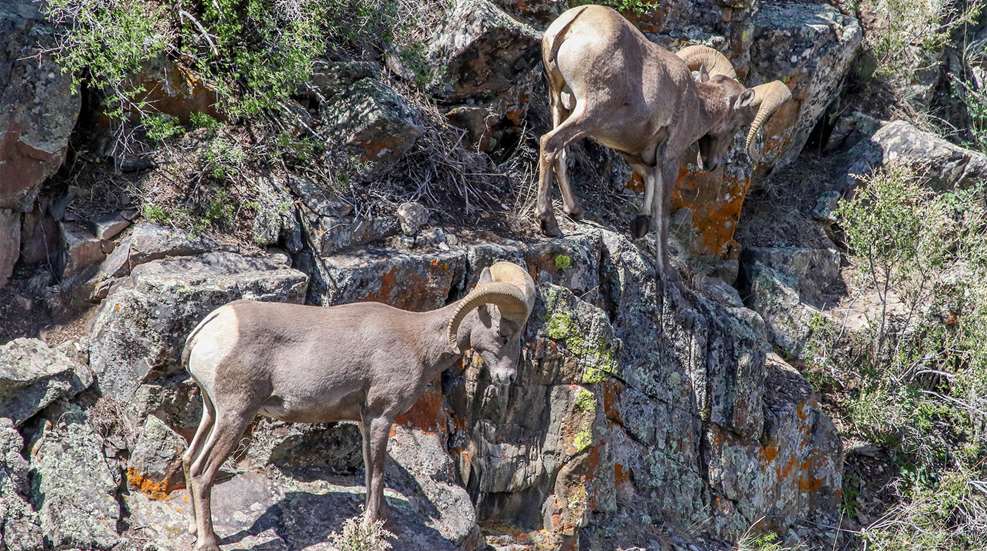
One of the world’s most productive copper mines is also one of Arizona’s most reliable sources of Rocky Mountain bighorn sheep. The bighorns are not shy about entering the Freeport McMoRan open-pit mining operation—near Morenci, Ariz.—but predators are. As a result, there’s no natural check on sheep population growth.
The drawback is the volume of sheep increases collision risk for mine workers and other drivers along U.S. Highway 191. The remedy, which benefits conservation, is a coordinated effort between the Arizona Game and Fish Department (AZGFD) and the mine. Wildlife managers routinely move sheep from dangerous locations amid mining operations and local traffic to more remote areas where they have an increased chance of survival.
“These translocations are great because AZGFD is able to boost the numbers of wild Rocky Mountain bighorn sheep and also lessen the hazard of vehicle collisions in the mine and nearby town,” said Justin Winter, AZGFD terrestrial senior wildlife specialist. “You could almost consider the sheep living in the mine a nursery herd—it keeps growing sheep and we’re able to utilize that population to increase numbers in the wild. The mine appreciates our translocation efforts, too, because each sheep we move is one less animal to pose a risk to workers and drivers.”
Two of the state’s established herds—East Clear Creek, just outside of Winslow, and the South Fork near Greer—were both started with sheep translocated from the Morenci mine. Eight sheep were caught during the most recent capture and were translocated to the Upper Blue River Area, where biologists hope they will join the local bighorns.
“The Blue River herd has been slow-growing and survey numbers have been low over the past five years,” Winter said. “If these eight sheep from the mine stay in the area, they’ll be a great addition.”
Some of the sheep were fitted with tracking collars, which will give wildlife managers valuable location and behavior insights. The units last about three years and utilize satellite-based GPS technology, giving biologists highly accurate and real-time data.
“These sheep will provide really good movement data,” said Winter. “We’ll be able to see which areas of the Upper Blue River they occupy and that’ll help us refine our surveys and get a better understanding of what the population looks like.”
Along with deploying the tracking collars, AZGFD’s assistant state wildlife veterinarian joined the capture to provide health checks. “They are a pretty healthy population,” said Dr. Ann Fan, DVM. “The one disease we worry the most about is bighorn sheep pneumonia (Mycoplasma ovipneumoniae). This population has been closely monitored and we’ve never detected it—and thankfully, all eight of these sheep tested negative as well.”
Of the eight sheep captured, seven were rams and just one was a ewe. Ideally, at least two more females would have been translocated, but AZGFD biologists do not capture ewes that are nursing or are still raising lambs. Officials noted having the help of Freeport-McMoRan’s security team and environmental division makes planning easy.
“It’s nice having people who already know where the sheep are and can help us navigate the mine and its operations,” Winter said. “We can just drive down and start our capture without spending hours looking for sheep.”