Shimmering stars spanned the horizon of Oklahoma’s prairie pothole region. Guided by headlamps, we got to work tossing out wigeon and pintail decoys. Soon the blind was brushed in. Then we waited.
An hour into the hunt and no signs of puddle ducks. “We might have to start shooting these ring-necks,” my buddy snickered. He wasn’t talking pheasants.
The next pair of ring-necks to dive into the decoys didn’t leave. I dropped another speedy drake after sending air balls on the first two rounds.
“You better start shooting,” I smiled. “I wasn’t serious,” he came back. Then a gadwall came in. My buddy was on the board. “Wigeon and pintails have been hammering this spot; I have no idea where they could be,” he pondered.
Ten minutes later I was done, a limit of ring-necked ducks in the bag. Forty-five minutes later my buddy couldn’t stand it. He shot a drake wigeon then rounded out his limit with ring-necked ducks. It wasn’t the first time divers turned a slow day of duck hunting into a memorable one.
In the Beginning
I started duck hunting in 1976. I was 12 years old. After school one day I hiked down to a river slough behind our house. It’s one in which I trapped beaver and muskrat. I knew it well. Wigeon had been using it, so I set a dozen decoys along a shallow, grassy edge. I didn’t see a single wigeon but went home with a limit of ring-necked ducks.
The thick-skinned, tightly feathered fowl weren’t easy to skin, but I figured it out. Mom cooked them up. They were delicious. I was one proud boy. Seems like yesterday.
Since those early days I’ve shot a number of ring-neck limits. They readily fall for a spread of puddle duck decoys. Likewise, I’ve shot limits of puddle ducks as they dropped into no more than a half-dozen ring-necked decoys.
In high school a buddy and I picked up a 14-foot boat with a little kicker motor. We hunted a big coastal lake not far from our homes. Canvasbacks, greater and lesser scaup, along with bufflehead were our target species. We’d hunted puddle ducks together a lot and welcomed the change, and challenges that ensued.
We set out 12 bluebills and 12 can decoys. All were drakes, highly visible on the dark water. Each decoy was on its own drop line. Two hours into the hunt a storm raged. The Pacific Ocean was less than a mile away. It sounded and felt much closer.
Forced to take shelter on the backside of a heavily wooded island, we waited for the feisty storm to pass. When the waves finally laid down we puttered around a mass of rushes. Our decoys were nowhere in sight.
The big waves and high winds carried them across the lake. We gathered them up and relocated. It took a while, but by late afternoon we shot mixed-bag limits of divers. We learned a lot that day and knew we had to come up with a better way to rig our decoys.
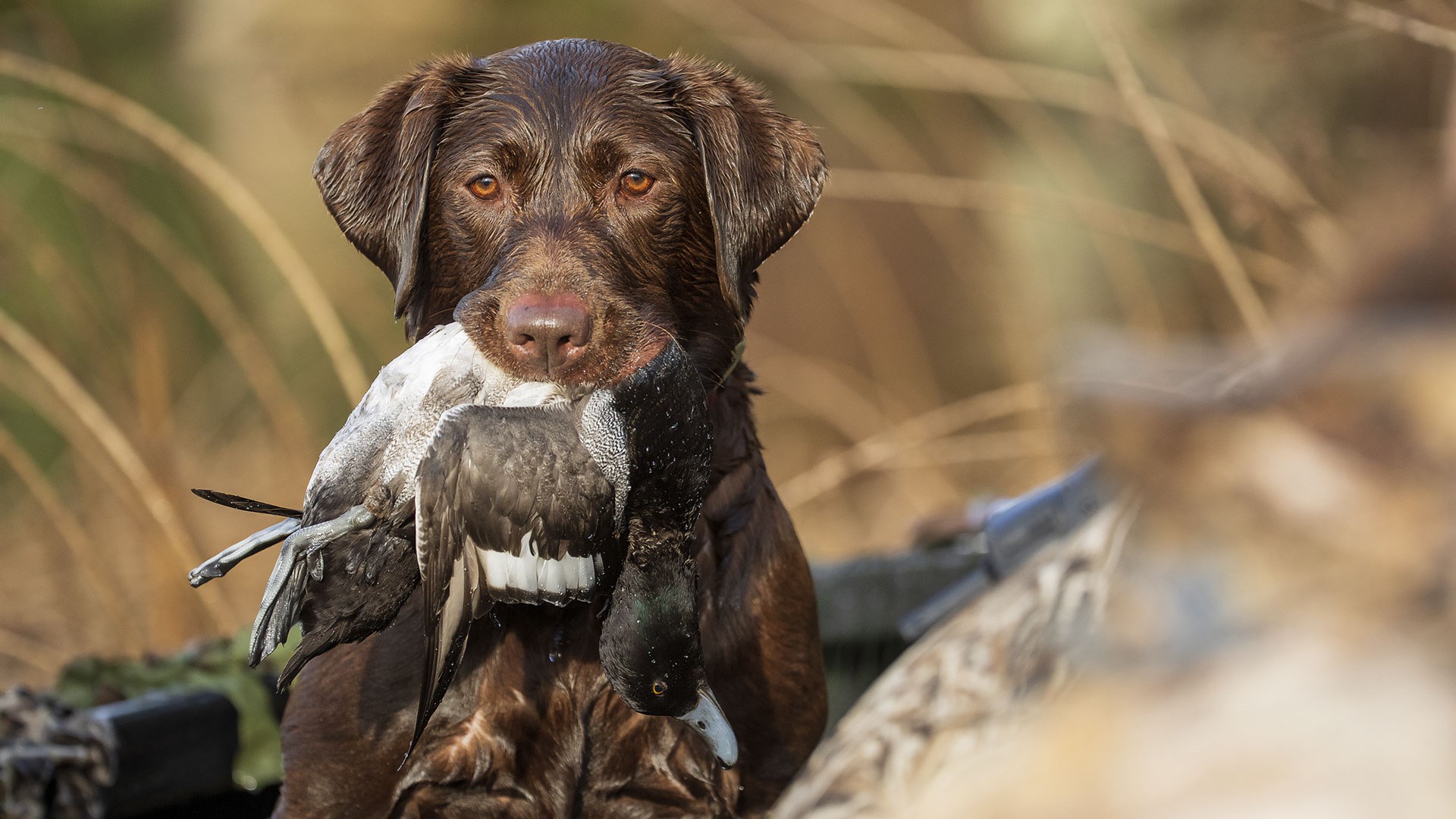
A few years ago I hunted that same lake with a buddy, Josh Farnsworth. More than 20 years had passed since I’d last hunted the lake. It looked the same.
Josh hunted it a lot during my absence and developed a great, inexpensive decoy rig. He picked up a couple of PVC-coated clothes lines at a general store. He’d tried decoy lines and cords but they weren’t stiff enough. He wanted something that wouldn’t tangle when coiling up decoys, something easy to manage when relocating throughout the day.
Josh rigs a clip on each end of the long line that holds an easy-to-remove 8-pound weight. Fifteen feet up from each anchor is where the first decoys are permanently attached to the long line. He runs 15-inch droppers on each decoy. A heavy barrel swivel is slid over the long line, spaced out about 3 feet, then crimped down with pliers. The dropper is tied to the other eye of the swivel.
He runs three separate long lines, 10 decoys on each. When hunting bigger, deeper water, he can just join a couple of lines at the ends to get a longer string, or buy clothes-line kits in 100- or 150-foot-long sections. This makes it easy to customize your long-line decoy setup.
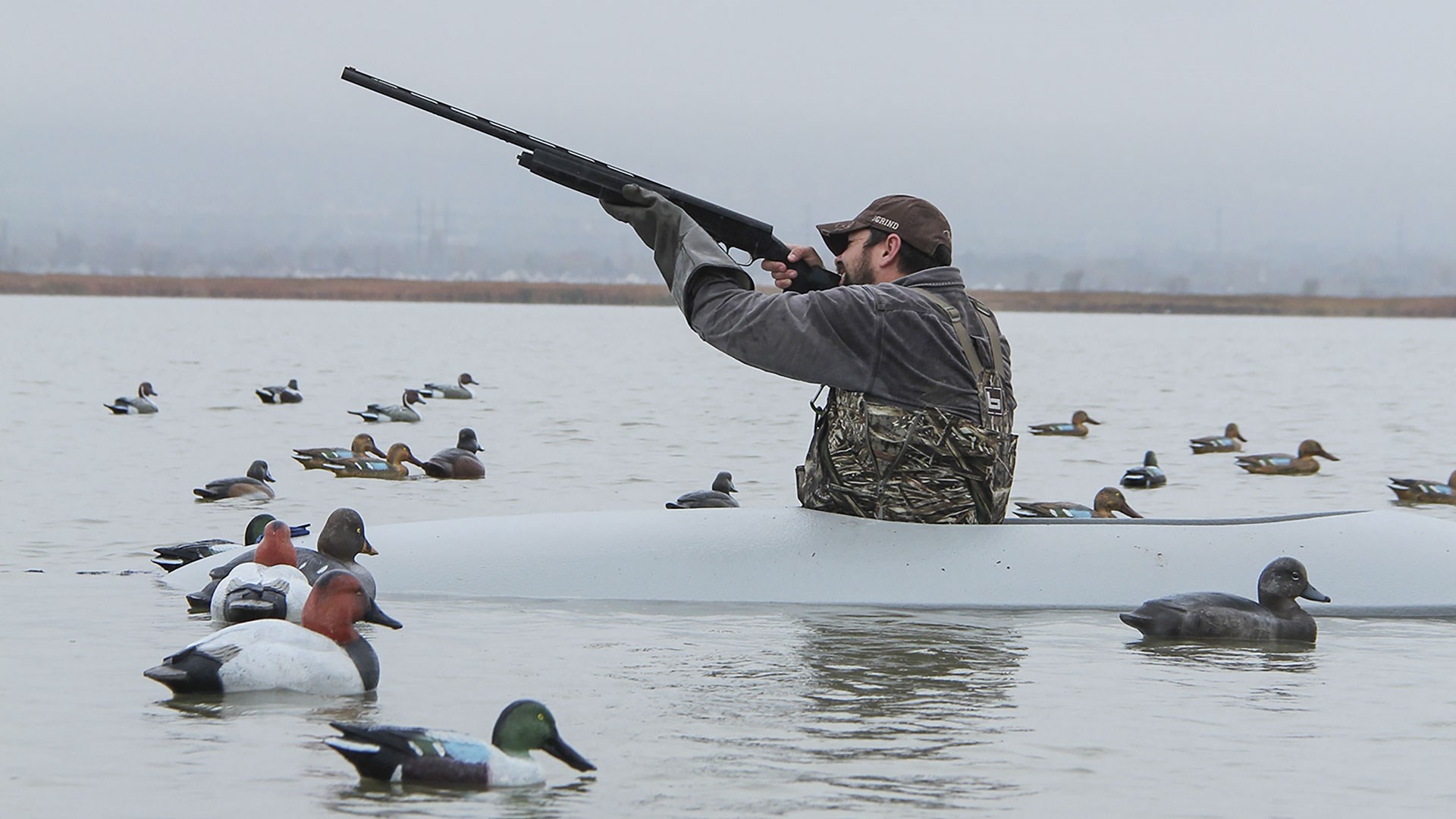
In the boat are three collapsible trash cans, each holding a section of coiled clothes line with 10 decoys secured. The line is stiff enough it won’t tangle when coiled up, nor will the decoys. Simply attach a weight, toss it overboard and feed out the decoys while the boat drifts. It’s a one-man job and it’s fast.
Complete the spread by tossing out six, single canvasback decoys near the end of the string where you’ll be hunting. Tie each decoy on a 20-foot dropper with 3 ounces of lead. These single decoys help create depth in the spread and direct birds where you want them. I’ve used this setup on a number of diver hunts, and love its efficiency and effectiveness, no matter the species.
I’m a fan of big diver decoys that can be seen from a long way, and the more action there is on the water, the better. If targeting late-season bufflehead, placing a half-dozen drake decoys to one side of a long line is effective because these little butterballs like being with their own kind.
If birds aren’t decoying, move. Late-season divers are smart and you have to get where they want to be, or at least in their path of travel. Two seasons ago a buddy and I relocated six times. We didn’t fire our first shots until shortly after 1 p.m. In less than an hour we were headed home with limits of cans, greater scaup, bufflehead and a stud ruddy duck.
The Kitchen Sink
One of my most memorable diver hunts didn’t begin as such. I was on the Great Salt Lake with a couple buddies. They put me in a layout boat surrounded by seven dozen decoys of about every species in the area, including multiple divers. It was a cool looking spread, but I wanted puddle ducks, not divers.
But few puddle ducks were flying that day so I busted the first diver that came in, a drake canvasback. Then a hen shoveler cupped into the decoys, followed soon by a nice drake bufflehead. I dropped a drake wigeon from a small flock, then a single gadwall that came in low and fast. It was slow for a while, so when a drake ruddy duck skimmed the water and set its wings, I shot it. One bird to go.
Three ducks came my way. I spotted them a long way off. There was no mistaking the shape and wingbeats of the lawn darts. When they got close I picked the lead bird, a drake. Then I texted my buddies for a pickup; they were tucked into some reeds a few hundred yards away, hunting from the marsh boat.
They taxied in, picked me up and we gathered dead ducks lying in the decoys. They badgered me when the first duck to come into the boat was a drake common merganser. “Haugen shot a scissor bill?” They went on and on. “It was the last bird I needed for a limit,” I smiled.
With all the birds gathered, I lined them up on the bow. “I’ll be damned!” One buddy smirked. “Leave it to Haugen,” the other came back. Seven ducks, seven species, over half of which were divers. The day didn’t start as planned, but four ducks into it, the mixed-species bag was realized. The big spread of all those decoys on their own strings, in only 6 feet of water, was to thank for a day I’ll never forget, complete with divers.
Go North
If you’re into diving ducks and sea ducks, head north to Alaska. From Kodiak Island to the Chain, and throughout the Southeast Panhandle, the mix of ducks to be hunted is every waterfowler’s dream. Even here a diamond in the rough can pop up.
One December a buddy and I hunted the northeast corner of Kodiak Island. Deer were our focus but two days of extreme weather found us tucked tight into a small, protected cove, with nowhere to go. We weren’t the only ones there. Ducks knew where the best shelter was, and they were thick. I untied the skiff from the mother ship and motored to a rocky point. I shot Barrow’s and common goldeneyes, along with a prized drake long-tail and a pair of drake harlequins. I didn’t have a single decoy set out, just pass-shot as birds winged by in the blustering winds and churning seas.
On another hunt out of Valdez, a friend dropped me on the point of a protected island with six drake goldeneye decoys. I set them on the inside edge of a calm inlet. The tide was just starting to come in. An hour later he returned. I had both species of goldeneyes, a harlequin, black scoter and a bufflehead. It was a great mixed-bag day of picking drakes.
The Big City
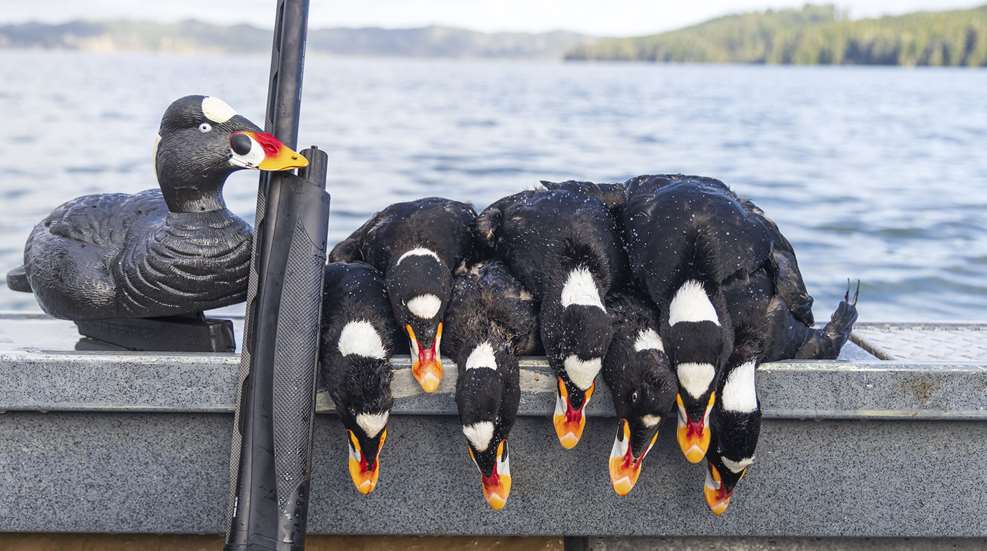
Last season I headed south, to San Francisco Bay. The target species was surf scoter. I’d fished the bay a few times over the years, catching stripers, halibut and leopard shark. I’d heard of the stellar surf hunting for years and wanted to experience it.
Some buddies and I hunted with Melynda Dodds, owner and operator of California Guide Service. Maddie, Dodds’ assistant, joined us. These gals are rock stars and made for two very memorable days last season.
We hunted from Dodd’s custom-built, 25-foot seaworthy Bankes Boat, one made specifically for this kind of hunting. Winds, tides and boat traffic determine where she hunts each morning. We were always in sight of long bridges and industrial buildings. And once the ships started funneling through the lanes, the scoters took wing like I’d never seen.
Our decoy spread was simple, clean and effective. There were five lines, 10-12 decoys on each line. A 5-pound weight on each end secured the lines. They were situated in a ray-type spread with the boat positioned at the narrow end. Think sunrise with the boat being the sun, the decoys being shafts of sunlight spreading out into the bay.
“These ducks aren’t shy, they’ll blast right into the decoys,” Dodds said, as Maddie dropped the bow anchor 15 yards from the narrow point of the decoys. She was right.
Line after line of the black ducks painted the waterline as far as we could see.
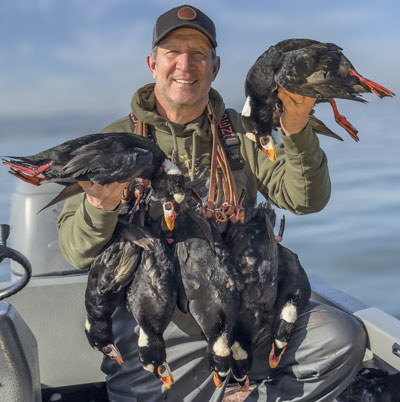
The wind and tide were perfect and ducks couldn’t help themselves. In less than two hours, four of us had limits of surf scoter. I picked all drakes. We were back at the dock by mid-morning. For lunch, my group went to Chinatown. San Francisco is one of my favorite cities in the country for the culture, food and fun to be had there. We missed a Warriors game on the front end, a 49ers game on the back. Reasons to return.
The next day we hunted the same spot. “The winds and tides are similar to yesterday,” Dodds told us when we met at the ramp. It took an hour longer to shoot limits. Again, I picked all drakes. Then it was back to the city for lunch, happy hour and dinner. Often we have ducks to thank for taking us to special places with good people. This was one such experience.
Big Rivers
Having a taste of aggressively decoying surf scoters in California made me want more. So when longtime buddy Bret Gesh invited me to join him on a big-river hunt for clown bills I didn’t hesitate.
“There are some big tides today,” Gesh confirmed. “We’ll head upstream a ways and set up on an inside corner of a big bend with the hopes of intercepting surf scoters as they fly by.” Due to a big incoming tide and high winds, the river swelled even more than anticipated. With so much water flooding into the estuary, ducks were spread out. We moved twice before firing a shot. But once we found the right spot it was game on.
Gesh set two strings of surf scoter decoys, only a half-dozen on each line. The first line was straight. The second was slightly staggered and just inside the first, but with a hook. The little J added movement and visibility to the otherwise straight line of decoys. The minimalistic spread worked. But early in the afternoon the scoters quit flying. I’d secured my limit of drakes but Gesh and a buddy had a few birds to go.
“Let’s toss out the bufflehead decoys and see if we can pull them in,” Gesh suggested. Loads of butterballs were flying up and down the bay, but none were coming into the scoter decoys.
We tossed out six, big, drake bufflehead decoys inside the closest scoter line. Before we could get the boat into position, a pair of bufflehead landed on the edge of the white decoys. In a matter of minutes we were done. “These little ducks really respond to decoys that match their looks,” Gesh smiled. Earlier in the season they’ll land in a mix of decoys, but in the final few weeks they clearly prefer flocking with birds of a matching feather.
Gesh also guides for canvasbacks, bluebills and other divers on the Oregon Coast, mostly in big lakes. As was the case on our surf scoter hunt, Gesh often relocates multiple times a day when hunting big bodies of water. “Just like puddle ducks, when divers hit the X, you have to be right with ’em, especially late in the season when they’ve been shot at for weeks. They’re a smart bird, but not picky when it comes to decoys. You just have to be where they want to be.”
Lone Star Redheads
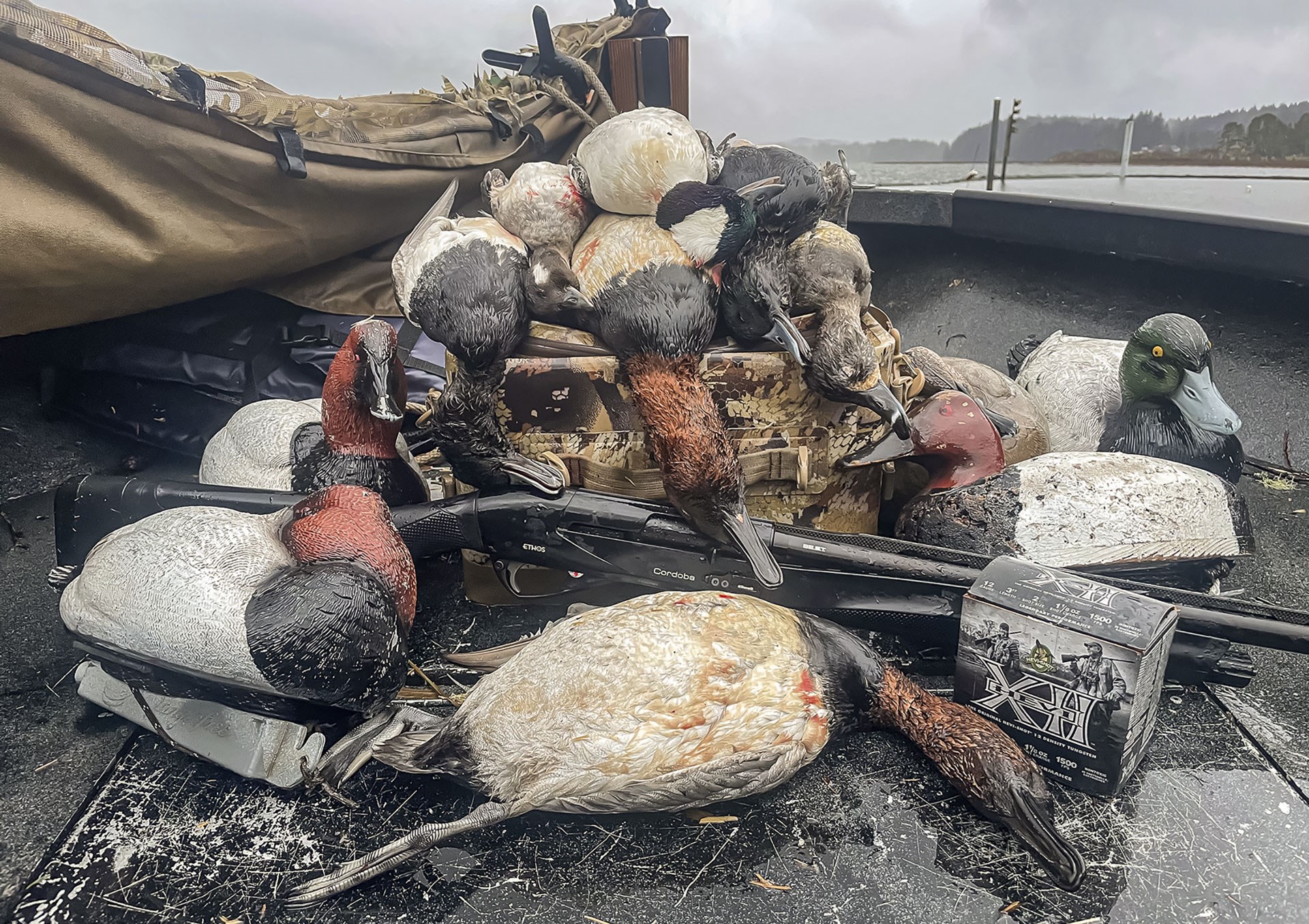
Growing up, I’d only shot a few redheads. They were all by chance. There weren’t many in our area. So when the opportunity to target these birds in big numbers came, I jumped.
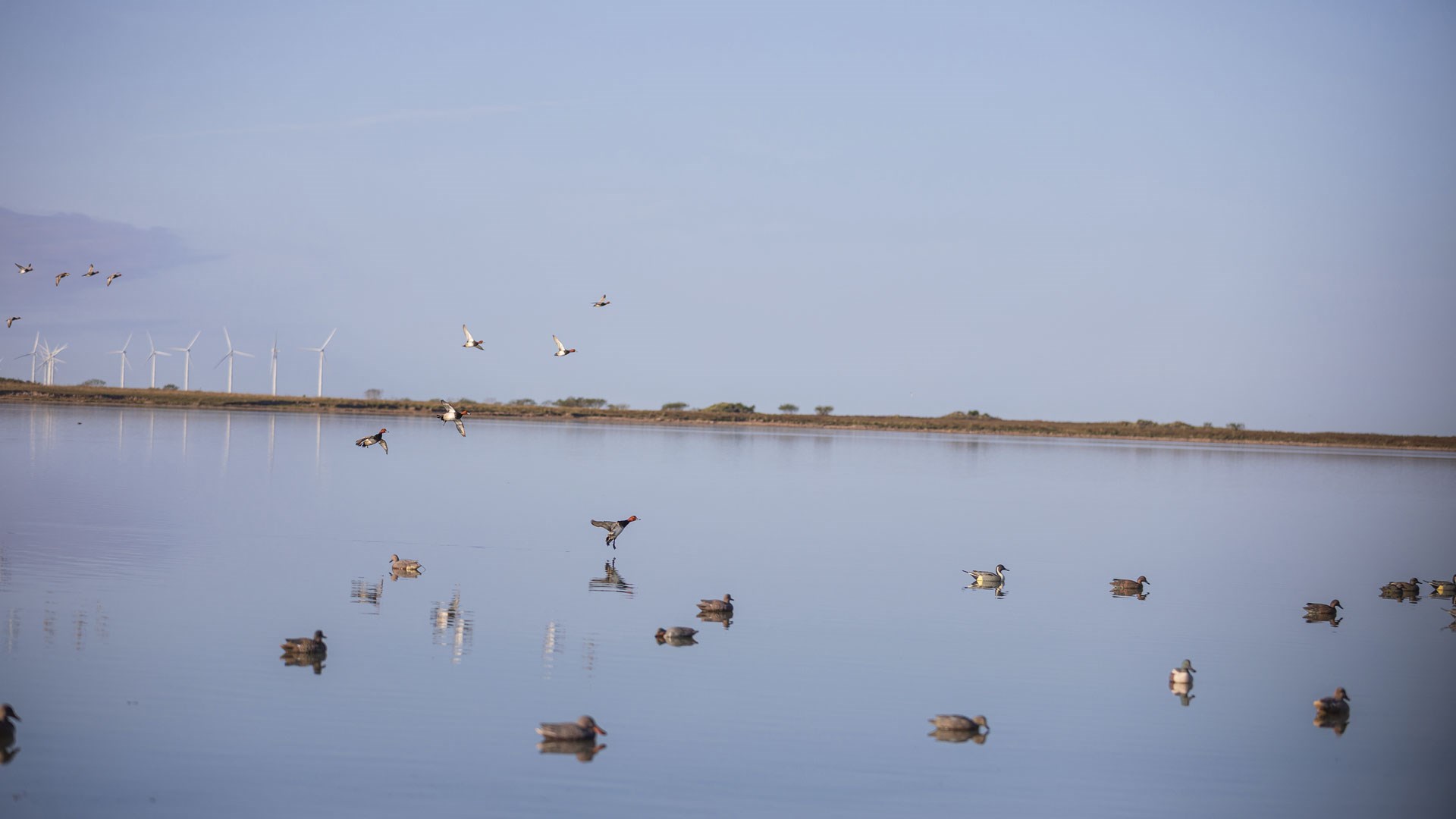
“Hunting divers here is all about scouting,” shared guide Justin Brodnax when I jumped into his truck. He’s hunted a high-salinity lagoon on the Texas’ lower Laguna Madre for more than 20 years. Baffin Bay is surrounded by private land so there is no road access. He’ll cover 60 miles a day scouting, all by boat.
“It’s shallow for miles and grass thrives here, which is what draws the ducks,” Brodnax continues. “When the tide is low, grass lays on the surface and ducks flock into the area by the thousands because it’s such easy pickings. As long as the weather holds the birds will stay.”
Brodnax primarily hunts redheads, scaup and bufflehead but gets quite a few canvasbacks and some goldeneyes. “When I’m scouting and find massive rafts of ducks, that’s where I’m heading the next morning,” Brodnax says. “I don’t wait, I get on ’em while the food source is there and bird numbers are building.”
Brodnax mixes up his decoy spread. He’ll combine redheads, scaup, bufflehead, coot, even shovelers. Spoonies were thick where we hunted and the drake decoys really popped. “I like canvasback decoys, too, because they’re big and easy to see,” he confirms. “I’ll even use sandhill crane and specklebelly silhouettes on the shore as they’re great for confidence.”
We hunted a shallow shoreline of Baffin Bay toward the end of the season. The addition of the crane and speck silhouettes pulled divers to the inside the big spread with conviction. Not only was it impressive, but it made for easy shooting.
Another day we hunted open water, which is a different beast to tackle in the late season. “We’ll go with 15-20 dozen decoys today, all on single strings,” Brodnax said as his airboat engine wound down. We were hunting in only a foot of water. The single decoys also allowed for quick and necessary changes to be made in the spread when ducks weren’t finishing as planned. “I run four drakes to every two hens out here,” he said. “I’ll pair-up decoys on the outside of the spread because shy birds will often land with the pairs, not big groups.”
Competing with big rafts of divers is another late-season challenge Brodnax constantly faces. “When ducks are landing by the hundreds, even thousands, I’m setting up based solely on wind direction. I’ll put the wind on the corner of the decoy raft so I can hunt the near end of the spread, closer to shore. This is where they’ll try to land. I make my big raft of decoys wrap around a point, into the wind, and make sure our blind is good. These ducks are smart and not easy to fool late in the season so decoy spreads and blinds have to be precise.”
No matter where late-season duck hunting adventures take you, don’t overlook the joy that divers can deliver. Whether you’re targeting them or they happen to save the day, there’s no shucking the addiction these gems bring to the game.
Editor’s Note: Scott Haugen is a full-time writer of 25 years. Follow his adventures on Instagram and Facebook.