If analysts consistently monitor anything for years they’ll eventually compile enough data to verify trends or dispel guesswork, whether it’s about deer kills or COVID-19’s impact on travel.
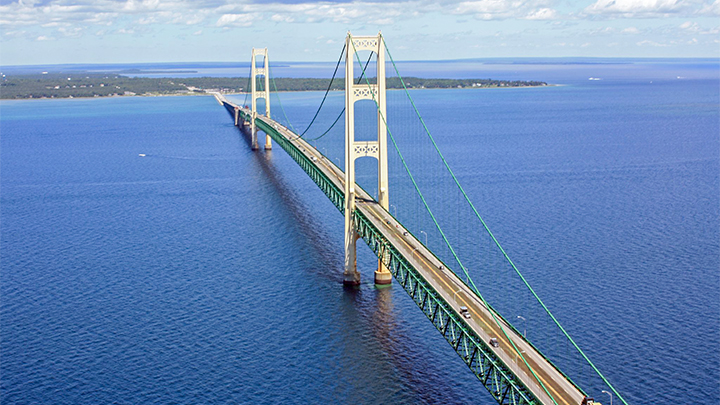
Good numbers tell good stories. Consider the Mackinac Bridge: The “Mighty Mac” is the Western Hemisphere’s longest suspension bridge, spanning the 5-mile-wide Straits of Mackinac between lakes Michigan and Huron, and connecting lower Michigan to its Upper Peninsula.
Ever since the big bridge opened in 1957, an army of hunters has caravanned northward across the straits each November, bound for U.P. deer camps to hunt "Yooper" deer from Bessemer to Sault Ste. Marie. Likewise, toll-booth workers on the Mighty Mac diligently counted every deer those hunters hauled home on their return crossings the past 62 deer seasons.
Even though the bridge’s late-November deer survey is considered “informal” by scientific standards, the toll-workers dutifully ask all drivers of southbound vehicles how many deer they’re hauling. And to ensure those numbers aren’t forgotten, the Mackinac Bridge Authority enters those annual counts into its historical logs.
Charts and graphs based on the toll-workers' annual deer counts track consistently well with the U.P.’s scientifically calculated harvest estimates. The Michigan Department of Natural Resources calculates those estimates soon after hunting season.
Consistent Trend Data
The DNR’s annual harvest estimates always show higher numbers than the bridge counts, of course. In 2019, for example, the bridge count fell 21 percent from 2018, but the DNR estimated the harvest fell only 5 percent. That’s because many roads lead to U.P. deer camps. Thousands of U.P. deer hunters live in that remote region, and nonresidents can enter the U.P. from across northern Wisconsin.
Still, the bridge count consistently reflects the gun-season’s harvest trends, rising with good years and falling with poor years. Generally speaking, if the U.P.’s winter weather is severe and hurts the herd, the bridge count in November will bear out the decline.
Those trend indicators have been especially accurate since the early 1990s as the Michigan DNR fine-tuned its calculations and estimates by including deer hunting data from a variety of surveys, including deer-camp reports, voluntary check stations and field checks by conservation wardens—while also factoring in hunting conditions, in-season snowfall, deer activity reports and Thanksgiving’s timing.
The Michigan DNR looks at the Mackinac Bridge data, too, but it’s an exaggeration to say agency biologists use those numbers to calculate the herd’s size and November’s gun-season harvest. “Our statisticians certainly look at the bridge count and keep it in mind for our early prognostications of the harvest, but it’s just one of many sources we review,” said Terry Minzey, the Michigan DNR’s regional wildlife supervisor in the U.P.
The bridge’s indicators of annual dead-deer crossings might not be pinpoint accurate, but they carry some weight with analysts. After all, they already have 62 years of uninterrupted data collection, as well as a consistent counting method: handheld clickers.
Highs and Lows
Since the bridge’s 1957 opening, toll-collectors have hit their clickers 420,204 times, an average of 6,777.5 deer annually. The highest tally was 1995, when hunters hauled 18,887 deer over the bridge. The third-highest tally came soon after in 2000 when 14,445 made that trip.
Those were two of only nine years in the bridge’s history when the deer count exceeded 10,000, and it hasn’t flirted with that level since. In fact, the past decade has recorded 35,113 deer crossings, or an annual average of 3,511. Those are the lowest numbers since the 1970s. The record low occurred in 2015 with 1,500 deer.
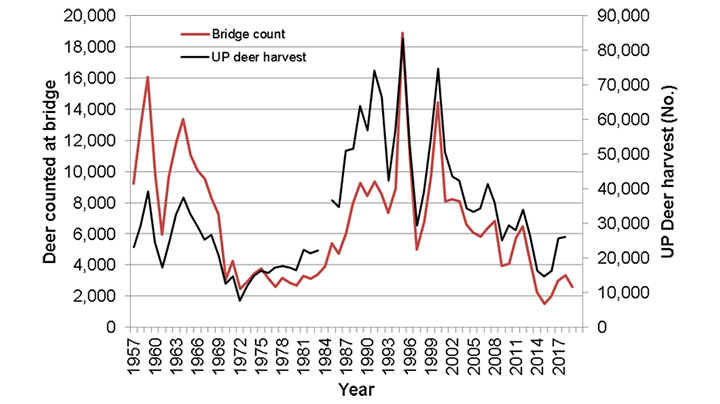
The best decade for deer occurred during the Mighty Mac’s first 10 years, 1957 to 1966, when hunters hauled 110,197 deer over the bridge, or an average of 11,020 deer per year.
Chad Stewart, the Michigan DNR’s deer-management specialist, said the bridge survey has historical value. He said people look forward to hearing the tally each year, often just to see how it tracks with their own observations.
You can include me among those observers, given that I hunted Iron, Houghton and Ontonagon counties in the U.P. from 1986 through 1996. In terms of my deer observations while hunting, no year came close to 1995, which coincided with the record bridge tally that year. Likewise, my worst year for deer sightings was 1992, when the bridge count (8,581) was 10,000-plus fewer than in 1995. Still, I fared far better my first year, 1986, even though that year marked the bridge’s worst tally (4,713) in the 11 years I hunted the U.P. I should also note that I never crossed the bridge those years, given that I live in Wisconsin.
Serious Surveys
Minzey considers the deer tally a fun, helpful service that toll-workers provide the hunting community. In contrast, the Mackinac Bridge Authority puts a high priority on making accurate counts of cars, cargo vans and semi-trailer trucks crossing the bridge. That’s why we know the exact impact COVID-19 had on bridge traffic earlier this year during the pandemic’s spring peak.
In looking at the past seven February totals, a seven-year high 216,732 vehicles crossed the Mighty Mac in February 2020. But when looking at the past seven March totals, a seven-year low 177,904 vehicles crossed in March 2020. Crossings plunged further in April 2020, with only 86,413 vehicles crossing. The number of vehicles crossing in May climbed to 222,071, but the previous low for the past seven May totals was 304,387 in 2014, or 82,316 more crossings than in May 2020.
Whether those bridge tallies involve deer or vehicles, their numbers tell compelling stories that stand the test of time.