There’s a certain set of ol’ boys down in Louisiana who’ve made quite a name for themselves calling ducks. You’ve probably heard of ’em—they’re from the Duck Commander call company—and with late-season migrators en route to my holes, I recently asked long-time duck hunter and general manager Justin Martin for his best calling advice.
1. What do hunters do wrong when calling ducks?
JM: The number one mistake is calling too much. We are very much minimalist callers here in the Deep South, because they have seen and heard it all by the time they make it to Louisiana. Another common mistake is not knowing when to call. Often folks call too quickly when ducks are circling and force them to do tight spins, which will cause them to bug out.
2. What is your best duck-calling tip for beginners?
JM: A single quack can be your best friend. You don’t have to know how to do all the fancy stuff to be successful. And most importantly, do your homework. Scout to find where the ducks want to be. That’ll make up for many other shortcomings you may have.
3. What is your best tip for seasoned callers?
JM: You need to be able to read the ducks quickly. If they respond to excited calling, then by all means keep it going. The same is true for the opposite. Don’t be afraid to mix non-mallard hen sounds in there, too. Pop in a few mallard drake or pintail whistles.
4. What is your bread-and-butter decoy setup?
JM: It all depends on the habitat I'm hunting. If I'm hunting a field and it’s a flight day (the day before or after a strong front), I’ll use 30 to 40 dozen decoys that can be easily seen from above. I’ll place a landing pocket directly in front of the shooters and set up with the wind at our backs.
In timber I’ll rarely use more than three dozen decoys placed with no real pocket so the ducks just land among them.
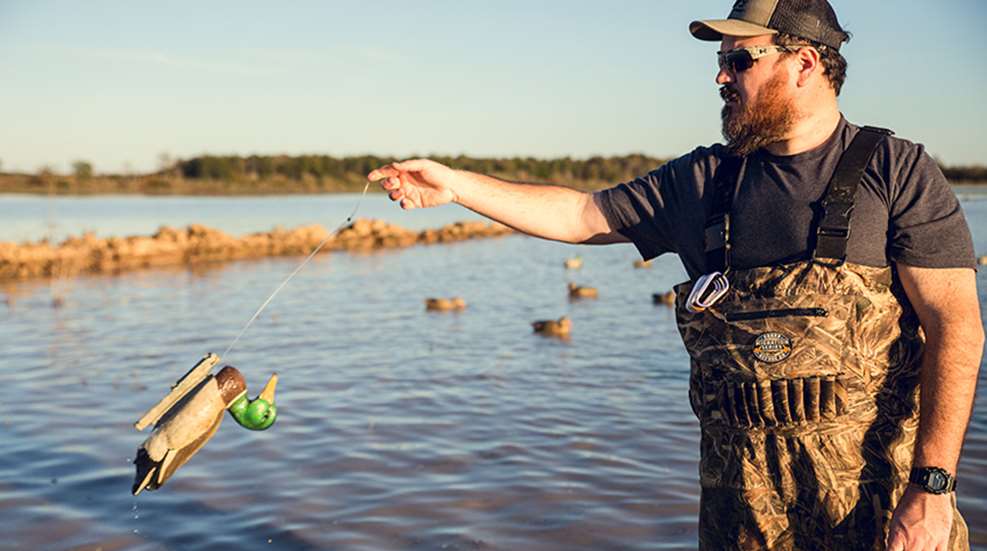
Also, I’m a huge believer in motion decoys. I love the Rippler series we designed with Mojo Outdoors. They are super easy to use and run a long time on AA batteries. I’ll also always have a couple of jerk rigs with me. Ducks on the water rarely sit still, so you need motion.
5. What three calls should all duck callers have around their necks at all times?
JM: I always carry a mallard hen call (our Cut Down 2.0 is my go-to), a 6-in-1 whistle and a teal call. Those calls pretty much cover all the ducks we may encounter down here in Louisiana, and I want to be ready for any situation that may arise.
Just make sure your calls match your decoys. If I'm hunting in a spot with lots of gadwalls, for example, I’ll add that call to the lanyard as well. The same goes for wood ducks.
Check out Duck Commander calls and other gear at duckcommander.com.