Fossil Footprints Show Hunt for Giant Sloth

by
posted on July 10, 2018
** When you buy products through the links on our site, we may earn a commission that supports NRA's mission to protect, preserve and defend the Second Amendment. **
fossilfootprints_lead.jpg

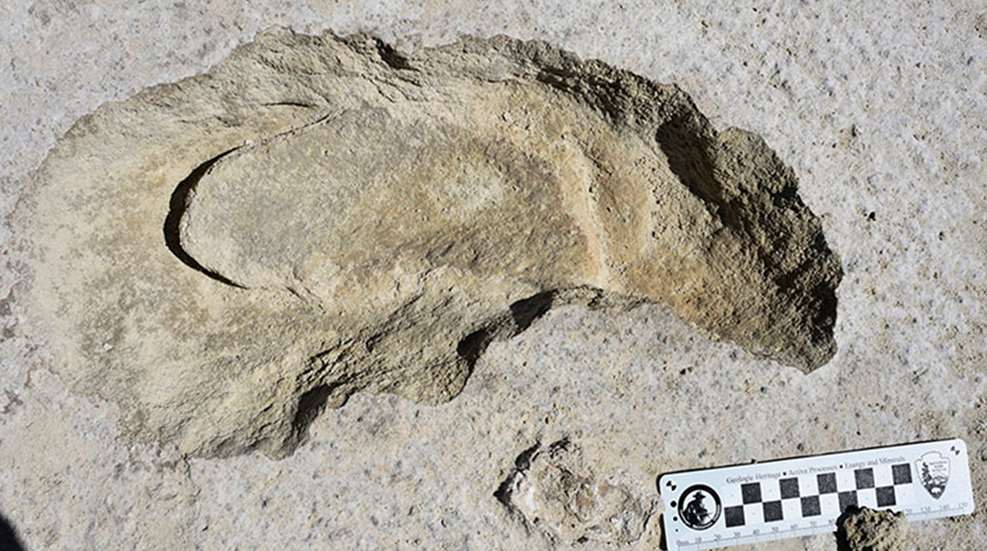
Prehistoric footprints of early human hunters have been found at the White Sands National Monument in New Mexico by a research team from Bournemouth University in southern England. According to a report published in the journal Science Advances, the tracks date back at least 11,000 years and appear to depict a group of humans stalking a giant sloth, an animal similar to sloths today, except it stood more than 6.5 feet tall and was 9 feet long.

Matthew Bennett, professor of environmental and geographical sciences at Bournemouth said, “The story that we can read from the tracks is that the humans were stalking; following in the footsteps, precisely in the footsteps, of the sloth.”

Sally Reynolds of the university’s Institute for Studies in Landscapes and Human Evolution explained how the hunt might have gone down. “The sloth would have raised itself up to full height and attempted to keep the attackers at bay with its long forearms and large, sharp claws,” she said. “The hunters would have needed to wait patiently to get the right opportunity to strike the killing blow in a vulnerable part of the sloth anatomy … . The hunters would have been at significant physical risk to themselves while the animal was defending itself.”

Bennett said the hunters likely coordinated their efforts to bring down the animal. “While [the sloth] was being distracted and turning, somebody else would come across and try to deliver the killer blow,” he described. “It’s an interesting story and it’s all written in the footprints.”

It’s commonly assumed that spears were the main tool of choice. Based on other human tracks found in the area, the hunters pursued the sloth as a group.

“Getting two sets of fossil footprints that interact, that show you the behavioral ecology, is very, very rare,” Bennett stated.

Latest

Hunter Silouhetted
Hunter Silouhetted

Can Hunting Become Cool Again?

Is hunting becoming "cool" again? In an era when America’s top podcaster and cage-fighting commentator, Joe Rogan, talking hunting with Yellowstone superstar Luke Grimes seems almost commonplace, you'd have to think that the popularity of hunting is on the ascendency. How can we help it along? Read on, for Frank Miniter's thoughts on breaking hunting back into the mainstream.

Head to Head: 7x57mm Mauser vs. .308 Winchester

The 7x57mm Mauser and the .308 Winchester are two of the most versatile and popular cartridges to make the jump from military to field use. Which makes the more sensible choice for the big game hunter? Follow along as Phil Massaro takes a dive into this pair of classics.

New for 2026: Winchester Long Beard Tungsten

Winchester Ammunition has added Long Beard Tungsten to its turkey hunting lineup of shotshells in 2026.

RMEF Grants $400,000 to Support WAFWA Wildlife Movement Projects

The Rocky Mountain Elk Foundation (RMEF) recently awarded a $400,000 grant to the Western Association of Fish and Wildlife Agencies (WAFWA) to fund three state-led projects aimed at conserving, restoring and enhancing big game seasonal habitat and migration corridors in Nevada, Washington and Wyoming.

Suppressor Etiquette: Is It Rude Not to Use One When You Can?

If you legally can use a suppressor, is it becoming rude not to? A recent hunt in New Zealand, where suppressors are almost required equipment, got Brad Fenson thinking about the question. Follow along for the pros and cons of cans, as well as a discussion of the changing cultural norms surrounding their use.

First Look: Winchester American Lever Range Ammunition

The Winchester legacy continues with American Lever Range ammunition, designed and optimized for its namesake platform.

Interests


Get the best of American Hunter delivered to your inbox.