There are a variety of waterfowl shotguns available today that are plenty good. However, I don’t know that I’d describe any as “perfect”. Most have features that I like and a few that I don’t—but nearly all, I argue, are a pound too light.
So, what would I do if I could design my own, ultimate duck gun? Glad you asked.
A True Heavy Duck Gun
Here’s my biggest complaint with many modern duck guns: You can’t just slap marsh camo on a lightweight shotgun—one best reserved for extended upland jaunts—and call it a duck gun. And yet 7-pound, 12-gauge shotguns dominate the waterfowl market, perhaps driven by consumers’ desire for one, do-it-all shotgun.
My ultimate duck gun, however, bucks this trend at a weight of 8.5 pounds. Such heft is in line with traditional logic, which dictated that a duck gun ought to weigh at least 8 pounds; indeed the legendary Winchester Model 12 Heavy Duck Gun weighed nearly 9. Why? Perhaps most importantly, weight absorbs recoil. You can slap as many recoil-reducing thingamajigs on a 7-pound gun as you want—guess what, a 3-inch magnum is still going to kick you.
And, to me, heavy guns are just more shootable. They slow me down, iron out errors in my technique and are smoother to mount and swing. They’re less than ideal for prolonged upland carry, but, hey, we’re building a duck gun here.
Long, Over-Bored Barrel
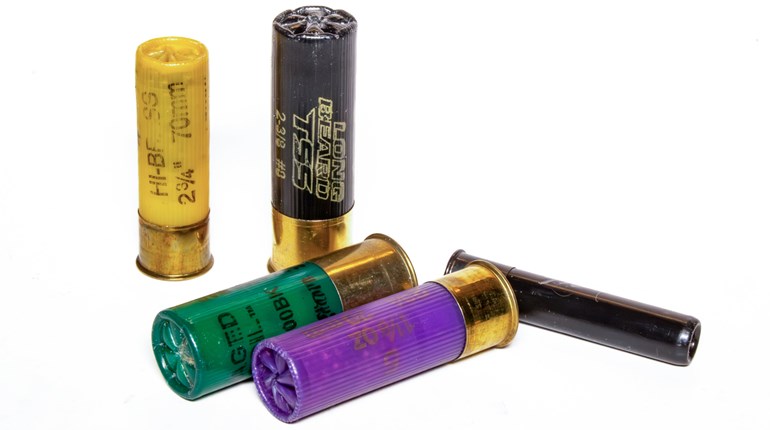
There are differing schools of thought on over-bored or back-bored shotgun barrels, in which barrel diameter exceeds standard 12-gauge dimensions. My opinion: Over-bore/back-bore barrels generally produce better patterns, but with magnum steel shotshells—particularly of size BB and larger—the difference is dramatic. Why? My thinking is that the added barrel diameter affords more sufficient space to large payloads of ultra-hard steel shot. Perhaps standard barrels squeeze the steel—which doesn’t give like lead—resulting in blown patterns and long shot strings. Regardless the ballistic science, I’m convinced that an over-bore or back-bored barrel typically produces denser patterns and shorter shot strings with magnum loads of large steel shot.
So, my ultimate duck gun will be equipped with the same barrel as found on Mossberg’s 935 Magnum 12-gauge semi-auto. It isn’t just overbored—it’s literally a 10-gauge barrel on a 12-gauge action.
As far as barrel length, I prefer 28 inches over the shorter options. Primarily my preference owes to the fact heavy guns balance better with long barrels. Some argue they also result in better velocity, but the difference is negligible. Lastly it is worth noting that short barrels in a duck blind often result in an ear-ringing experience.
12-Gauge Inertia Action
Next I will pair my 28-inch over-bored barrel with the Benelli Super Black Eagle II’s semi-auto, inertia-operated action. It’s proven itself to me to be among the market’s most reliable auto-loading systems, particularly when dirty.
Given the importance of reliability in a waterfowl gun, why not opt for a pump-action? Modern semi-autos are so improved that I believe they all but negate the pump’s advantages. In fact, over the course of a season, I suspect I’d short-stroke a pump more often than many semi-autos would malfunction. Pumps are less costly, sure, but I’m designing my ultimate gun, not my most affordable.
I did consider designing my ultimate gun as a double-barrel model, simply because I enjoy shooting them. However, the semi-auto is likely a more practical choice for most waterfowlers.
Weather-Proofing Inside and Out
Okay, I’ve got a duck gun that’s built to perform. Now I want it to last. The shotgun’s entire exterior will receive a camo dip—any camo will do, really. Dips aren’t perfect barriers, but they certainly provide a layer of protection over bluing alone. The receiver and barrel will further receive a rust inhibitor such as Browning’s Dura-Touch Armor Coating. The interior of the barrel will be chrome-lined. All other internal parts will be nickel-plated.
Interchangeable Recoil Pads
Many shotguns are fully adjustable thanks to shim and spacer kits and, in the case of the Mossberg Flex, fully interchangeable stocks. My ultimate shotgun will keep things comparatively simple: Three removable recoil pads with differing thicknesses will offer shooters an adjustable length of pull. There’s a thick, recoil-absorbing pad for t-shirt weather, a medium pad for early fall, and a thin pad for late-season hunting in a heavy coat.
All three recoil pads will feature slick material and taper at the heel to prevent snagging.
Further Accessories
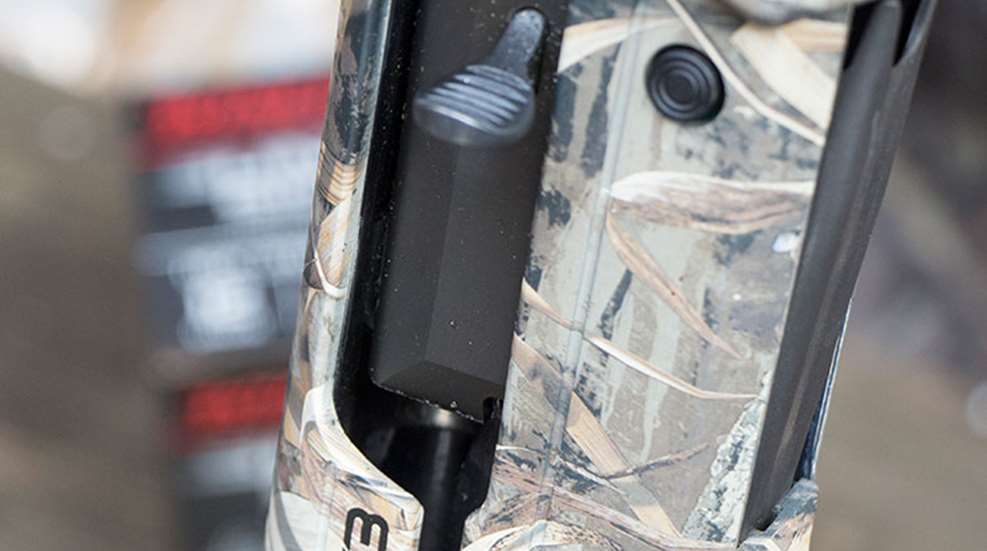
Finally no ultimate waterfowl gun is complete without attending to its likely operation with cold, gloved fingers. My gun will feature a generous trigger guard and oversized controls, including the bolt handle, safety and bolt release.
So, there’s my idea of the ultimate waterfowl shotgun. Anyone interested in funding the prototype?