Roughly once per decade a new design changes the archery industry. The Wisconsin-based Mathews, Inc. did it in 1992 when it unveiled its SoloCam bows that, with its large "idler wheel" turning in unison with a cam on bottom, greatly mitigated timing issues more common with dual-cam bows. For 20 years it was likely the world's most popular hunting bow because it was easy to shoot well. The industry, however, is cut-throat, and does not rest on a good idea for long. While there remain legions of Mathews loyalists, other companies insisted their new renditions of two cam bows were faster and had less nock travel—which would inherently make them more accurate. Although the accuracy issue is debatable, the quest to eliminate nock travel began.
Nock Travel
Nock travel is the non-linear vertical and horizontal movement of the nock as the string is released. If it isn't perfect, the arrow can fishtail horizontally or porpoise vertically. Of course, the purpose of fletching is to correct these flaws while in flight, but a bow's accuracy potential is better if the arrow starts out straight from the beginning. In the Solo Cam's case, because the cam's rotational axis was different from the idler wheel, some vertical nock travel occurred. On two-cam bows, if timing, or the synchronization of the cams, isn't exact, the string can be pulled up and down during the powerstroke, resulting in vertical nock travel. Furthermore, if the force placed on the cams or wheels during the draw makes them lean even a millimeter to either side, horizontal nock travel can result.
As daunting as all this sounds, the whole issue is more of a quest for engineers and a selling point for marketers—it's not giant issue for bowhunters. That's because at bowhunting distances, a millimeter of nock travel doesn't matter, especially if that nock travel is consistent. But, for the advancement of bowhunting as a whole, don't we want bows that are as accurate as they can possibly be? Mathews founder Matt McPherson thinks so. So he invented the No Cam.
The No Cam Remedy
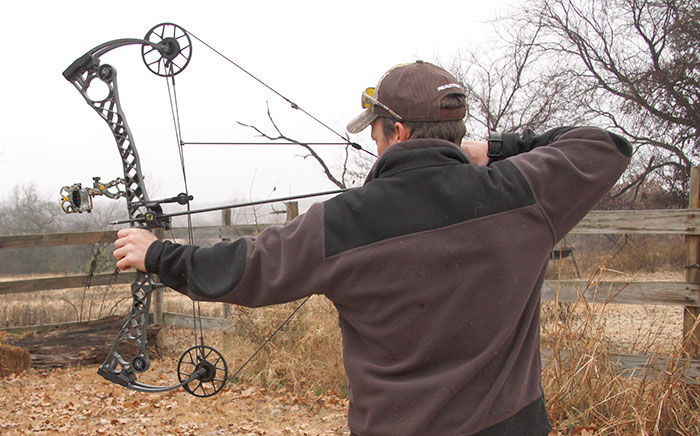
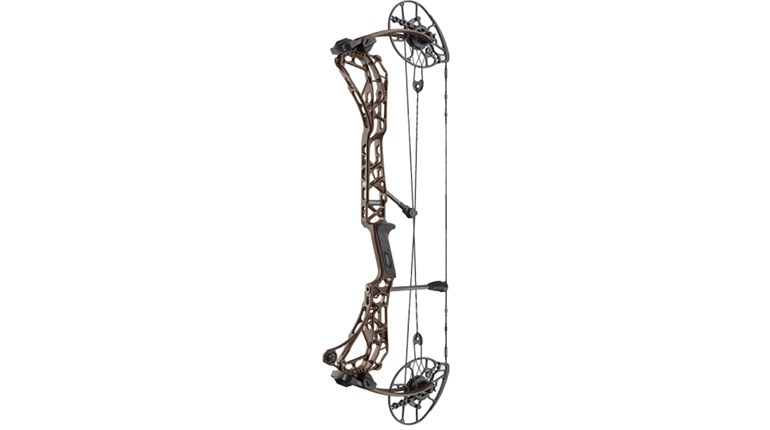
Befitting its name, the No Cam utilizes two large 4.28-inch wheels to deliver the powerstroke, or the path of the bowstring as it pushes the arrow. Because they rotate on axles in their exact centers, they exhibit three traits: 1. Their rotation is concentric; 2. Their rotation is always synchronized with each other and; 3. The string always remains at the same radius from the center of the wheels' rotation during the entire stroke. Because of these things, timing issues, and therefore vertical nock travel is mitigated. Because the string remains in one channel, or track, cam lean is also mitigated. Simple, right? Wrong.
If the bow used nothing but these two round, concentrically mounted wheels, it would not be granted mechanical advantage necessary to flex and load the limbs—resulting in power—or to provide let off to the shooter.
The No Cam's secret lies in its two smaller AVS (Advanced Vectoring System) wheels that are pinned alongside the large wheels but in a non-concentric manner. They provide camming action—the bow's power—and are responsible for the draw stroke the shooters feels—one that is actually quite aggressive compared to previous Mathews bows. These wheels are slaved to a let-off module that also rotates, rather than to the limbs, so they stay synchronized. Mathews calls its let-off modules "Rock Mods." The shooter can choose from 65-, 75-, or 85-percent let off, albeit the more let off felt, the slower the bow's speed. My test unit came with 85-percent let off and features a brace height of 6 5/8 inches.
The HTR features a slew of typical Mathews features that make the bow quiet, smooth-drawing and easy to shoot, such as a Geo-Grid machined aluminum riser, Harmonic Stabilizers, Roller Guard, string stop, Monkey Tails, Focus Grip, new color options and other whistles, but the story here is the innovative new eccentrics system. So let's get to it.
No Cam Performance
I've read multiple reports that say the No Cam is Mathews' smoothest bow ever. While it is silky smooth in terms of lack of friction, its draw stroke is not Mathews smoothest. Rather, it's fairly aggressive and has notable "snap over" just before entering a short valley. What the No Cam is, is amazingly quiet and superbly accurate.
I was skeptical of Mathews' claims of nock travel elimination, but outside of a lab, this is very tough to test, and bow companies are not quick to give up their proprietary data. So I called Joe Marzullo. Joe is retired from manufacturing and engineering and is named on 37 U.S. patents. His passion is archery, and specifically, pushing the industry by developing his own testing devices and parameters. He's known to be critical of manufacturer's claims. "To date," said Marzullo, "the No Cam is the best bow for lateral bow torque and nock travel that I have tested."
Make no mistake, the No Cam is not a speed demon. In fact, it's slow for a modern, top-dollar bow. My test bow, measuring 60.2 pounds at 36.5 inches and shooting a 376-grain arrow averaged 244.1 fps. For reference, at this set up even the fastest bows on the market rarely shoot above about 270. Last's years Creed XS shot 257. I am not making excuses for the No Cam; rather, I'm a hunter and I'll take the quietest bow over the speediest any day. Mathews has never tried to win the speed trophy, and as hunters, we need at least a few companies trying to build the perfect hunting bow as others push for speed.
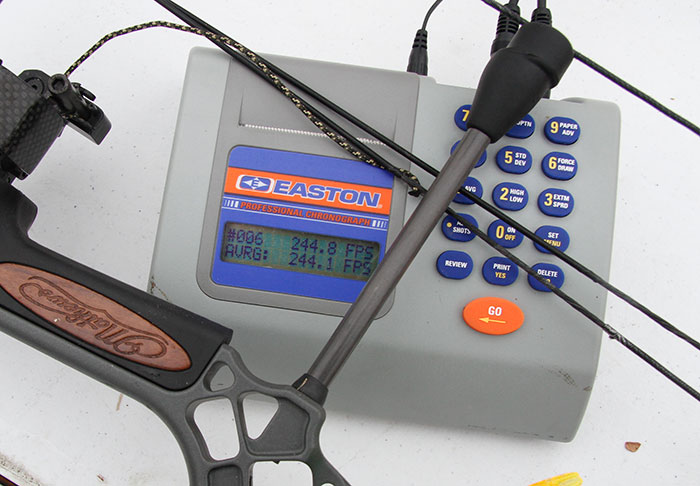
Set up for hunting, I shot 2.1-inch groups with my No Cam, and that's very good for me. The bow was about as quiet as bows get. There was little vibration or hand shock, and it was fun to shoot, especially as I watched my arrows stack in the bullseye. I love the simple focus grip and the very firm back wall of the draw. All told, it's a great bow, as it should be for $1,100.
Will other companies follow suit, or at least push the archery envelope to keep pace with Mathews? Time will tell. But for now, the No Cam is a different hunting bow that's quiet, easy to tune, and, most importantly, easy to shoot accurately. After all the hype, accuracy is what puts deer in the freezer and on the wall.
Technical Specifications:
Brace Height: 6 5/8"
Draw Weight: 50, 60, 70 lbs.
Bow Weight: 4.14 lbs.
Let-Off: 65 percent, 75 percent, 85 percent
Draw Lengths: 24"-30" with ½-inch half-sizes
String Length: 59.78"
Riser Length: 28.92
IBO Rating: 330
Axle to Axle Length: 32"
MSRP: $1,099