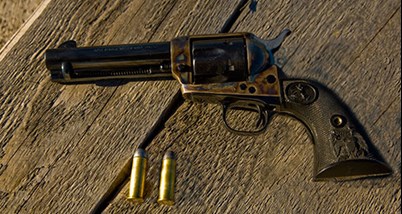
 Anyone who has read my diatribe for very long knows of my affinity for the .44 caliber—both Special and Magnum. But there is an even older .44 that has wormed its way irrevocably into my heart and that is the .44-40 Winchester Center Fire or WCF. It first saw daylight in 1873 when Winchester debuted it along with the 1873 Winchester repeating rifle. It took four more years for Colt to stuff it into a revolver, calling it the Colt Frontier Six Shooter. Originally loaded in balloon-head cases, it consisted of 40 grains of FFg black powder behind a 200-grain round-nose, flat-point bullet, launched at some 1,245 fps.
The .44-40 WCF was wildly popular during the settlement of the west. With one cartridge that was useable in both rifle and pistol, it was deemed a very desirable feature and contributed greatly to its popularity. Its reputation as a man stopper was well documented, and the wide-open west provided ample opportunities for the .44-40 WCF to strut its stuff in the game fields.
But the Industrial Revolution carried on, and eventually the single-action revolver and lever-action rifles yielded to the semi-autos. By 1940 the .44-40 was relying on its voluminous sales over the years to justify continuing to load it. No new guns were being chambered for it, and it was generally regarded as more-or-less obsolete.
It was the cowboy action game that brought forth a renaissance in the old girl. I was always aware of it, but it wasn’t until about six years ago did I ever pay much attention to this cartridge. The first .44-40 I bought was a Uberti 1873 rifle. It came from the box as slick an accurate a little lever action as anybody could want. Next I really splurged on a matched pair of consecutively serial numbered Colt Single Action Armies. Then came another Uberti, this time a replica of the Colt Burgess lever action. Now I find that I enjoy shooting these .44s nearly as much as my treasured .44 Specials and Magnums.
I generally use a mid-range load consisting of 30 grains of Goex FFg behind a Lyman 427666 that falls from my mold at 213 grains; in Starline brass. In the revolvers I get 700 fps, and in the rifles it leaves the muzzle at 946 fps. Some complain that because the mouth of the .44-40 case is so thin, it makes it difficult to load. I find that as long as one is careful, loading the .44-40 WCF is no more difficult than any other cartridge.