It was just one of those mornings.
We were covered up with turkeys, but we couldn’t seem to do anything right. It had been light only an hour and we had already been busted twice by birds coming from behind us. It was looking like my last morning in Texas was going to end poorly.
Then a gobbler followed a bunch of hens out of the woods about 100 yards in front of us. Steve Elmore yelped at him and the greedy letch left his loyal lovers and came strutting to us, only to hang up just out of range. We spent the next eternity with me holding the gun on his head and Steve purring like a hen in heat. Gobbling until he was hoarse, the tom slowly closed the gap until he obviously remembered that old saying about a “bird in hand” and made a move to return to his patiently waiting harem. I centered the Benelli’s bead on his neck and pulled the trigger.
That old gobbler dropped in his tracks and never argued the point with a flop, flip or flutter. Now that I could, I got out my Nikon rangefinder and measured the distance: 47 yards. Not too bad for a 20-gauge.
Most turkey hunters know by now the effectiveness of Federal’s Heavyweight tungsten-alloy ammo. This pellet material has a density of 15.2 grams per cubic centimeter (g/cc), which makes it more dense than lead at 11.35 g/cc. Tungsten is also much harder and will not deform like lead. This does two things. First, it keeps the patterns tighter because the pellets do not deform in the shotgun barrel. Second, they penetrate better. Round pellets simply penetrate better than flat pellets, and no energy is lost to reshaping a malleable pellet, so it’s all directed to penetration.
Because it is so dense, the pellets hit harder than lead in any given diameter. For example, Federal says its tests show that No. 7 Heavyweight pellets hit with the same energy as No. 5 lead pellets (when launched at the same velocity.) This not only allows the use of smaller pellets so that there are more in the shot charge, but the smaller pellets also penetrate deeper due to their smaller diameter. Theories abound about why it’s so effective at killing turkeys—mine is based on penetration—but nobody who has used it disputes that Heavyweight pellets are even more effective than lead.
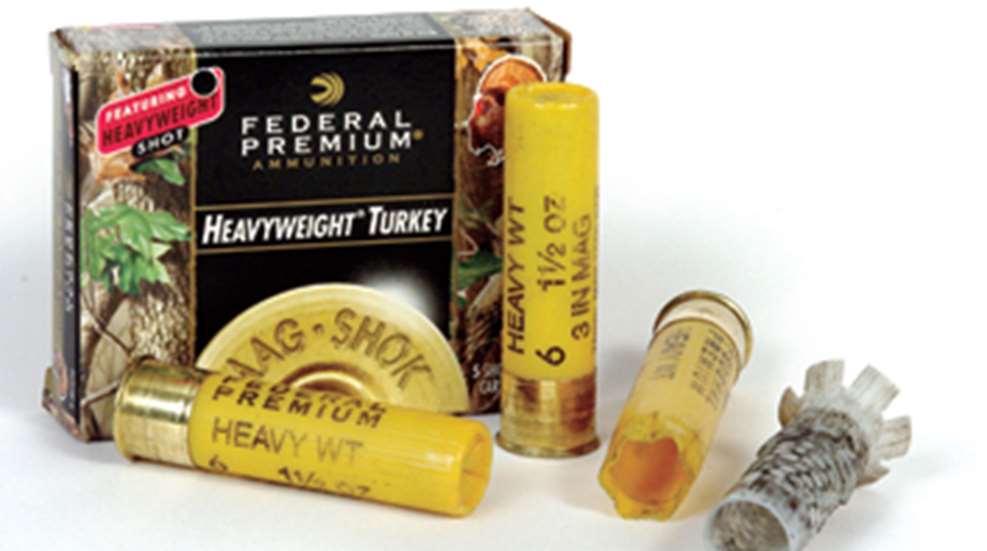
Federal Premium Heavyweight Turkey ammo uses the company’s FliteControl wad, which produces even tighter patterns. The FliteControl is a full, un-cut cylinder that stays with the pellets after leaving the shotgun. Once the heavy, plastic wad is free from the shotgun, several fins pop out from the rear to add air resistance. This will slow the wad, pulling it back from the shot charge farther from the muzzle than a traditional wad, which keeps the pellets together longer and produces tighter patterns downrange.
This ammo has been around for a while in 12-gauge shotshells, but in 2009 Federal introduced it in 20-gauge. The 20-gauge Mag-Shok Heavyweight Turkey loads have 11/2 ounces of shot in either No. 6 or No. 7 with an advertised muzzle velocity of 1100 fps. One and a half ounces of Heavyweight No. 6 contains 223 pellets, while No. 7 has 337 pellets.
Like most of the hard pellet materials, Heavyweight seems to work best with less choke constriction than is traditionally used for lead. In my Benelli shotgun I used the supplied full choke, which is .590 inch. With the Benelli’s nominal bore diameter of .620 inch this results in a .030-inch constriction. That’s half the constriction for a lot of turkey chokes designed for lead use, but perfect for Heavyweight ammo. The average of three patterns at 30 yards was 60 pellets on a turkey’s head and neck in a Shoot-N-C target. One load put 75 pellets on the head and neck. A single target at 40 yards had 24 pellets in the head and neck. This new Federal load brings the performance level of the 20-gauge higher than some 12-gauge loads that were popular for turkey hunting in the past.
Why a 20-gauge? Simple, the shotgun is smaller, lighter and kicks less than a 12-gauge. That makes it a favorable choice for smaller-sized hunters and those who are recoil-sensitive. Don’t think that it performs identically to the best 12-gauge loads—it doesn’t—but as I found, it’s plenty effective for most situations. Some years back I did an extensive test of the lineup of 20-gauge lead pellet turkey ammo. My conclusions were that, to be effective, the shots should be restricted to no more than 35 yards. This new Federal load certainly expands the horizons of the 20-gauge
It should also be noted that the Federal Premium Mag-Shock Heavyweight Turkey ammo in 20-gauge is legal for waterfowl hunting and would be extremely effective. However, the cost makes it an expensive choice for the high-volume shooting often found in waterfowl hunting. But when turkey hunting, where you may get only one shot all season, I recommend shooting the most potent load available. If you choose to shoot a 20-gauge, this may be it.