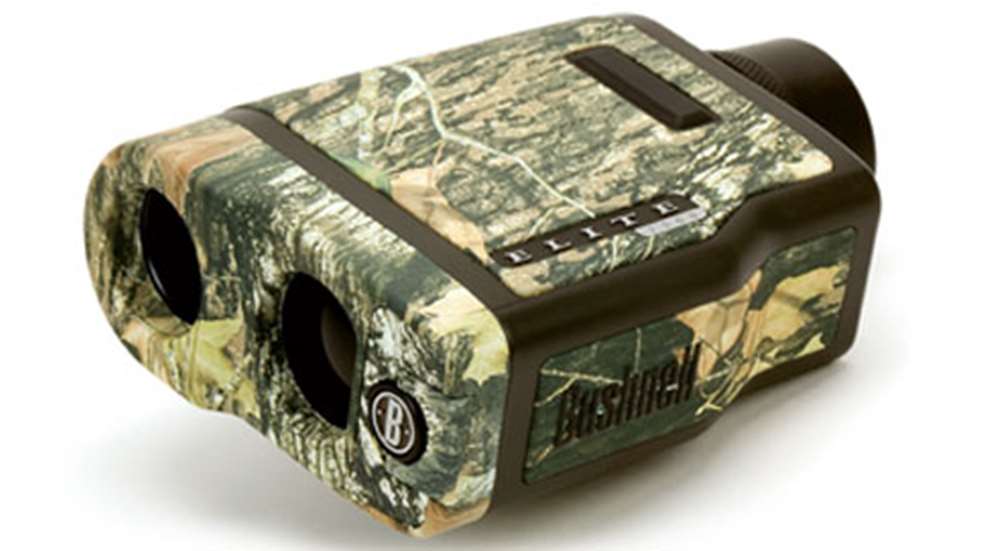
Laser rangefinders are a great tool for hunting-it's as simple as that. Archers, muzzleloaders and centerfire rifle hunters can all rely on lasers to provide fast, accurate distance readings down to the yard. Bushnell introduced affordable, accurate and simple laser rangefinders over a decade ago. Since then they've become smaller, rangier and more energy efficient. The latest is the Elite 1500.
The Elite 1500 offers seven-power magnification through a 26mm lens. The lenses feature Bushnell's effective Rainguard water-resistant coating.
The 1500 employs high-grade, multi-coated glass lenses. The improvement over previous Bushnell units is very significant in terms of brightness and clarity.
Under optimum conditions the unit is capable of obtaining readings out to 1500 yards or even longer-thus its name. But its effectiveness, like all laser rangefinders, depends on the reflectivity of the object being lased, how steady the unit is held and the lighting conditions. Bright light kills the effectiveness of lasers, bringing maximum operating ranges down about 50 or 60 percent. But 50 or 60 percent of 1500 is still a long distance. The Elite 1500 offers three operating modes: "Standard," which has an automatic scan, "BullsEye" for acquiring readings on small objects or the closest object read, and "Brush," where the unit ignores clutter in the foreground.
At the NRA convention in Houston, Bushnell staff showed me how effective the "BullsEye" and "Brush" modes work. About 47 yards from the Bushnell booth a 6-foot length of extension cord hung from a ceiling rafter. With the unit on "BullsEye" I could obtain readings off the cord! With the unit on "Brush" I got readings off the far end of the building. The unit worked perfectly every time.
There are two primary questions about the Elite 1500. First, how does it compare to my Bushnell YardagePro 1000 that has worked so well for so many years? Second, how does it compare to the higher-dollar European rangefinders on the market?
I'm probably one of the few individuals who has virtually worn out a Bushnell 1000 rangefinder. I know what that model will do, based on dozens of hunts from the Arctic to the Rio Grande. I have found that the 1500 offers significantly better optics and provides readings much farther than my "Old Faithful 1000." I can use the modes to better advantage and even use the 1500 as a monocular during hunts.
I have also compared the Bushnell 1500 with two popular European laser rangefinders during recent hunting trips. The bottom line is that the European brands have slightly better optics and readings. But the European brands cost more than "slightly more" money.
The 1500 is very simple to use. One touch on its "Send" button turns on the display. A simple black circle appears. Simply hold the Send button down and read the resulting numbers. The unit only weighs 12 ounces and it fits in the hand comfortably. A 9-volt battery provides power and it lasts me about a year.
The Elite 1500 is offered in two configurations: the standard 1500 and a more sophisticated ARC, or "Angle Range Compensation" model. In a nutshell, the path of a projectile relative to the shooter's line of sight is effected less by gravity when shot at steep angles. Therefore, the horizontal distance to the target is the true distance for which you should aim. The ARC unit calulates and relays this distance to you in an instant.
The ARC model also has a set of trajectory modes that will offer bullet-drop info at a glance. To use this function, just select the group of calibers closest to the one you are shooting and the unit will indicate inches of drop. The ARC model retails for roughly $100 more than the standard Elite 1500.
The Bushnell Elite 1500 and 1500 ARC are reliable, accurate, easy to use and affordable laser rangefinders.
Type: laser rangefinder
Magnification: 7x
Objective Lens Diameter: 26mm
Advertised Range: 5-1,600 yds.
Battery Type: 9-volt
Housing: armored; waterproof; floating
Reticle/Display: LED crosshair/LCD
Field of View @ 100 yards: 340'
Lens Coatings: fully multi-coated optics, Rainguard exterior coating
Dimensions: height-1.7"; width-3.7"; length-5.1"; weight-12.1 ozs.
MSRP: $400 (tested)