If you’re like me, you live for the crisp air of November when whitetails take to the rut. It’s when bucks run wild in a haphazard quest to procreate; it’s an annual, two-week bonanza when a Booner you didn’t know existed might cover miles of ground looking for a receptive doe and wind up under your stand at noon.
Due to the rut’s unpredictable nature, now’s not the time to be conservative. Rather, it’s time to pull out all the stops, toss aside your fears of spooking deer and hunt hard. What follows are simple, data-backed, wide-open strategies for maximizing your odds this year.
Rutting Bucks Don’t Care
A recent study by Texas Parks and Wildlife (TPW) suggests hunters may not have as much influence on buck movement and behavior as we think—at least not during the rut. TPW’s “Public Hunts on Deer Movements and Behavior” was conducted by capturing and GPS-collaring 30 mature deer (14 does and 16 bucks) aged 3.5 years and older. Their movements were tracked across the 6,500-acre Kerr Wildlife Management Area (KWMA) of Central Texas. The high-fenced KWMA was divided by a low fence into two 2,500-acre parcels containing similar cover. The study was conducted over four hunting seasons from 2013 to 2016 wherein one side was open to public hunting and the other side was closed to hunting as a control. The study used more than 200,000 GPS-collected data points representing the hourly movements of individual deer. The data points were recorded, plotted and analyzed to draw conclusions on how hunters could be more successful during the rut.
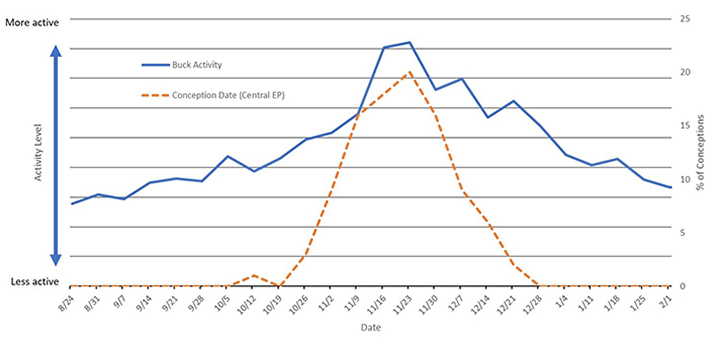
The study found that during most of the year, bucks spent much of their time in an average core area of 148 acres. Not surprisingly, it found that bucks utilized much larger areas—785 acres on average—during the rut. But what is surprising is that these average range numbers were virtually the same for bucks in the hunted area and bucks in the non-hunted area. So the notion that deer hole up or bug out during the rut “when guns start banging” is bunk. Rather, it suggests that even if you spook a buck in the rut, he probably won’t leave the vicinity.
The study’s GPS-gathered data points were time-stamped so researchers knew exactly when deer moved. Males showed more movement activity during the hours of 0600 and 1000 (6-10 a.m.) and another smaller peak between 1600 and 2000 (4-8 p.m.) in both the hunted and unhunted parcels.
This data indicates that movement times of mature bucks during the rut aren’t significantly altered by the presence of hunters. Bucks that typically moved during the day didn’t suddenly “go nocturnal” when hunters entered the woods.
The takeaway is, hunters shouldn’t be scared to hang a stand in a buck’s core area or even to hunt when the wind isn’t perfect during the rut. The study also strongly suggests hunters should get out in the woods early—before dawn—and stay at least until 11 a.m. for their best chance to kill a mature buck during the rut.
Best Rut Stands
While I normally advise hunting heavy cover before the rut when big bucks are secretive and wary, during the rut it’s often best to sit in stands that command a larger viewing area. By increasing your field of view when bucks are chasing and covering large portions of ground, your chances of spotting a big deer are increased. Now is the time to concentrate on more open fields and food plots where you typically only see does during daylight hours. Rest assured, if there are does around, bucks soon arrive.
My favorite rut stands offer the best of both worlds, however. They are located on the edges of wooded pinch-points that naturally funnel deer through them, but also near a field or meadow where I can watch for cruising bucks. Ideally, I want the wind blowing to the field rather than into the close-quarters woods. With a rifle, I can shoot both the funnel and the field; with a bow, I can shoot the funnel, and if I see a good buck cutting across the far side of the field too far for a shot, I can climb down and go after him or at least develop a plan now that I know he exists.
Still-Hunting
Because a buck’s first instinct during the rut is to pause to see if the strange smell or sound is a doe rather than immediately high-tailing it like all other times of year, the odds of success via still-hunting during the rut increase drastically. However, unless the ground cover allows it or you are a ninja, it’s best to wait for a day when the ground is wet so your sound will be minimized as you slip around. Go as slowly as possible and keep your head up, scanning for deer. If you see a buck, however, realize you’ll only get a few moments to judge it before it realizes you aren’t a doe. The only downside to still-hunting is that if you’re a trophy hunter who routinely passes up many small bucks and does, these deer will often work their way around your position and ultimately sense you and spook. When they do, they could take a nearby mature buck with them.
Hot Doe: The Ultimate Bait
It always surprises me when I hear a hunting buddy report that he saw a couple small bucks chasing a doe, but now wants to change stand locations because he didn’t see a shooter. That’s like a fisherman reporting that crappie are tearing up the minnows, but now he suddenly wants to try an artificial lure in a new location! Reality is, the doe the small bucks were chasing was obviously in estrous, and there is no better big-buck bait in the world! Eventually a dominant buck will find her. Does have smaller ranges than bucks and generally stick to a home area, so if you find a hot doe, stay put.
Hunt Hard and Often
The very best advice for success during the rut is the simplest: Big, wary bucks that don’t often leave their lairs are most vulnerable right now. So even if the weather is bad, you’re tired, the wind is wrong, you haven’t seen any good bucks on trail cams or whatever, your best bet is to get out in the woods as much as possible during this magical time. Anything can happen, and you should be ready and waiting with your loaded rifle or bow when it does.