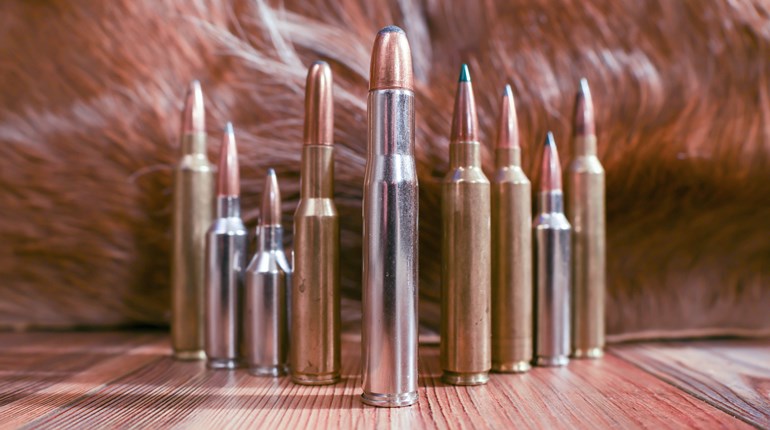
Anytime a new cartridge is introduced many ask if it’s really needed. We have hundreds already, so the question is valid. What many overlook are the subtle and even substantial, advantages a new cartridge might offer. The new .300 HAM’R from Wilson Combat is a perfect example. It turns the AR-15 into a rifle capable of bettering the performance of the iconic .30-30 Winchester.

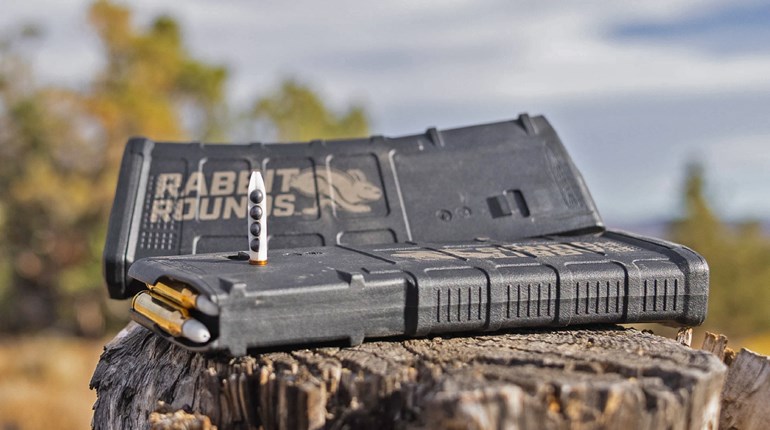
Bill Wilson of Wilson Combat is a die-hard hog hunter; he kills hundreds every year on his Texas ranch. Bill has tried every AR-15-compatible cartridge looking for the one that offers the ideal balance of simplicity of conversion and terminal and external ballistics. He finally decided that to get what he wanted, he would have to design his own. Starting with another proprietary cartridge he developed—the 7.62x40 WT—Wilson slightly increased case capacity while maintaining compatibility with standard AR-15 magazines. When he paired his new creation with Hodgdon’s CFE BLK powder, he hit a home run.
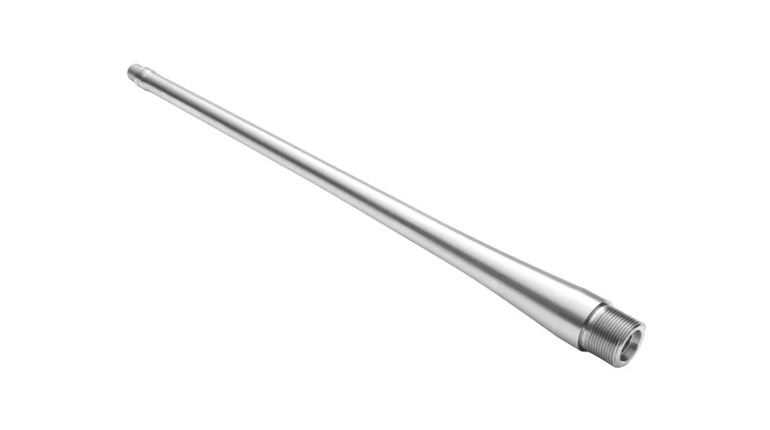
Operating at AR-15 platform-safe pressures between 50,000 and 58,000 psi, this little cartridge performs exceptionally well from carbine-length barrels. Now keep in mind, this is not a subsonic cartridge; it’s a supersonic cartridge you can convert your AR-15 in .223 Remington to, with only a barrel change. With a 1:15″ twist, it’s exceptionally accurate, and is death to swine with a wide variety of .308 caliber bullets.

Out of a compact .30-30 lever-action with a 16-inch barrel, you can expect to push a 150-grain bullet to about 2250 fps. Because of the low ballistic coefficient (BC) of the blunt-nosed bullets, necessitated by the tubular magazine, they’ll deliver in the neighborhood of 1,250 ft.-lbs. of energy at 100 yards. Because the .300 HAM’R feeds from detachable magazines, it can use pointy bullets with higher BCs. At 100 yards, the .300 HAM’R will hit 20 percent harder than the .30-30 Winchester—and because of these more aerodynamic bullets, trajectory is flatter.

Of course, the .30-30 Winchester cannot be fired in an AR-15, so better comparisons might be other AR-15 cartridges, such as the 7.62x39, which will push a 123-grain bullet to around 2350 fps and generate about 1,500 ft.-lbs. of energy. The very popular .300 AAC Blackout will launch a 135-grain bullet to near 2100 fps, but is even more anemic at only 1,300 ft.-lbs. Even the 6.8mm Rem. SPC can only push a 120-grain bullet to about 2450 fps, while delivering only 1,600 ft.-lbs. of energy. The .300 HAM’R out performs them all.

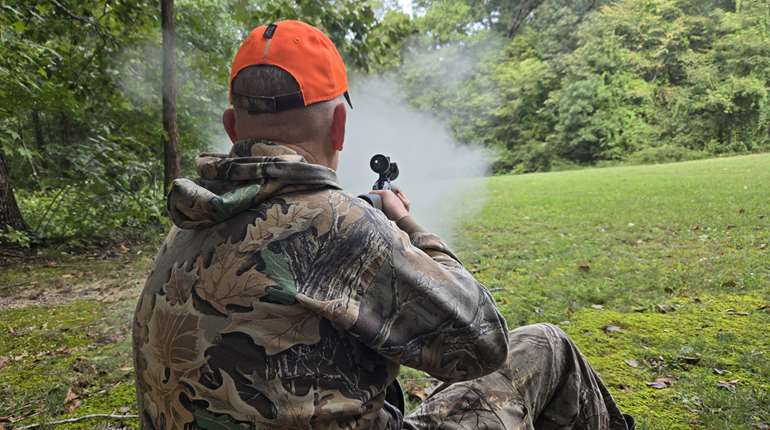
I’ve been testing this cartridge in a Wilson Combat Tactical Hunter, and I can’t decide if I’m more impressed with the new cartridge or the rifle. Every .300 HAM’R load from Wilson Combat (they offer seven) produced five-shot, 100-yard groups, right around the inch mark. Surprisingly, I noticed all the loads seemed to shoot to near the same point of impact. So, I loaded ten rounds in a magazine—two cartridges from five different loads—and fired a 10-shot group that measured only 1.56 inches. That’s astounding, especially considering bullet weights ranged from 110 to 150 grains. Try doing that with any other rifle you own.
There are two main takeaways. The first is that the Wilson Combat Tactical Hunter—which weighs only 6 pounds—might be the slickest operating, best shooting AR-15 I’ve ever fired. The second is that the new .300 HAM’R cartridge is unquestionably the best big-game cartridge you can fit inside an AR-15 without going to a larger bolt, like is used with the 6.5 Grendel or the .30 Remington AR. The .30-30 has been successfully used for everything from coyotes to moose for more than 100 years. In the late 1920s, ivory hunter Wally Johnson even used his .30-30 for lion.

The .300 HAM’R will do everything the .30-30 Winchester will do and more, but from an AR-15 platform; and in the Wilson Combat Tactical Hunter, it weighs less, shoots better and holds a lot more ammunition than any .30-30 lever-action rifle ever made.
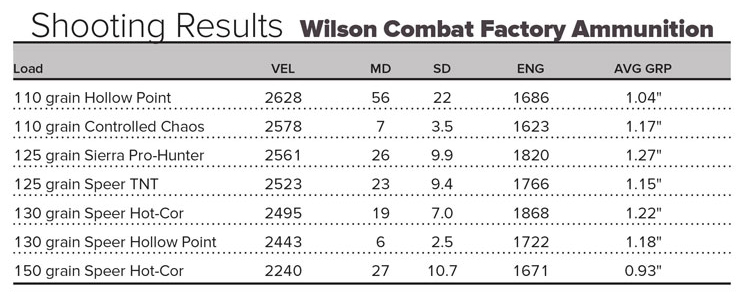
NOTES: Average muzzle velocity (VEL), maximum velocity deviation (MD) standard velocity deviation (SD) and muzzle energy (ENG) were established by firing 10 shots over a Caldwell Ballistic Precision Chronograph G-2 with the screens positioned 10 feet from the muzzle. Average Group (AVG GRP) was calculated by firing five, five-shot groups from a sandbag rest at a distance of 100 yards using a Trijicon 3-9X40 AccuPoint riflescope with magnification set to 9X.