“If you don’t like the weather now, just wait 10 minutes”: This adaptable expression has debatable Mark Twain roots, but it’s echoed still today in every ZIP code to define changing weather events. For turkey hunters the 10 minutes may not pass soon enough when weather storms your hunt.
Rain, sleet, snow, wind and even searing temperatures affect the way turkeys carry out their daily existence. How you tailor a plan to intersect with these weather-influenced behaviors could spell success or doom on your hunt.
Go with the Snow
Unless you hunt turkeys only in the southernmost stretch of the nation, be prepared to battle snow. Surprise spring snowstorms may not last long, but they can dump excessive amounts of the white stuff and affect turkey behavior dramatically. I’ve witnessed turkeys loathing the snow as it occurs. When Weather Service warnings dramatize travel difficulties, consider your safety first. Waiting for the sun to break out and fire up a chilly tom trumps burying your truck in a snowdrift.
If a few flakes obscure vision, turkeys oftentimes go about with a business-as-usual mind-set. Don the appropriate clothing to stay warm and dry, and join them as you benefit from their snow-restricted view. It may take a more aggressive conversation, but you can fire up gobblers in a snowy setting. One change you may encounter with a few inches of snow is their tendency to hug cover. Pine or cedar canopies attract turkeys because they reduce snow cover, making it easier for birds to scratch.
If the storm is severe turkeys may return immediately to a winter pattern. I’ve seen this time and time again in states like South Dakota, Montana and Wyoming. Look for them to congregate at livestock feeding operations where they can scratch easier due to farm animals snowplowing paths and spilling tasty leftovers.
After a storm’s passing, glass for dark objects rambling in a backdrop of white. If you can’t spot a flock, search for tracks. Straight lines amongst a bevy of tracks signals a strutting gobbler’s dragging wings. It’s time to begin tossing calls out ahead. Turkeys fire up quickly after a storm’s passing, revealing a sunny outlook for the rest of your hunt.
Be Ready for Rain
Nobody likes to be wet, and that includes turkeys. Matt Brunet is the turkey and whitetail manager at Harpole’s Heartland Lodge in western Illinois. He has guided for a dozen years in game-rich Pike and Calhoun counties.
“Look for behavior changes during rain. Turkeys gobble less, strut less and stay on the roost a little longer in the mornings,” notes Brunet. “During a rain it all depends on how hard it comes down. The harder the rain, the less they move.”
From his experience turkeys tend to move toward cover, further into timber and hollows. In extended rain events Brunet has seen turkeys using briar patches and brush piles as cover, only leaving them occasionally to feed nearby.
After a rain is when Brunet gets excited. He follows turkeys to open fields, especially short green fields. Turkeys move there to preen and dry. By scouting and planning ahead, Brunet sets up ground blinds on favorite fields to be ready for rain. Using decoys and soft calling, he waits for the turkeys to show.
If the rain arrives in a splash-and-dash event, like a thunderstorm, Brunet hunts aggressively ahead of and after the storm. “Light rain quiets footsteps, and there’s no need for locator calls as gobblers sound off to every clap of thunder,” he says.
Play the Wind
D.J. Randolph is a regional pro-staff manager for Mossy Oak. North Dakota is home, and he’s no stranger to wind while chasing longbeards. An Ohio native with 16 years of turkey hunting in his background, Randolph realizes turkeys react differently with high wind warnings in play.
“I can’t say that I am more successful turkey hunting on windy days, but I can say that I am more successful than sitting at home,” Randolph quips. “Wind creates new challenges, but it also creates opportunity. When it’s very windy we have trouble hearing the birds, and they have trouble hearing us. I see this as a time to be more aggressive.”
Randolph uses this weather opportunity to move more while calling louder. His strategy is the opposite of many, as he prefers the wind in his face. After locating protected side-hills, benches or bowls, he utilizes a higher-pitched call to cut the wind. A face full of wind makes it easier to hear any returning gobbles since they’ll be carried his way.
If he hears a response he knows patience is vital. Randolph recognizes that turkeys, like most animals, are more nervous in windy conditions. He forgoes using a full-fan decoy and instead stakes out a jake, or a jake-and-hen combination. After that it’s all about time and waiting for birds to work into range.
Keep Your Cool
Despite your thoughts on global warming, high temperatures during your turkey hunt could have the birds wishing for more winter. Throw in bugs and sweat, and you’ll be longing for the same if you don’t play it cool.
ScoutLook Weather co-founder Cy Weichert owns a farm in the Syracuse region of New York, where steamy weather invades the May turkey season. No doubt Weichert relies on precise weather forecasts from his innovative hunting app, but he also understands that with heat it’s time to alter your modus operandi for turkeys.
“When it’s hot the biggest problem is the black-fly hatch. Without a Thermacell, they’ll carry you away,” jokes Weichert. “Bugs aside, when it gets hot it’s actually harder to locate turkeys in the morning. Unlike during cold and miserable conditions, when turkeys carefully choose sheltered locations, they can roost anywhere when it’s warm. They spread out, making it harder to find them since they roost randomly.”
When the thermostat cranks up Weichert focuses on cool, shady locations. On his farm he targets the creeks, especially those along agricultural fields.
“Trees offer shade, and it’s always cooler in a creek bottom. Turkeys also can get a drink there anytime,” notes Weichert. “There’s a big hill on our farm that blocks the heat of the morning sun, and they’ll hug that for shade, too.”
Terrain types that offer cool locations for turkeys can be hot spots. New York is a state that permits only half-day gobbler hunting in the spring, but even so, Weichert recognizes that understanding where turkeys scatter in the heat of the day helps put a plan together for the next morning.
Lighten Up
When weather threatens to complicate your hunt, it pays to pare down your turkey gear if the sheltering comfort of a blind isn’t part of your plan. Carrying fewer calls in a minimalist rig lets you keep them under raingear, protected from rain or snow. (The less stuff that gets wet, the less stuff you’ll have to dry for the next hunt.) On days when temperatures soar, hunting light only makes sense to minimize sweat and fatigue. Here are two new front-carried setups that keep the essentials at hand but force you to leave the extras at home.
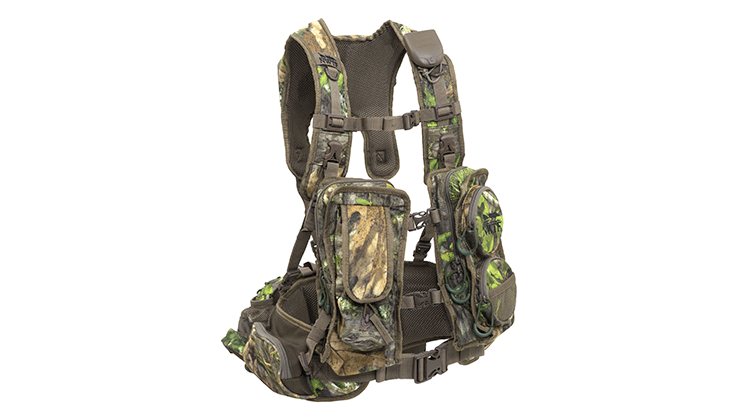
Alps Outdoorz Long Spur
The Long Spur combines two call carriers on a shoulder harness with a lumbar pack on a padded waist belt. On days that start out dry, stow your raingear in the lumbar pack until you need it. If it’s already raining when you leave the truck, zip off the pack and wear the call carriers on the harness under your waterproof jacket. The carriers have dedicated pockets for two pot calls, two mouth calls and a box call, plus space for locator calls and five shell loops. One shoulder strap also includes a rigid carrier for mouth calls, and the back of the harness holds a pull-out game bag. MSRP: $99.99; alpsoutdoorz.com.
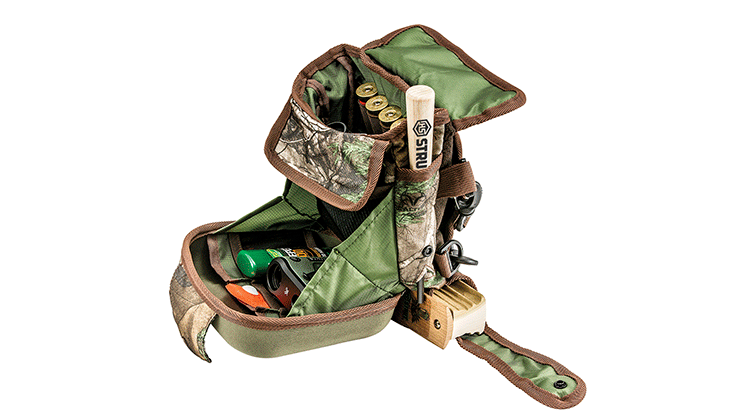
H.S. Strut UnderTaker
About the size of a binocular carrier, the UnderTaker chest pack rides on a four-point harness system and keeps turkey tools front and center. The main compartment has magnetic closures, and its front drops down to offer quick access to the contents. Inside, three mesh pockets hold diaphragms while a large, webbed pocket carries other gear. The UnderTaker also has an exterior box-call pocket and striker holsters, as well as a seven-round shell belt and three more pockets at the rear to hold pot calls, gloves and other must-haves. MSRP: $44.99; hunterspec.com.