There are those hunts where a cartridge larger than your favorite deer rifle is required, especially in the higher latitudes of North America. While the .30-06 Springfield proved early on that it was perhaps the definitive hunting cartridge for nearly all North American game, there are species here, and around the globe, that require a bit more than what the .30-06 has to offer. Considering the selection of cartridges that will handle the larger North American mammals, two have most certainly risen to the top, and yet there are many who fervently choose one over the other. Let’s take a more detailed look into these two classic cartridges.

The .375 Holland & Holland Magnum is the elder of the two cartridges, having been released by the prestigious British firm in 1912. With its gentle, sloping shoulder and belt of brass at the base of the cartridge used for proper headspacing, the three-seven-five feeds like a dream from a box magazine bolt-action rifle. Though Britain classified the cartridge as a medium bore, the .375 H&H soon showed its abilities on all game around the globe. Elephant in both Africa and India, all the large cats, buffalo on any continent, any color of bear; all were neatly handled by the .375 H&H.
 Its popularity didn’t actually gain its full head of steam until after WWI ended—and hunters began to head abroad again—and was only bolstered when American ammunition and firearms companies began to offer the cartridge. To this day, a pre-’64 Winchester Model 70 in .375 H&H remains among my ‘most-wanted’ rifles. It was designed to use 235-, 270- and 300-grain bullets, making it perfectly suitable for game of all shapes and sizes. The admittedly light 235s were launched at 2800 fps, but the bullet construction a century ago isn’t what it is today. The 300-grain soft points and solids, driven to a muzzle velocity of 2530 fps, offer over 4,000 ft.-lbs. of energy at the muzzle, and yet maintain a respectable trajectory. This cartridge has garnered a reputation for deep penetration, yet a recoil level that most shooters can handle with practice.
The .338 Winchester Magnum is one of four cartridges developed by Winchester that are based on the shortened .375 H&H belted case. It has its roots in the series of OKH cartridges developed by Charlie O’Neil, Elmer Keith and Don Hopkins. The trio took both the .30-06 case and the shortened .300 H&H Magnum case and necked them to hold the bullets for the .333 Jeffery cartridge. It was the .334 OKH, based on the belted H&H design, that had a direct influence on the .338 Winchester Magnum. Winchester took their .458 Winchester Magnum case—itself a shortened and blown out .375 H&H case—and necked it to hold the .338″ diameter bullets the company used for its rimmed .33 Winchester.

Bullet weights of 200-, 250- and 300-grains were initially offered for the .338 Win. Mag., making for a highly useful cartridge. The 300-grain load has long since faded, being only available from the boutique ammo companies. But there is a wonderful selection of bullets available today, including the 250-grain bullets that maximize the potential of the case. Leaving the muzzle at 2650 fps, it has a good trajectory and plenty of striking power for almost all game species, save the African heavies. The lighter 200- and 225-grain bullets—especially the premium designs—will handle elk, moose and bear, and the light bullets between 175 and 185 grains make a good deer bullet, especially at longer ranges.
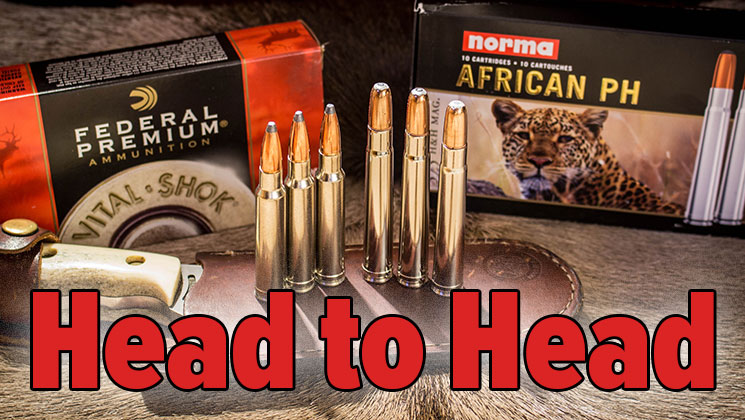
Which of these two has the advantage, and would make the better choice? Well, here in North America it’s pretty much a dead heat, as the .338 Winchester Magnum and its 250-grain bullets can effectively handle all of our game animals, including the great bears, and the .375 H&H Magnum—with the lighter premium bullets like the 235-grain Cutting Edge Raptor—can handle the lighter game species better than you’d think, and handles the big guys with no issue. If you plan on traveling off the continent, I’d give the advantage to the .375 H&H Magnum, for a couple of reasons. First, it meets the caliber minimum for hunting dangerous game enforced by a number of African countries. It makes perfect sense as a rifle for Australia, as well. If you want to enhance the performance of the .375 H&H, Norma’s African PH load offers the 350-grain Woodleigh Weldcore and Solid bullets at a muzzle velocity of 2300 fps. Second, the popularity of the .375 H&H is very similar to the .30-06 Springfield here in the U.S.; it’s one of the most renowned and readily available cartridges around the globe. I’ve seen spare .375 H&H ammo in almost every African camp I've been in, and it was very popular among the Australian buffalo guides.
In spite of requiring a longer action, I feel the .375 H&H Magnum mates up with a 7mm or .30 caliber rifle a bit better than does the .338 Winchester Magnum. Most of the larger .30s can use the 220-grain slugs, and aren’t too awful far behind the .338 Winchester, where the .375 H&H picks up with the 230- and 235-grain bullets, and extends up to the 300s and 350s. I have shot both rather extensively, working up handload recipes for both, and have hunted with the .375 H&H quite a bit. I find that, especially off the bench, the .338 Winchester Magnum’s recoil can be quick, and rather nasty, while the .375 H&H’s recoil is a gentler push, though still substantial. Put another way, I’d much rather put two boxes of 300-grain .375 H&H ammo downrange in a single sitting, than I would two boxes of 250-grain .338 Winchester Magnum.
The .375 H&H Magnum offers a larger case capacity than the .338—95 grains versus 86 grains—and that gentle eight-degree shoulder makes for easy feeding. There are no flies on the .338 Winchester Magnum—I wouldn’t hesitate to use one for any appropriate game animal—but I find that a hunter with a good .375 H&H Magnum is fully prepared for any hunt he or she could imagine. I like the three-seven-five for its flexibility; for the big-game hunter, it truly is the most useful cartridge ever designed.
Looking for previous installments of our "Head to Head" series? We've got you covered.
• .30-30 Winchester vs. .35 Remington
• .257 Roberts vs. .250-3000 Savage
• .270 Winchester vs. .280 Remington
• .35 Whelen vs. 9.3x62mm Mauser
• .416 Rigby vs. .416 Remington Magnum
• .308 Winchester vs. .30-06 Springfield
• .22 Nosler vs. .224 Valkyrie
• .300 Win. Mag. vs. .300 WSM
• .223 Remington vs. .22-250 Remington