The first group—three shots from a cold barrel at 100 yards from a solid rest—measured 1.05 inches center-to-center. The second was .94 inch.
The final shot of the third group touched the first two for a 0.81-inch group.
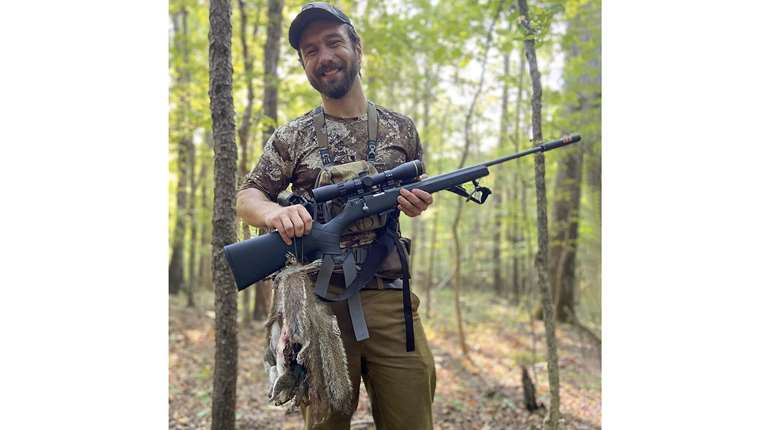
Here’s where I tell you that I’m talking about a shotgun with slugs.
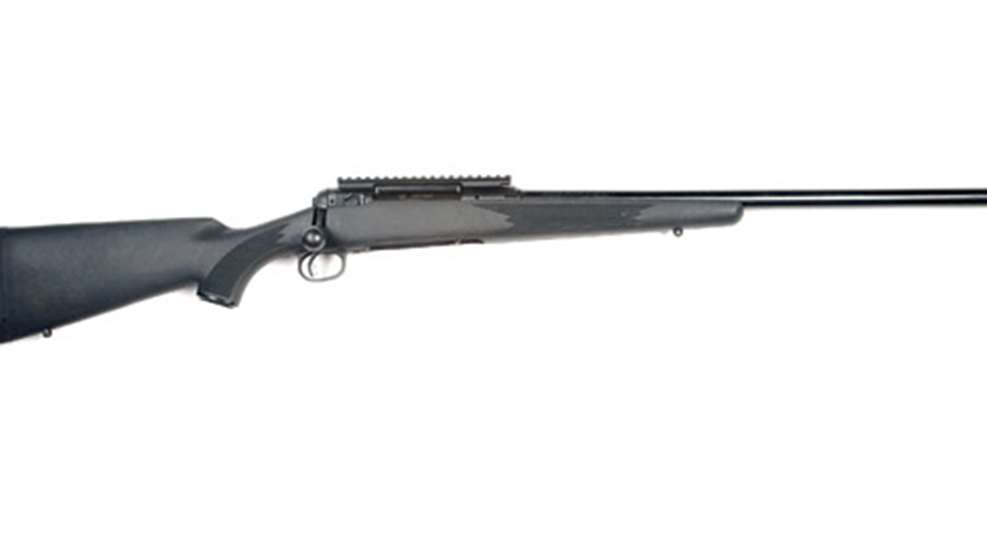
If I hadn’t witnessed it myself, I would have scoffed at the claim. Granted, minute-of-angle accuracy and palm-sized 200-yard groups with shotguns have been described in print. But those reports are invariably written by people who get their accuracy quotes from press releases. Having shot every slug shotgun and slug on the market over the last 25 years, I would have deemed them unattainable standards. Notice the use of the past tense in the preceding sentence. The new Savage 220 bolt-action, rifled barrel, 20-gauge shotgun has made me a believer.
Introduced last summer, the 220 is the evolution of the long-established 12-gauge Savage 210 bolt gun, which was introduced in the mid-1990s. The 210 had a reputation for accuracy but was not without its warts, such as inconsistent ejection, an awkwardly designed integral box magazine that protruded from the bottom of the action like a squared goiter, a heavy trigger and a short firing pin throw that failed to ignite some ammunition.
Some of its shortcomings were fixed, to an extent, but companies, including Savage, are reluctant to overhaul a product that sells fewer than 10,000 units annually. Such is the dedicated slug-gun market.
It was improvements in 20-gauge sabot ammunition and innovations in Savage rifle design that eventually fueled the development of the 220.
This newest Savage gun features the company’s renowned, adjustable, uniquely two-stage Accu-Trigger that would have made the 210 a better gun. Savage’s innovative CEO Ron Coburn, the Irishman who took over a tired, bankrupt company in the 20th century and managed it back to prominence in the 21st, told me in 2005 that two major American arms companies offered to pay royalties to use the Accu-Trigger on their guns. He refused, but is now in court with companies making knock-offs of this design.
Coburn said at the time that fitting the Accu-Trigger to the 210 would’ve required a redesign due to its too-narrow trigger slot in the bottom of the receiver. The 220—and the new 210 that was announced at the NRA Annual Meetings in May—incorporate the new design that will accommodate the Accu-Trigger.
The 220 has a removable, flush-fit, two-shot polymer magazine, redesigned bolt angle, free-floated 22-inch barrel and the now-gospel 1:24-inch twist rate that has proven so effective with high-velocity slugs.
Some will tell you that Savage’s unique barrel nut is the foundation of its rifle line’s vaunted accuracy. At first I didn’t give the nut much credit for the 20-gauge shotgun’s accuracy, since we’re dealing with a fraction of the chamber pressure in a shotgun compared to a rifle. But given the fact that a slug must jump a cavernous half-inch or more from the chamber to engage the rifling, the nut certainly is part of the gun’s accuracy because it provides a much more solid lockup between barrel and receiver and reduces vibration.
Ejecting bulky shotgun hulls from a rifle-sized action with a bolt is problematic, and the old 210 displayed that weakness. Early versions of the 220 ejected too vertically, which commonly bounced hulls off scopes. The post-November 2009 models, however, eject more laterally and, fitted with a 7.5-inch Picatinny scope rail, and later two-piece Weaver mounts to accommodate different scopes, the gun never failed to cycle cleanly for me. Some 210s, and I’m told some early 220s, failed to consistently ignite slugs with deep-set primers on some loads from Remington and Hornady. Savage cured the short-throw firing pin problem early in the 220’s evolution. My test gun touched off everything it was fed with impunity.
Add the controlled-round-feed with stationary blade ejector, the 1-inch P.A.D. recoil pad and the 220 is, quite simply, a long-action Savage 110 rifle chambered in 20-gauge. That dimensional similarity, which made the design more cost-efficient since it uses the same basic receiver, was probably a factor in bringing out a 20-gauge slug gun.
Fact is, the modern 20-gauge slug deer hunter is at virtually no disadvantage to the 12-gauge, given the right choice of slug style. The smaller diameter and relatively increased length of the high-velocity (1800-2000 fps) 20-gauge sabot slug allow it to get through the air more efficiently than its 12-gauge counterpart and thus offer comparable trajectory and only slightly less energy past 100 yards—certainly more than enough energy for deer at 200 yards.
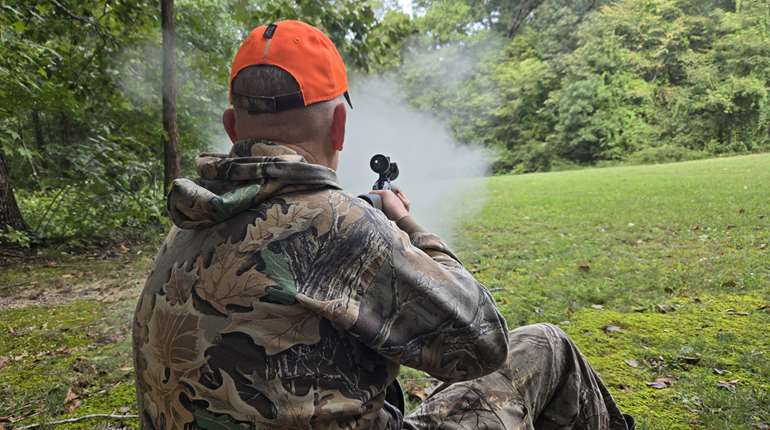
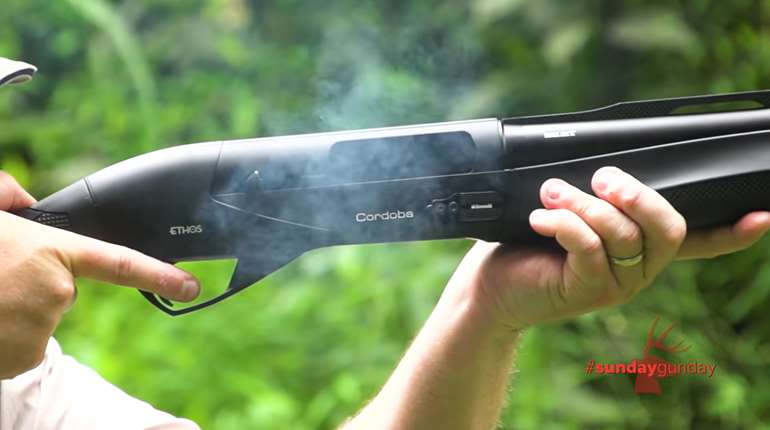
Consider that shooting consistent groups with a slug-shooting shotgun is problematic, to say the least. The slug is in the barrel so long that the recoil event is well established before the slug exits the barrel. That attendant barrel movement, and the various other harmonics involved while the shotgun recoils a half-inch, assures that the muzzle is not be pointed in the exact same place when the slug exits that it was at ignition.
To overcome the vibration when shooting a slug gun from a bench, the shooter must grip the forearm firmly and draw it down and rearward while drawing the stock solidly back into the shoulder. Allowing the barrel to ride freely is a prescription for inconsistent slug groups.
The 220 arrived with a 100-yard test target that showed a 1.3-inch, three-shot group with Remington Accu-Tip slugs. Imagine my glee when my first three 100-yard groups with the out-of-the-box 220 and Accu-Tips all measured tighter than the factory’s. The gun printed now-defunct Hastings Laser slugs to roughly the same accuracy and digested Federal’s 3-inch Barnes Tipped Expanders with groups that were only slightly larger. The comparison was so close, in fact, that on any given day—or with another shooter—any of the three slug designs might have slightly out-shot the others in this gun.
As for long-range accuracy, the Hastings and Barnes slugs grouped 3 inches at 180 yards (the limit of my outdoor range) while the Accu-Tips and SSTs stayed inside 4 inches. In three range sessions and over 100 rounds, the Savage 220 proved more than capable.
All in all, I’m employing only minor license when referring to the Savage 220 as the most accurate production slug gun ever built.
Specs:
413-642-4262, savagearms.com
Type: bolt-action shotgun
Gauge: 20
Barrel: 22", fully rifled barrel; 1:24" twist
Trigger: Accu-Trigger; adjustable pull weight
Magazine: detachable box; 2-shot capacity
Sights: none; Picatinny scope rail
Safety: tang-mounted
Stock: synthetic; LOP—135/8"; (youth version—125/8")
Overall length: 43.75"; youth version—42.75"
Weight: 6 lbs., 12 ozs.
Metal finish: blued
MSRP: $519 blued; $572 Realtree camo stock; $519 youth version