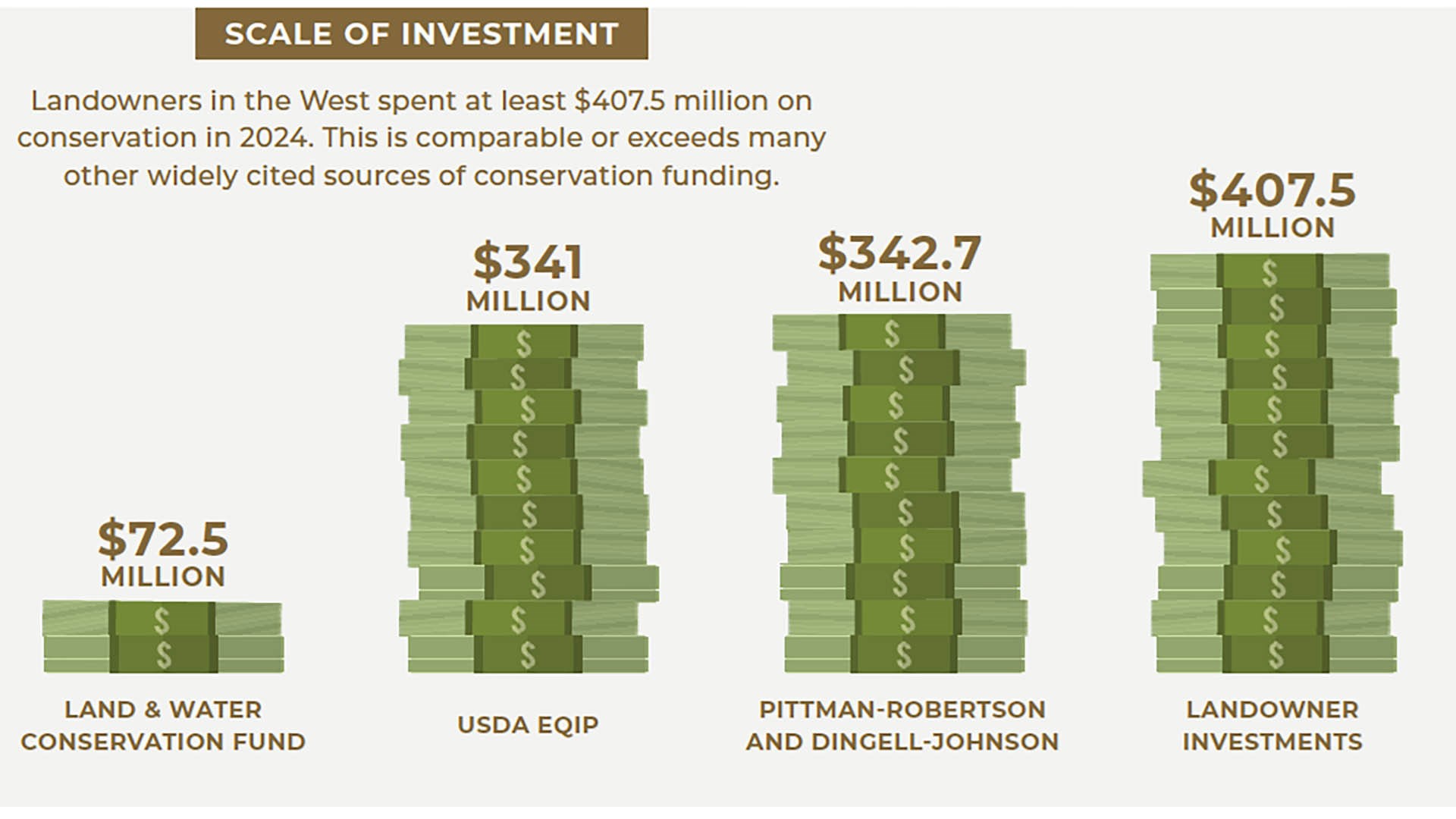
Private lands play a central role in the well-being of people and wildlife throughout the West, but the economic pressure increases each year. A new, groundbreaking report sheds light on the efforts and investments landowners continue to make, despite that challenge, to conserve and steward remaining intact lands and natural resources. Collectively, private landowners invested at least $407.5 million out-of-pocket in conservation practices in 2024 alone.
The survey, commissioned by Western Landowners Alliance (WLA) and conducted by Southwick Associates, gathered data from 649 landowners who own 500 acres or more. Based on this data, the report estimates average conservation investments across 11 western states. Spending included activities across the landscape from forestry and rangeland management to riparian restoration and wildlife reintroductions.
The report also highlights the scale of private stewardship relative to major public funding streams. Across the same 11 states in 2024, landowner investment outpaced the $342.7 million in contributions from firearm and fishing equipment taxes earmarked for state wildlife agencies. It also topped the U.S. Department of Agriculture’s cost-share for environmental quality program (called EQIP), which spent $341 million.
“Most people don’t realize it, but private landowners are pivotal in conserving the lands and natural resources of the American West,” said Lesli Allison, CEO of Western Landowners Alliance. “Their investments generate major public benefits that extend far beyond their fencelines, from healthy soils and clean water to fish and wildlife. Understanding landowner contributions, motivations and challenges can enable us to better partner with them in conserving the lands and habitats on which both people and wildlife depend.”
In addition to out-of-pocket investments, the survey also found that landowners passed up significant economic opportunity in favor of conservation in 2024. Fifty-nine percent of respondents intentionally gave up income-generating opportunities to benefit conservation. Common forgone opportunities included agricultural expansion, residential or commercial development, and recreation or access-based income. Many of those opportunities would have generated less than $50,000, but one in five exceeded $1 million.
“It’s time to be honest about how much landowners give to the land every day,” said Shaleas Harrison, policy manager for Western Landowners Alliance. “This stewardship is something to be celebrated and something to be proud of. Opportunity costs are rarely counted when people consider the cost of conservation in America. This report shows that we can’t afford to overlook the daily decisions of private landowners if we want to address land conversion, habitat loss and struggling rural communities.”
“The Scale of Landowner Investments in Conservation Across the American West” report quantifies private conservation spending across Arizona, California, Colorado, Idaho, Montana, Nevada, New Mexico, Oregon, Utah, Washington and Wyoming among landowners with holdings of 500+ acres.