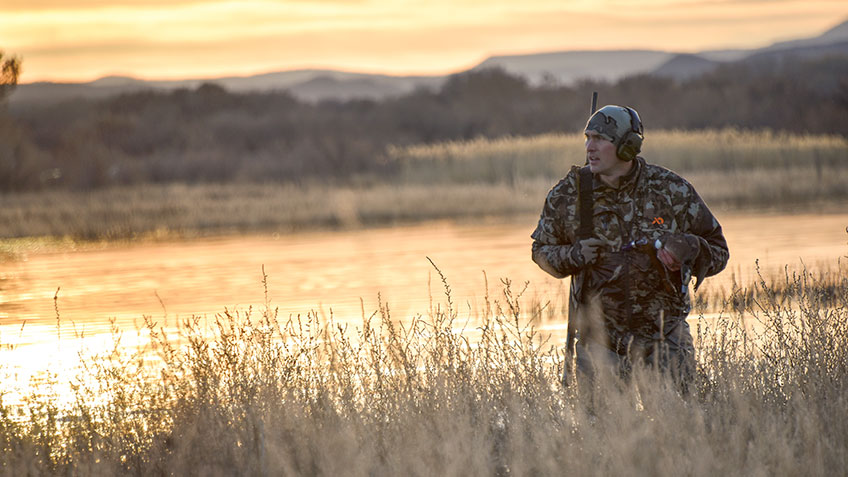
Had our roles been reversed, Karl Malcolm would have wondered what kind of clumsy, impatient, foul-mouthed lunatic he invited to hunt ducks on a crisp December morning in the marshy backwaters of the Rio Grande’s river basin.
But Malcolm is none of those things, so he simply smirked in embarrassment when the shotgun’s magazine spring and retaining cap from his wife’s 20-gauge splashed into the muddy water in the pre-dawn blackness. Seconds later he smiled and added, “Well, now I’m hunting with a single-shot.”
Malcolm had loaned me his pet 12-gauge autoloader, and grabbed Shoshana’s youth-sized pump-action shotgun when we left their home two hours earlier at 3 a.m. When he later discovered her gun’s magazine wasn’t plugged to limit its capacity to two shells, he shrugged, grabbed a salt-cedar branch, measured two-plus shotgun-shell lengths and broke off a plug.
Everything went fine until the wood wedged into the spring’s retaining cap, freeing the coiled steel when Malcolm tried tweaking the fit. The resulting mortar launch sent both parts into the dark sky and then the waters 25 feet beyond. And that’s where they’ll remain forever—or at least until a drought or upriver dams temporarily close the spigot on the river’s wetlands.
A Southwestern Surprise
Hunting ducks had been the furthest thing from my mind when I called Malcolm days before leaving cell-phone range for a late-season elk hunt in northern Arizona. Malcolm is a wildlife biologist with the U.S. Forest Service in Albuquerque. We’ve been friends since his days as a doctoral student at the University of Wisconsin-Madison, and promised to rendezvous when I started home from elk hunting.
“If you can stay a day or two, I’ll show you some duck hunting you’d never expect in the Southwest,” Malcolm said. Then he added the clincher: “New Mexico’s rivers and wetlands are great for duck hunting. That might be news to you, but Aldo Leopold knew all about it when he worked and hunted here over 100 years ago.”
Leopold, of course, is widely recognized as North America’s father of wildlife management, and arguably the 20th century’s most influential author and philosopher on conservation. His fame springs largely from his legendary book A Sand County Almanac, which was published after his death in 1948. He also wrote the seminal book Game Management in 1933, and spent his final 15 years leading the University of Wisconsin’s “game-management” department. Leopold’s school evolved into UW-Madison’s Department of Wildlife Ecology, which is where Malcolm earned his Ph.D. in 2011.
Malcolm and other scholars who study Leopold believe his time along the Rio Grande River and its tributaries helped shaped his belief that ecosystems are best served by diverse inhabitants and habitats, including people who respect and protect those communities’ wild complexities. As Leopold later wrote in A Sand County Almanac: “A thing is right when it tends to preserve the integrity, stability, and beauty of the biotic community. It is wrong when it tends otherwise.”
A Principled Biologist
Leopold expressed those beliefs in countless deeds throughout his nearly four-decade career. Among his early accomplishments was helping establish the Gila Wilderness near Silver City in southwestern New Mexico, which was the nation’s first proclaimed wilderness area. As he later wrote: “I am glad I shall never be young without wild country to be young in. Of what avail are 40 freedoms without a blank spot on the map?”
But Leopold also believed humans need connections to nature even inside major cities. That’s why he helped found the Albuquerque Wildlife Federation, served as secretary on Albuquerque’s Chamber of Commerce and advocated for responsible growth in Albuquerque itself. He helped lead efforts to create nearby gems such as the Rio Grande Valley State Park, Rio Grande Zoological Park, Albuquerque Botanical Gardens, Rio Grande Nature Center State Park and Middle Rio Grande Conservancy District.
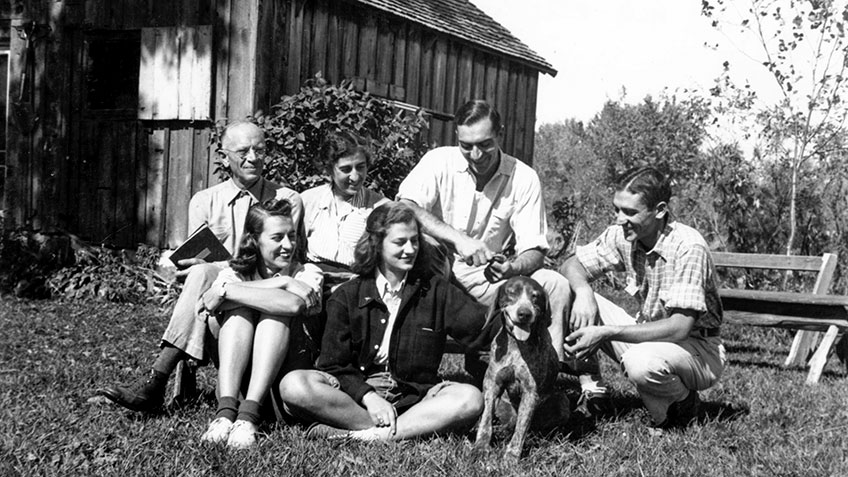
Leopold also realized the importance of protecting the one natural resource routinely in short supply across the region. As Cary Weiner at New Mexico’s Museum of Natural History and Science recently wrote: “In the early 1900s, while most people fought for their right to water, Aldo Leopold fought for the river’s right to water.”
Duck hunting helped connect Leopold to the Rio Grande’s channel and vast marshes and waterfowl habitats, from New Mexico’s northern border with Colorado to its southern border with Texas. Leopold was just as interested with the wildlife and habitats of the Rio Grande’s tributaries and other New Mexico rivers, including the Rio Chama, San Juan, Pecos, Canadian and more.
Duck Hunting Data
When he wasn’t studying how grazing livestock triggered soil erosion along New Mexico’s rivers, Leopold was using data from his river-bottom hunts to note seasonal changes in duck weights and plumage. In addition, he documented the migration patterns of duck species by sex and age from October through January.
He didn’t stop there. He also led efforts to protect unique waterfowl habitats such as “Stinking Lake,” which was later renamed Burford Lake. This is New Mexico’s largest natural lake, and it’s home to one of the state’s most noteworthy wetlands. Leopold considered this alkaline lake and its surrounding marshes to be the “greatest natural wonder” in New Mexico. At least 10 duck species and 30 water-bird species breed in this complex and three nearby smaller lakes on the Jicarilla Apache reservation. It’s also a vital summer molting area for the region’s ducks.
Leopold wrote: “Before he departs for the happy hunting grounds, every man whose heart thumps at the sound of whistling wings and quacking mallards should go see Stinking Lake. He will find nothing like it, either this side or the other side of the Great Beyond. But he should resolve in advance neither to talk nor write of what he sees. St. Peter does not smile on digressions, even though they be duck stories.”
Unlike most scientists of any era, Leopold described his findings with poetic power. He noted, for example, that the plains bordering New Mexico’s rivers and tributaries were still green at times, but not their natural shade of green.
“It is the kind of green which could deceive only a tourist,” Leopold wrote. “It is not the greenness of grass, it is the greenness of tumbleweeds and snakeweed and pinque—worthless substitutes which a denuded nature has invoked to cover her nakedness.”
Leopold carefully documented the proof of such change in his research papers, realizing that most people don’t notice such things and still others deny them. Noting agriculture’s growing impacts on Southwestern habitats, Leopold wrote, “[People] persist in believing either that abnormal erosion was always there, or that it is somehow an act of God instead of an act of goats, sheep and cows.”
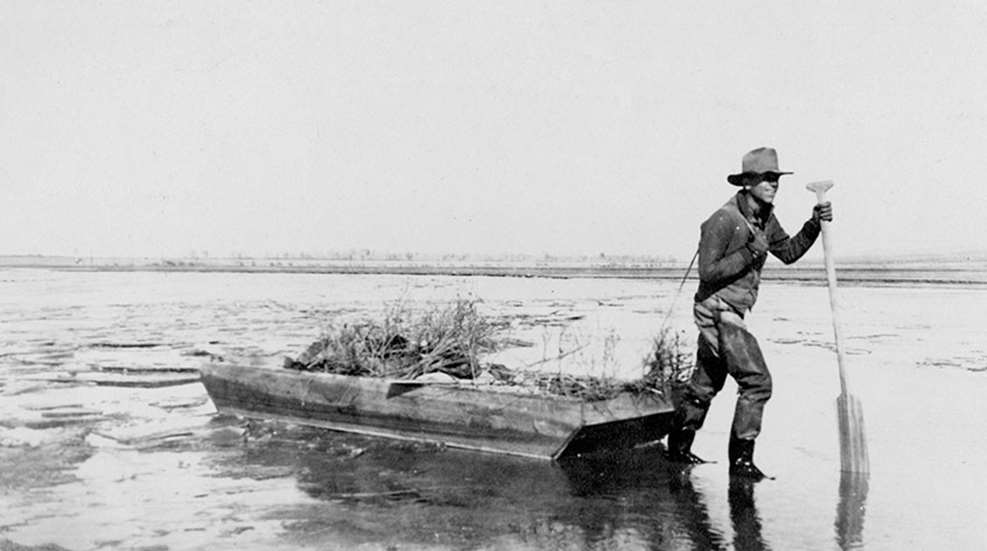
Leopold wrote such observations while working from his U.S. Forest Service office in Albuquerque, but his thoughts often took root while hunting ducks in New Mexico’s marshes and lowlands. The legendary conservationist looks young and jaunty in a 1918 photo that shows a 32-year-old Leopold pulling his homemade duck-hunting boat through broken ice and ankle-deep water in a marsh that waterfowlers still hunt today.
That particular photo shows Leopold with a tow rope over his right shoulder and a canoe paddle in his left hand, probing the marsh’s silty bottoms. To picture his boat, “The Binnacle Bat,” envision a modern ice-fishing sled made of black plastic, or a big trough like those bricklayers use for hand-mixing cement. With its flat bottom and rectangular shape, The Binnacle Bat is neither sleek nor graceful. It’s actually more barge than boat, but no one names or christens barges, do they?
Hunting in Leopold’s Shadow
The farther I followed Malcolm into that New Mexico marsh in early December 2017, the better I understood Leopold’s boat. The water’s depth during our half-mile hike in chest waders varied from my ankles to lower knees, but was slightly lower for Malcolm, who stands a half-foot taller than me at 6 feet, 2 inches.
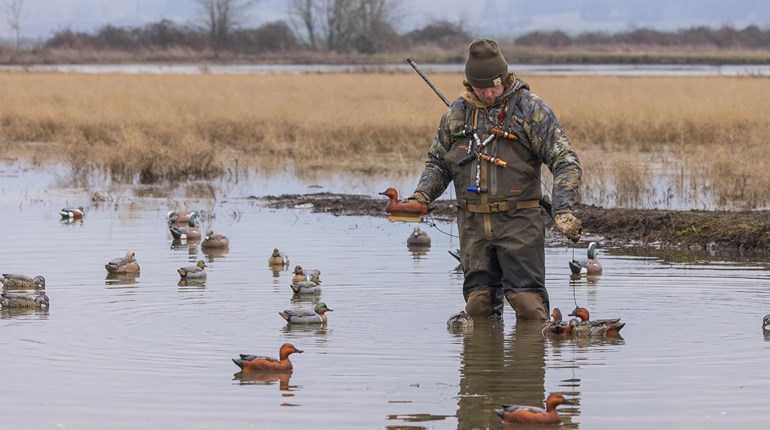
Wide, flat-bottomed boats ease the burden of pulling duck-hunting gear to distant hotspots in such shallows. Even so, Malcolm and I carried our gear in backpacks, including a half-dozen decoys we spread after reaching our site an hour before shooting light.
Like Leopold, Malcolm loves duck hunting. And like Leopold 100 years before, Malcolm moved to New Mexico for a U.S. Forest Service job in late 2011. Within two years he discovered duck hunting on and along New Mexico’s rivers, lakes and reservoirs was better than anything he enjoyed near his former home near the Wisconsin River in that state’s southwestern corner.
Malcolm whispered all sorts of Leopold-inspired history and insights as we waited for shooting light, pausing often to blow his calls and track wing beats as invisible ducks zipped overhead in the darkness. Did I know, for example, that Leopold fell in love not far from here, and that his wife, Estella, was from the prominent Luna-Otero family of Santa Fe? Yes, Estella, the daughter of a sheepherding clan, was as close to royalty as one got in New Mexico.
But good ol’ Aldo—an Iowa native and 1909 Yale graduate—landed his first job and his only wife in this faraway state. He then spent roughly the next decade trying to save the region’s native wildlife and habitats, most of which had been foreign to him earlier in life. Chances are, Leopold was as surprised by New Mexico’s wealth of ducks as most waterfowlers remain today. After all, Americans have long been schooled in the storied duck-hunting traditions of Louisiana, the Great Lakes, the Mississippi River corridor, and the Eastern Shore of Virginia and Maryland.
Malcolm assured me I wasn’t the first Midwesterner befuddled by his invitation to hunt ducks. But the more he talked about the region’s waters and natural resources, the more it made sense why so many locals love hunting ducks in New Mexico and its western neighbor, Arizona.
“When you look at the Southwest’s arid landscape, you can’t help but think about water—and when and where you’ll find it,” Malcolm said. “The drier this region gets, the greater the ducks will be concentrated wherever they find water. You’ll find them on the reservoirs, along the rivers and back in the marshes. But wherever you find ducks, you’ll also find duck hunters. It gets pretty crazy out there some weekends.”
When we pulled into one of those marshes that Monday morning, Malcolm said we’d likely hunt from a distant brushy patch of salt-cedar, a now-unwelcome invasive species introduced to the Pecos and Rio Grande river basins during Leopold’s era to help stabilize the Southwest’s streambanks. After Malcolm parked his truck, we gathered our gear and talked with other hunters several minutes, assuring them we’d walk beyond their intended setups.
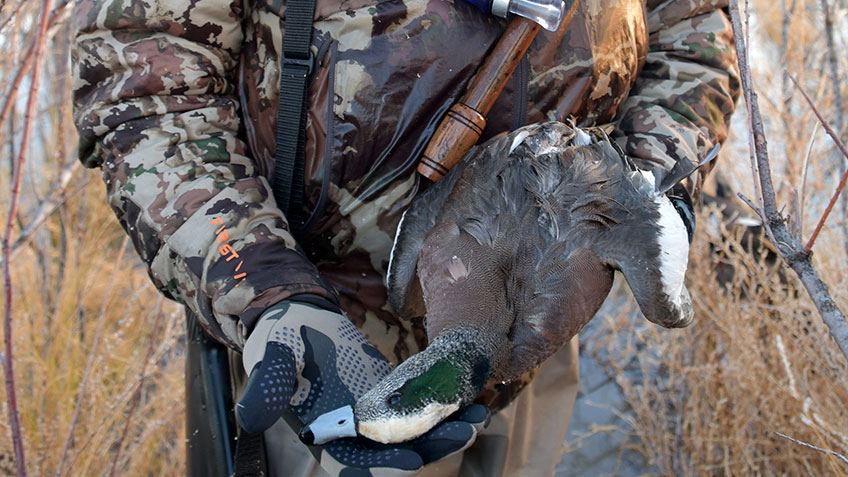
Later, as the minutes ticked down to legal shooting time, Malcolm moved us closer to his decoys, where we quickly fashioned a makeshift blind with brush, branches and plants we pulled from the shallow waters. When shooting light finally arrived, we enjoyed some of the best duck hunting I’ve known, finishing about 9 a.m. with a hen mallard, two drake gadwalls and six wigeons.
Changing, Plucking and Eating
When time expired and work beckoned, we waded back to Malcolm’s truck, where I gutted our ducks and laid them atop ice inside a thermal bag while Malcolm changed into his office garb. His transformation was impressive. One minute he was just another wader-wearing duck hunter with mud in his hair, and now he was just another young urban professional in black shoes with mud in his hair, destined for tardiness at an important meeting.
When he dropped me off at my truck about 90 minutes later, he promised to send a marinade recipe to his wife. “If you’ll clean our ducks back at my place, I’ll grill four of them for dinner when I get home tonight,” he said.
I liked that idea, and promised to pluck our ducks rather than skin and breast them.
“Ah, the gold standard,” Malcolm said. “Plucking takes longer, but plucked ducks taste so much better.”
He then quoted author Steven Rinella, who often paraphrases the late poet and author Jim Harrison, who reportedly said, “To skin a bird is a sin against God and man.” As Rinella wrote: “By which [Harrison] meant, pluck your damn birds, don’t skin them. The skin retains the flavor and adds some much-needed fat. And it looks cool.”
After returning to the Malcolms’ home, I set to plucking in their backyard while Shoshana waited for the new marinade recipe. “You’ll have it soon,” I promised. “Karl said you’ll need to soak the ducks at least four hours before he starts the grill.”
That evening Malcolm grilled duck and Alaska halibut for me, Sho and their daughter, Clara, age 3. We didn’t think to toast Leopold while eating our feast, and drinking our beer and wine, but Malcolm paused to praise my plucking.
Although such skills never bring fame, they’re valuable assets worth sharing with friends.