On May 15, the Rocky Mountain Elk Foundation (RMEF) and natural resource and outdoor recreation survey and research firm Responsive Management (RM), in partnership with the NRA Hunters’ Leadership Forum (HLF), held an inaugural communications workshop near NRA’s Virginia headquarters, called “How to Debate and Communicate Effectively about Hunting.” The sold-out event drew 100 people from state fish and wildlife agencies and non-governmental organizations.
A culmination of a year-long Multistate Conservation Grant study initiating research on communication strategies to increase support for hunting, the workshop was funded through the Wildlife Restoration Program administered by the Association of Fish and Wildlife Agencies. The goal: to institutionalize the way forward to protect hunting, starting with teaching hunters winning debate tactics to communicate hunting’s benefits and build long-term support.
The foundation of the grant study was the NRA HLF-funded study “How to Talk to the American Public about Hunting.” In 2016, the NRA hired RM executive director Mark Damian Duda to conduct a comprehensive national survey and focus group study examining public attitudes toward animal rights, animal welfare and hunting. The hunting community needed to gauge public perceptions to craft messages that resonate with non-hunters. In January 2019, RM worked with the National Shooting Sports Foundation on a similar study, “Americans’ Attitudes toward Hunting, Fishing, Sport Shooting and Trapping,” which underscored the NRA data, documenting America’s overwhelming support of hunting. The workshop factored in a supplemental 2019 NRA HLF-funded RM study revealing more than 80-plus pro- and anti-hunting responses explaining why participants support or do not support hunting. Each was tested in surveys with 15,000 Americans to identify the most effective pro-hunting arguments.
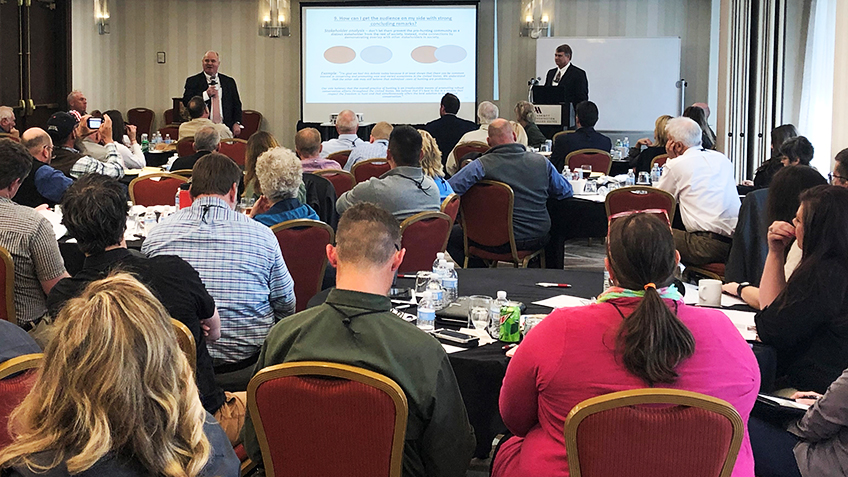
The workshop tapped the services of noted debate strategist Samuel Nelson, director of Cornell University’s debate team. Nelson immediately conveyed the challenge of thinking strategically through mock debates with participants, playing the role of the anti-hunter before sharing how to beat him.
Nelson shared strategies hunters should remember in order to persuade those who would campaign against us. To begin with, it is important to remember that, as Greek philosopher Aristotle said in 350 B.C., truth does not speak for itself. Therefore, to persuade, one needs three things: ethos (credibility), pathos (empathy) and logos (logic). This was reinforced centuries later by philosopher Stephen Toulmin (1922-2009), who said a good argument needs three things: a claim (thesis), a warrant (justification) and data (the proof). American hunters have all three.
The first strategy is the PCAN method. PCAN stands for problem, cause, answer, net benefit. In The Art of Woo: Using Strategic Persuasion to Sell Your Ideas, authors Richard Shell and Mario Moussa promote the PCAN method. To use it, first explain there is a problem and that you understand the cause. The answer is the solution. As for net benefits, Nelson said, “The more reasons you give, the greater chance you will persuade.”
Secondly, remember the IBM method. IBM stands for identify, beat, mean. That is, identify the argument you will respond to, beat your opponent’s best argument and mean it by sharing why your argument is important—IBM. For example, Nelson proposed an argument asking how we can love animals but hunt them: “If we need meat, we have to kill,” he said. But recognize some people have no reference point on this.
Any seminar providing insight on how to effectively debate anti-hunters is welcome news. To save hunting’s future, we hunters must build our communication skills—we must learn to push back against animal-rights extremists and reach those in the middle who have never been exposed to hunting to set the record straight. We already have scientific facts and the truth on our side, yet too often we cannot score points on the merits of legal, regulated hunting because we do not have the strategic thinking and communication skills to win the debate. But the tide is turning, and this seminar proved it.
2. How can I learn to think quickly on my feet? Assess your competence in the specific interaction. If you cannot give a response, cite the question you want to answer, then answer it. “It’s okay to say ‘the bigger question is’ or ‘here’s what this debate is about,’” said Nelson. And take low-hanging fruit, such as by addressing problems with invasive wild pigs. Explain why your opponent’s frame does not work.
3. How can I structure my best persuasive response to any argumentative attack? Think PCAN or IBM. For example, anti-hunters argue hunting causes accidents. Explain this is not about a harm intrinsic to hunting but rather improper hunting procedures, which hunter education addresses. The perceived disadvantage to hunting is relatively small and is outweighed by hunting’s broader benefits.
4. How can I turn critics’ arguments against them? Use offensive arguments to capture their argument. Try a “link turn” by saying the thing they think we cause, we prevent or what they think we increase we decrease. Or try an “impact turn,” explaining what they think is bad is good.
5. How can I pivot to my strengths? Analyze the audience. Appeal to credible sources such as conservationists Aldo Leopold and U.S. President Theodore Roosevelt or wildlife officials. For example, explain your opponent misunderstands the fact that hunting is intertwined in conservation.
6. How can I stay on point? Do not let opponents change the subject. Explain their other topic is a different debate. Offensive arguments can win you the debate on their own. Nelson says the strongest argument is “I respect your right.” “So say, ‘I respect your choice not to hunt. I’d appreciate it if you’d respect mine,’” he said. Grab moral high ground and invoke the assumption of reciprocity.
7. How can I effectively interact with difficult people? Listen to your opponents, identify their argument and acknowledge their contribution. For example, say, “I appreciate that you care for animals. We agree there, but I think we should apply science, which has proven effective.”
8. How can I improve my critical listening skills? Identify the frames used by opponents, take notes and keep track. Outline the structure of their arguments, marking transitions to distinct arguments.
9. How can I get the audience on my side with strong concluding remarks? Offer competing frames for evaluating the debate and control perception. “They won’t say they don’t want wildlife conservation or freedom,” said Nelson. “They want you to say you just want a head on your wall.”