An online brushfire flared up last November after a Wisconsin TV station reported on a dispute involving a runaway 9-point whitetail. After shooting the deer, an 11-year-old hunter and his dad were trailing it when they heard shots from the neighboring property. There they found the landowner with the dead buck.
Legally it was the neighbor’s kill, but nonetheless a debate ensued, colored by the fact that it was the youngster’s first deer. It came down to a coin flip, which was won by the landowner, an outcome that rankled the dad, who said, “I wish [the landowner] would have done the right thing to begin with. All my son wants is his deer.”
The story went viral and comments streamed in by the hundreds. Surprisingly few antis butted in, and the remarks fell into three general categories: 1) Tough luck for the kid, life lesson learned. 2) Give the boy a break—the landowner sure was a poor sport. 3) The youngster needs better skills, better equipment or both. What hunter hasn’t had well-hit deer run off.
While the need for shooting skill is absolute, is it possible to upgrade the shooting gear deer hunters rely on? I have been told that FAQ No. 1 for ammo makers is for a load that will drop deer in their tracks, and accordingly Winchester product developers conducted extensive R&D that eventually yielded Deer Season XP, the company’s flagship introduction for 2015.
 Focusing on the component that directly impacts the game, Winchester settled on a polymer-tipped bullet as the best way to obtain the accuracy and flat trajectory favored by today’s hunters. To produce the degree of trauma necessary for rapid knockdown, it would have to expand radically upon impact, but not so radically that it would fail to penetrate the vitals. Cost containment was also important, since the company knew the product must be priced competitively with popular loads.
After much trial-and-error, Winchester’s development team under Mike Stock came up with a solution: Enlarge the polymer tip, both in length and diameter. Doing so caused the rapid upset they sought, though to achieve the optimum expansion-penetration ratio, the developers then had to experiment with jacket thickness and tweak the lead alloy used in the bullet’s core.
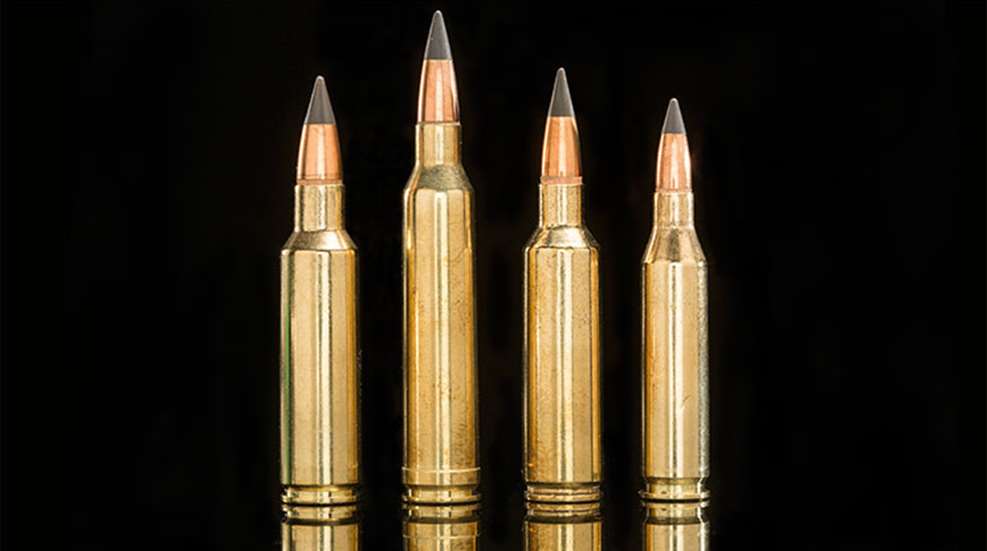
The end result is the Extreme Point (XP), and it’s easy to see the tip is oversized. At the same time, XP jackets taper from very thin at the front to a stout contour at the base. The progressively thicker material checks the initial radical expansion and ensures a solid, substantial core remains to drive through inner tissue.
We first learned about the project in December 2013 during a north Texas whitetail hunt with Winchester marketing director Greg Kosteck, who supplied NRA Publications colleague Tom Rickwalder and me pre-production cartridges topped with bullets bearing an unusually large tip.
The bullets grouped nicely in our rifles, and our threesome proceeded to take three mature bucks, a hog and a coyote. Impressively, all were dropped right where they stood. Upon closer examination, it was evident that the rapid-expansion ploy did indeed cause extreme tissue damage, just as intended. Even so, we recovered just one bullet, the rest completely passing through. My buck, a broken-racked 5x4, was struck on the shoulder at 130 yards, and the .308 Win. 150-grain XP’s exit through the off-side ribcage tore a 3-inch hole, penetration on par with any well-made bullet.
In fact the XP bullet left evidence of extreme tissue destruction and excellent penetration in all of the 20 or so deer and hogs I have either examined firsthand or discussed with fellow hunters shortly thereafter. Winchester has received scores of similar reports from field-testers. Not every animal was dropped in its tracks, but I know of only one instance where the hunter lost sight of his quarry after the shot.
That hunter was me, as Kosteck and I reunited last season in Oklahoma for a second field-test hunt. Also present was NRA’s Chris Sprangers, who quickly dropped a great old-timer buck that had come to feed in a wheat field. Greg scored, too, killing a dandy 10-point. In both cases Deer Season XP met the drop-’em-right-there objective.
My buck luck wasn’t as good, but I did single out a mature doe traveling alone and shot it with the .270 Win. 130-grain XP load from a hilltop blind at 120 yards. The deer hunched, but with one leap vanished behind a wooded point. I expected to find the doe in a heap right there, but no. However, in a few seconds I spied blood, which soon became a trail of red splashes that, incredibly, extended more than 100 yards.
My steeply angled shot had entered behind the shoulder, eviscerated the heart and then punched out between the front legs. The bullet path was about 10 inches long and effectively drained much of the deer’s blood. I was amazed and humbled by this graphic lesson in the unpredictability of terminal ballistics.
I knew beforehand that not every deer shot with the new ammo would tip right over, and folks from Winchester certainly know that, too. First, the hunter has to make a killing shot, and for XP to realize its true potential those shots should be through the heart-lung area where the bullet can exert maximum effect. Even then, there will be exceptions, and in my case it produced a blood trail that made it easy to recover the deer.
What’s more noteworthy than that exception is the consistent track record Deer Season XP has amassed thus far. Additional feedback from American hunters employing this ammo in the 2015 season promises to be fascinating.
Technical Specifications:
• Caliber: .243 Win., .270 Win. (tested), .270 WSM, 7mm Rem. Mag., .308 Win. (tested), .30-06, .300 WSM, .300 Win. Mag.
• Bullet Type: polymer-tipped Extreme Point (XP)
• Bullet Weight (in grs.): 130 (.270 Win.), 150 (.308 Win.)
• Ballistic Coefficient: .450 (.270 Win.), .392 (.308 Win.)
• Muzzle Velocity (in fps): 3060 (.270 Win.), 2820 (.308 Win.)
• Muzzle Energy (in ft.-lbs.): 2702 (.270 Win.), 2648 (.308 Win.)
• MSRP: $20-$22 per box of 20