Everything seems to be going A.I. these days. Web tutorials? A.I. Trouble with a test? Just let A.I. do it. My job? That’ll probably be done by A.I. soon too. Okay, I hope that last one was an exaggeration, but you never know. In the meantime, it now seems A.I. has reached a new frontier—shotguns. Benelli means something quite different with its A.I. moniker, though, and it was in the works long before our current A.I. obsession.
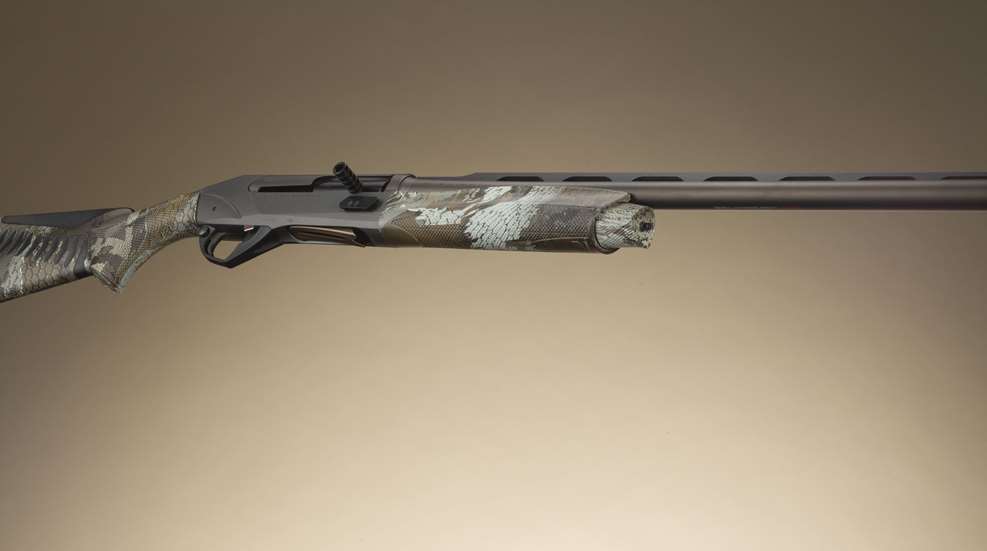
The Benelli Super Black Eagle 3 A.I. BE.S.T. is, put simply, on the fast track to being considered a waterfowling marvel. Standing for Advanced Impact technology, the SBE 3 A.I. shoots its shot with improved downrange results thanks to a very, very proprietary barrel technology that actually assists in energy retention for greater downrange velocity. Sounds crazy, right? Just another marketing gimmick? That’s what I thought too; then I took the gun to Montana’s Bighorn River and had my mind blown.
At its core, Advanced Impact is a brand new ballistic contour from Benelli that is integrated into the bore of its barrels. Not simply an overbore, the contour undulates back and forth throughout the barrel’s length at a specific, algorithmically determined interval, working in tandem with Benelli’s Advanced Impact Crio chokes to enhance and retain shot-column velocity at distance. Far from speculation, Benelli has firm numbers on this. The company has found a 4 percent increase in velocity, and a 6 percent increase in energy a meter beyond the muzzle compared to a standard barrel. It’s important to note that Benelli is not claiming the A.I. barrel increases muzzle velocity, rather it assists in maintaining velocity once the shot leaves the barrel. This is partially thanks to the slipstreaming effect caused by the A.I.’s more uniform shot columns, which further adds increased pattern density. The best part? While all shot types see benefits, it works best with steel. Waterfowlers take note: Benelli’s tests have found this velocity retention adds up to 50 percent more penetration on targets downrange, meaning your cripples likely just became dead ducks.
This is, of course, the most exciting new feature of the SBE 3 A.I., but we’ll get back to that in testing. The rest of the gun is classic SBE 3, with the features waterfowl hunters the world over have come to know and love. With Benelli’s BE.S.T. coating on all metal components, the gun will virtually never corrode, even if you don’t take care of it. Cared for and cleaned properly, it will keep a near perfect finish for years to come—Benelli even backs all BE.S.T. metal components with a 25-year warranty against rust and corrosion.

Meanwhile, the 28-inch Crio System barrel has been frozen to minus 300 degrees Fahrenheit, along with its specially designed, lengthened and also cryogenically frozen A.I. choke tubes. The freezing process relieves the stress caused by hammer forging, and creates an even, slick surface that promotes more uniform patterns, reduces friction and stays cleaner longer.
Moving rearward, the gun’s Inertia Driven System will cycle the gamut of hunting loads, from light 2 3/4-inch shells all the way up to 3 1/2-inch magnums, while still staying cleaner than a gas gun. The bolt’s locking system helps with this as well, as it takes advantage of a spring-activated ball detent to lock the bolt into battery—no need for a heavy slam every shot. It will even defeat accidental bumps and jolts, re-locking the bolt head automatically. Controls are oversized and the trigger guard has been widened for easier manipulation through cold-weather gear.
Finally, Benelli’s ComforTech 3 stock is, potentially, the most easily recognizable part of the shotgun. With its trademark shock-absorbing chevrons running diagonally from the top of the heel to the bottom of the grip, the diagonally split stock acts entirely as a recoil pad ensuring very little force ever reaches your well-padded shoulder. Benelli engineers have even added a Combtech comb pad to soften the impact on the shooter’s cheekbone. The end result of all this tech? A gun meant to shoot soft and well for a long course of fire.
Back to A.I. though. Out in Montana, I watched this gun repeatedly flatten ducks and geese with steel in a single shot, almost all dropping belly up and stone dead. Our party needed probably half the amount of follow-up shots as on a normal hunt. Quite frankly, it hit like tungsten, but at a fraction of the cost. I couldn’t wait to see how it looked on a patterning board back home—I was desperate to see what this magic really looked like up close.
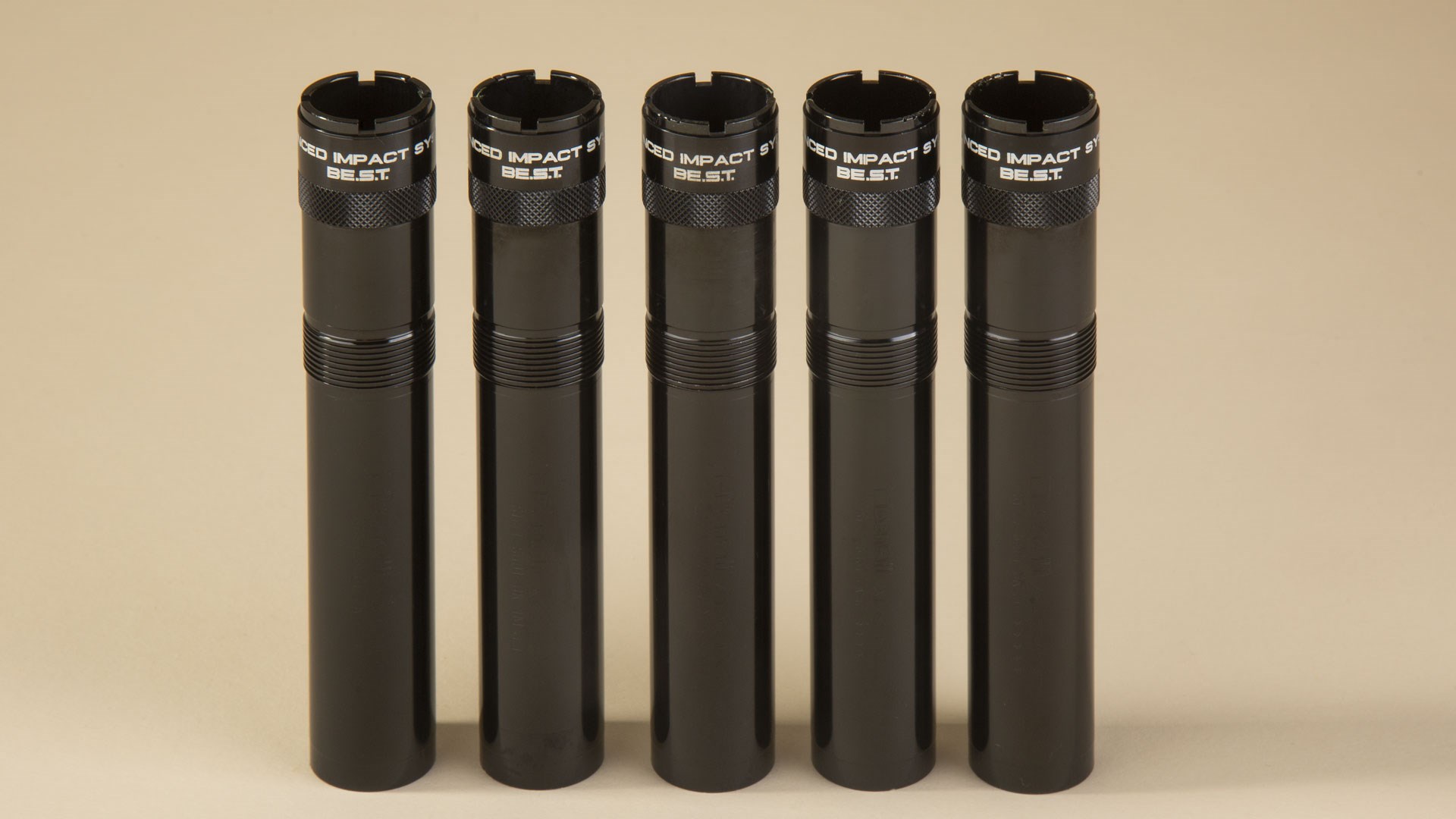
This in mind and gun back in hand (finished in attractively subdued Gore Optifade Timber), I set up patterning paper at 40 yards and grabbed a box of steel Fiocchi Golden Waterfowl 3-inch No. 2’s with an advertised velocity of 1350 fps. After swapping out my I.M. for a modified choke (the general standard for 40-yard patterning) I loaded up and got to work. The results were impressive—the gun kept an average of 93 pellets out of 152 within a 21-inch circle. Expanded to 30 inches, it was 119. That’s an excellent pattern average, but not quite good enough on its own to explain the staggering results we saw from these guns in the field. So, I decided to go a little deeper.
I snagged two blocks of FBI-standard 10 percent ballistics gelatin from Clear Ballistics and grabbed another shotgun. Same gauge, barrel length, chamber length and action type, just without an A.I. barrel. I swapped I.M. chokes into both guns to keep my pattern a little tighter for more impacts, and set the blocks at 30 yards. I shot one with the A.I. gun and the other with my “generic,” 28-inch semi-automatic. Then I measured the rough center of the patterns captured by the gel; as the shot didn’t penetrate past halfway, I was even able to use both sides of each block. The regular shotgun penetrated about 4-inches. The A.I. gun? Roughly 4¾-inches.
That may not sound like much at first, but consider this. First off, 10-percent gel is often used as an analogue for big game, so using it to test a waterfowl load is slight overkill right off the bat. The target area you’re shooting for on waterfowl (head and neck) isn’t even 4-inches thick, and the body is certainly thinner-skinned. Second, ¾-inch more penetration over the standard load represents a roughly 19-percent increase in terminal performance/energy transfer. So don’t let the absolute size of the numbers fool you, the difference is significant. Whatever is going on in these A.I. barrels, they are producing patterns that stay dense and retain energy better over the long haul. The verdict? If you like watching ducks and geese go belly-up after a single shot of steel, check out an SBE 3 A.I. this season. You won’t be disappointed.
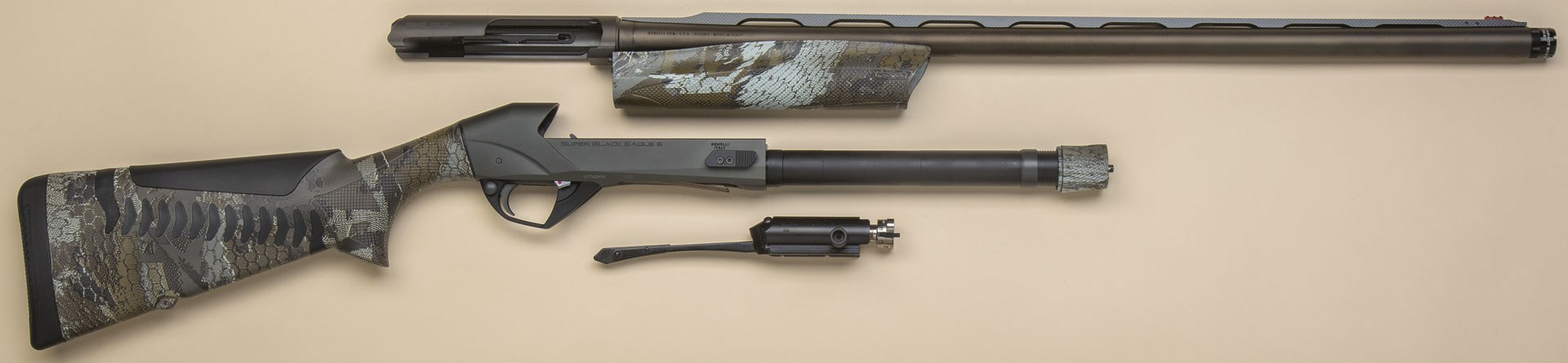
Benelli Super Black Eagle 3 A.I. BE.S.T
- benelliusa.com
- Type: inertia-driven, semi-auto shotgun
- Gauge/Chamber: 12/3½” (tested), 20/3"
- Capacity: 3+1
- Barrel: A.I.; 28"; carbon fiber vent rib; interchangeable choke tubes
- Trigger: 4.5 lbs. pull weight
- Sights: red fiber-optic front sight; drilled and tapped for scope mount
- Safety: cross-bolt
- Stock: ComforTech 3; synthetic; Gore Optifade Timber; LOP 143/8"; drop at heel 21/8"; drop at comb 13/8"
- Metal Finish: Benelli BE.S.T. (Matte Gray)
- Overall Length: 50¼" (with choke installed)
- Weight: 7 lbs.
- Accessories: A.I. choke tubes (F, M, IM, IC, C), choke wrench, stock spacers, drop and cast shims, hard case
- MSRP: $3,199