The reflex, or reflective, sight was invented in 1900 as a better gunsight for aircraft gunners because it didn’t limit field of view or eye relief like telescopes of the day. The sight formed a visual collimator to superimpose a reflected image of a reticle onto a curved lens in the shooter’s line of sight. Whereas a simple reticle that’s etched or wired onto a lens moves in relation to the target as the shooter’s eye moves, due to the reticle and target being in different focal planes, an image of a reticle that’s reflected stays on target because it appears in the same plane. Translated, parallax is minimized.
In the 1970s the reflex sight as we know it was brought to market by the Swedish firm Aimpoint. It contained a battery-powered, light-emitting diode (LED) that allowed these compact, tubed sights to function in darkness. Its glowing red dot soon became its street name. It didn’t take long for a few competitive handgunners to discover the red-dot sight’s advantages.
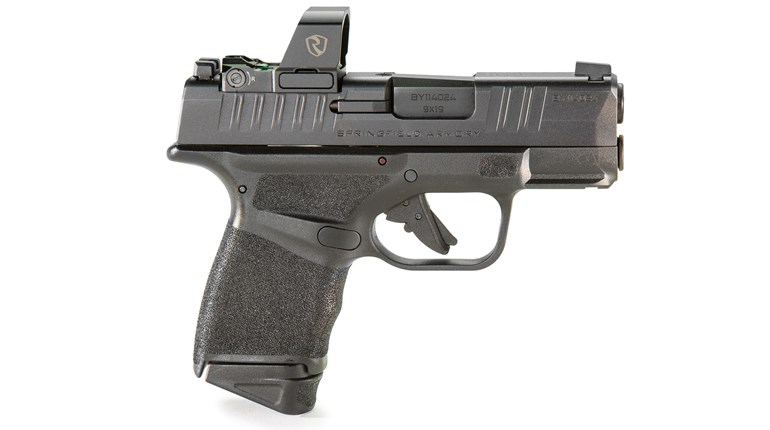
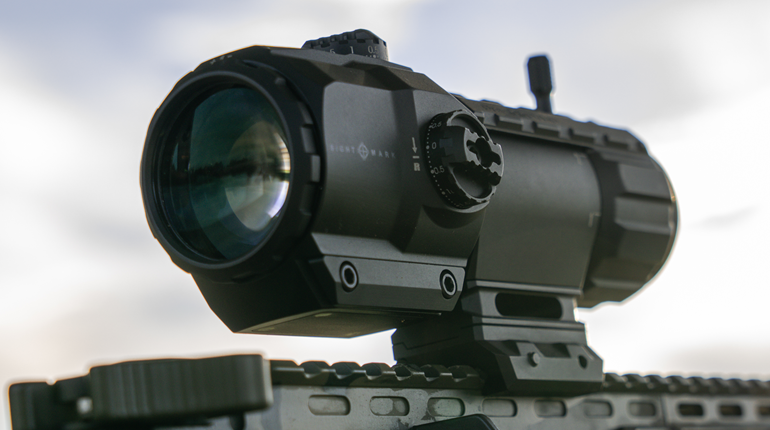
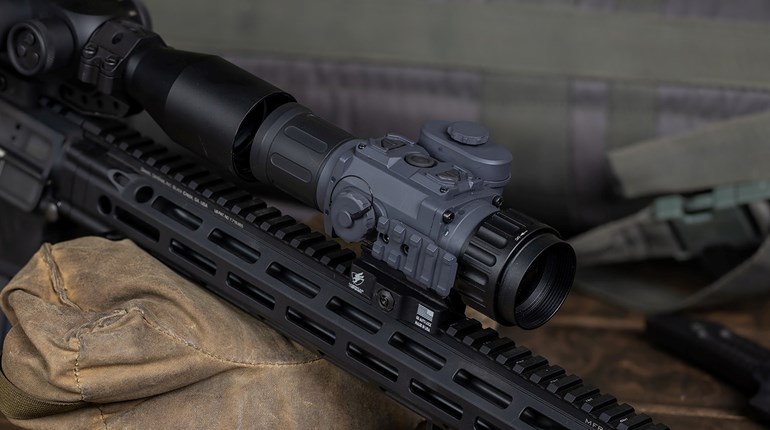
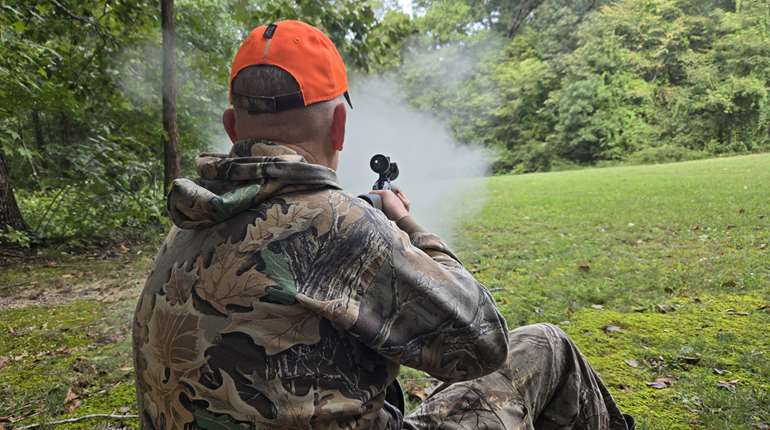
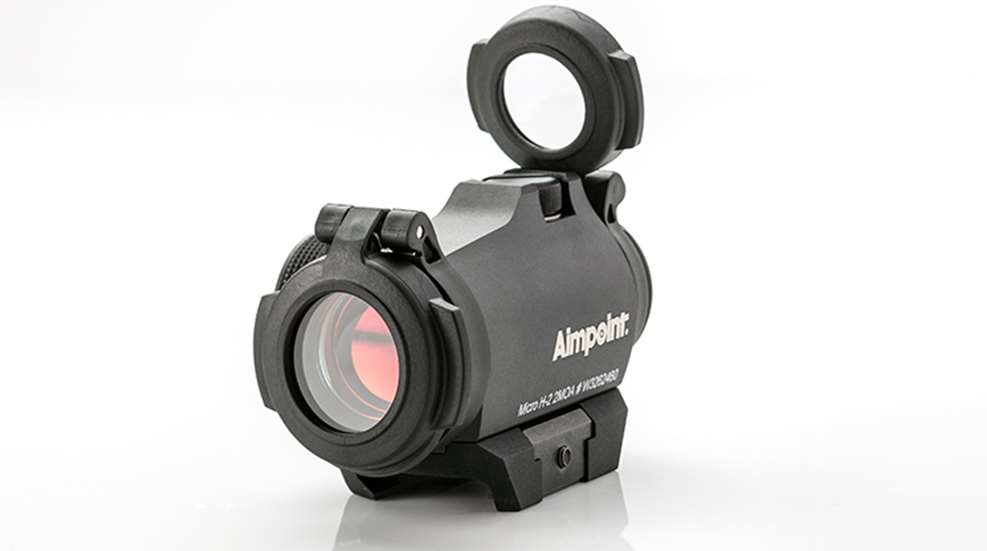
Since then, reflex sights have been ruggedized, miniaturized and placed on handguns, shotguns, machine guns and rifles. The U.S. military believes they make soldiers more accurate with less training, so it buys thousands of them. Finally, hunters are coming around to the merits of red-dots, especially for close-range, running game, or low-light scenarios. Aimpoint has responded with its Micro H-2.
The H-2 is improved from Aimpoint’s H-1 model in that its machined aluminum body includes ramps that protect the elevation adjustment turret from snagging. In addition, transparent lens caps snap over both lenses to seal out dust and moisture. Internally, the H-2’s optical clarity is enhanced with new lenses and lens coatings. This is difficult to appreciate until you attempt to aim into a setting sun, but the improvement can’t be overstressed.
The H-2’s adjustment system features .5-inch clicks that really do click. I tested by “shooting the square” and found them true and repeatable. Because the dials are so small, however, Aimpoint integrated an adjustment tool into the windage turret cap. Don’t lose it! And that’s my only complaint. I wish Aimpoint would devise a method of finger adjustments.
The H-2 has 12 daylight settings and an off setting marked on the rheostat dial located on its right side. I learned to go a couple settings brighter than what’s perfect at the moment, so that if the day becomes brighter, I’ll still be able to shoot.
I took a bolt-action rifle equipped with the Micro H-2 to Bulgaria for driven wild boars in thick cover. This is exactly the type of hunting Aimpoint engineers had in mind when they designed the sight. Here’s what I found.
At 4.6 ounces, the H-2 is as close as optics come to the handiness of open sights while lending all the advantages of a red-dot. Namely, I didn’t have to focus on the front sight, align it in the rear notch and then place them both on the target. Instead, when a boar shot out of the timber going 20 mph I unconsciously pasted the 2 MOA red dot on his black hide and pulled the trigger. He skidded to a dead stop.
This one-focal plane trait is especially notable for aging hunters who suffer from presbyopia, or the inability to focus on close objects. So while the sight is perfect for running game, it’s also great for turkey guns, squirrel guns and any other relatively short-range work where the bulk and magnification of a riflescope is not necessary but a single, easy-to-aim dot is. The H-2 took nothing away from my Merkel’s balance and only impeded my vision minimally. Field of view is unlimited due to zero magnification, and this proved invaluable on running game.
Before experimenting with the H-2, I was skeptical of the use of a battery-powered optic for dangerous game. My fears were alleviated not after I read that its CR2032 battery would last for five years, but instead when I turned on the unit and it stayed on for the entire duration of my evaluation period—and hunt. It’s still on. Through advances in LEDs and electrical engineering it calls Advanced Circuitry Efficiency Technology, Aimpoint has done a remarkable job of remedying its product’s biggest drawback: battery life.
My other concern was durability. I’m tough on gear, especially as a reviewer for this magazine. My firearm is a tool for hunting, and during the heat of the hunt—or even the ride there—my perpetually uncased rifle often gets muddy, bloody and battered like a football helmet. Still, I expect it to work.
I can expect the H-2 to work, too. The unit is waterproof to 15 feet. I dropped mine in a swimming pool for an hour while turned on. It’s still going. Then I actually bounced it on concrete. It’s one of the toughest optics available, period.
I admit that I haven’t been a huge fan of red-dots for hunting due to my concerns about battery life and durability. But Aimpoint has addressed them, and now for running game, for hunters with aging eyes, and for guns that don’t need magnified optics, the Micro H-2 is the answer.
Technical Specifications:
• Type: reflex sight
• Magnification: 1X
• Objective Lens Diameter: 18mm
• Eye Relief: unlimited
• Field of View @ 100 Yds: unlimited
• Reticle: illuminated, 2-MOA dot; 12 brightness settings; CR2032 lithium battery power source
• Adjustments: .5"
• Coatings: fully multi-coated
• Dimensions: length 3.1", width 1.6", height 1.9", weight 4.6 ozs.
• Construction: anodized aluminum body; waterproof; side illumination intensity rheostat; integral base for Weaver- and Picatinny-style rails
• Accessories: transparent, flip-up lens covers
• MSRP: $780