The AR-15 style rifle is well suited to hunting predators, except for the cartridge it typically shoots. Predator calling for most of us means coyotes, and the cold, hard truth is I have seen the .223 Remington fail more than any other cartridge when hunting coyotes. Far too many of them get up after being shot and run away. When using the AR-15, that problem is compounded due to the velocity loss from a shorter barrel.
I have long advocated for a .22-caliber cartridge that produces a higher velocity in the AR-15. Perhaps we now have the cartridge I and other coyote hunters have been waiting for.
The 22 Nosler was announced at this year’s SHOT Show and was pretty much the big buzz of the event. It takes the AR-15 platform to the next level of performance with .22-caliber centerfire cartridges, and already several companies have jumped on board to build guns or uppers.
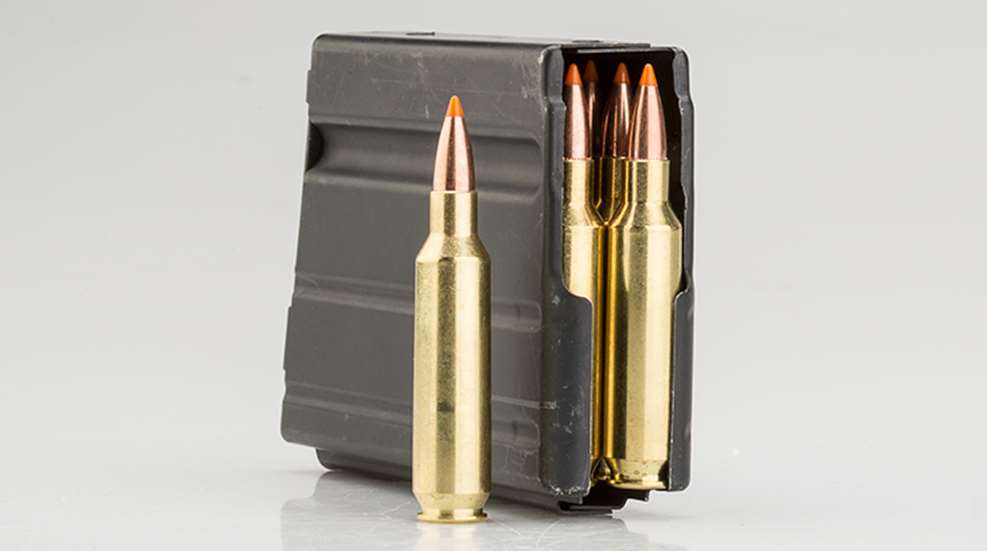
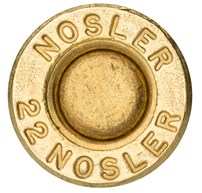 The key attribute of the 22 Nosler is that it’s compatible with AR-15 rifles chambered for .223 Rem. or 5.56 NATO. All that’s required is a new upper or replacement barrel chambered in 22 Nosler, along with a magazine designed for the 6.8mm Rem. SPC. The same bolt used for the .223/5.56 works for the .22 Nosler. While the 22 Nosler case is larger in diameter than the .223 Rem. case, hence the need for a different magazine, the case head is rebated so it fits bolts designed for standard .378-inch case heads.
I measured the water capacity of fired .223 Rem. and 22 Nosler cases. The .223 case held 30.7 grains of water to the top of the neck. The 22 Nosler held 36.8. That’s an increase in capacity of 19.87 percent. Nosler’s comparisons using sized cases showed a 20.44 percent increase in powder capacity with 55-grain Ballistic Tip bullets seated to SAAMI overall cartridge length specifications.
The 22 Nosler case body measures .420 inch in diameter where it meets the case head, compared to the .223 Rem. at .3739 inch. (The 22 Nosler body diameter is pretty much the same as that of the 6.8mm SPC case, although Nosler says there is no parent case.) At the shoulder the .22 Nosler measures .400 inch in diameter and the .223 Rem. is .3542 inch. The 22 Nosler has a 30-degree shoulder while the .223 Rem. has a 23-degree shoulder.
The case lengths of the two cartridges are the same at 1.760 inches. However, the length from the base to the point on the shoulder that determines the minimum headspace dimension is shorter for the 22 Nosler. This is to prevent a .223 Rem. cartridge from chambering in a 22 Nosler rifle. Nosler’s engineers had to sacrifice some performance to idiot-proof the guns. Both cartridges are commercially loaded for a SAAMI maximum average pressure of 55,000 psi.
Nosler currently offers three factory loads for the 22 Nosler. The first is a 55-grain Ballistic Tip Varmint with an advertised muzzle velocity of 3350 fps from an 18-inch barrel. My chronograph measurement on a cold day was 3257 fps at the muzzle from the 18-inch barrel of the rifle Nosler sent for testing. Based on Nosler’s data, that load generates 1,370 ft.-lbs. of energy at the muzzle. With a 200-yard zero the bullet is 1.2 inches high at 100 yards. At 300 yards it’s 6.4 inches low, and at 400 yards it’s 19.4 inches low.
The 77-grain Custom Competition load has an advertised muzzle velocity of 2950 fps. My chronograph measured it at 2831 fps. This load generates 1,488 ft.-lbs. of muzzle energy. With a 200-yard zero the bullet is 1.7 inches high at 100 yards, 7.7 inches low at 300 yards and 22.9 inches low at 400 yards. As this is designed as a long-range load, the Nosler data says it is 47.4 inches low at 500 yards and 83.8 inches low at 600 yards, where it still has 1519 fps of velocity remaining and retains 395 ft.-lbs. of energy.
I went to my database gathered from years of testing ammo, and found that 55-grain .223 Rem. factory loads fired from rifles with 18-inch barrels had an average muzzle velocity of 2992 fps on my chronograph. Factory .223 Rem. loads with 77-grain bullets averaged 2555 fps from 18-inch barrels. With my chronograph measurements of ammo from 18-inch barrels, the 22 Nosler shows a 265 fps increase in muzzle velocity over 55-grain .223 Rem. factory loads and a 276 fps increase over 77-grain loads. Granted, this is a bit of an apples-to-oranges comparison, as it’s based on brands of ammo other than Nosler, but it shows that the 22 Nosler is considerably faster than the .223 Rem.
Laboratory-generated velocity data for both cartridges is from a SAAMI-standard 24-inch test barrel. The 55-grain Ballistic Tip Varmint 22 Nosler load has a muzzle velocity of 3500 fps from this longer barrel, a 300 fps increase over the .223 Rem. load with the same bullet, which is significant. The 77-grain Custom Competition 22 Nosler load generates 3100 fps from a test barrel, an even more substantial gain of 350 fps over the .223 Rem. with the same bullet.
Nosler also lists a 62-grain Varmageddon load for the 22 Nosler with a muzzle velocity of 3100 fps from an 18-inch barrel, but it was not available for testing in time to meet my deadline. The company already has reloading data for other Nosler bullets on its website, and brass for sale. Most of the die makers are on board, and I got mine from Redding without any waiting.
In the rifle Nosler sent for testing, the 55-grain Ballistic Tip Varmint load produced three-shot groups at 100 yards that averaged .51 inch. Groups with the 77-grain Custom Competition load from the same rifle averaged .68 inch. Clearly these are two accurate loads.
While I see the 22 Nosler as primarily a predator and varmint round, no doubt this cartridge will also be used for deer and hogs. I am not an advocate of any .22-caliber centerfire for hunting big game, but the increase in power is a good thing. For varmint shooters, this cartridge will carry more energy with less bullet drop to long-range prairie dogs and groundhogs.
It was 4 degrees below zero at dawn on March 5 when Bobby Sholan and I got into a big pod of coyotes in northern Vermont. Bobby shot the first one to come to the call with the 22 Nosler using the 55-grain Ballistic Tip Varmint load. The coyote, a big male, simply dropped. Is one coyote a definitive statement that the 22 Nosler is a great predator cartridge? Of course not, but it’s a hell of a start.
Technical Specifications
• Caliber: .22
• Bullet: 55-gr. Ballistic Tip Varmint (tested), 62-gr. Varmageddon, 77-gr. Custom Competition (tested)
• Ballistic Coefficient: .267 (55 gr.), .340 (77 gr.)
• Muzzle Velocity (advertised fps w/18" barrel): 3350 (55 gr.), 2950 (77 gr.)
• Muzzle Energy (advertised ft.-lbs.): 1,370 (55 gr.), 1,488 (77 gr.)
• MSRP: $29.95 per 20-rnd. box