It's China's fault that handloading is making a big comeback. The cost of metals is soaring and economists say it's because of demand created by the military and economic build-up in China. No matter what the reason, the cost of ammo has gone up fast and high. So a lot of shooters are handloading to save money. But they are also discovering that the rewards reach far beyond just economics.
Competitive shooters, who consume thousands of rounds of ammo every year, long ago turned to progressive loading machines. One of the leaders in that field is Dillon Precision. Recently Dillon introduced a low-cost, progressive handloading machine designed for hunters, the Model BL 550.
The company's best-selling machine is the RL 550. I've had one for years that I use to load handgun ammo for competition, and it has produced many thousands of rounds without a single problem. The new Dillon BL 550 is the stripped-down version of this machine without the auto prime or auto powder measure. Of course, that cuts the cost by about 40 percent. But I also think it makes it better for loading hunting ammo. Until now I never used a progressive machine to load my serious hunting ammo because I feel it removes me from too much of the process. For hunting ammo I want total hands-on control so I can ensure quality every step of the way. This BL bridges the gap as it allows you to load ammo at a much faster rate than with a single-stage press while maintaining the same "zero tolerance" quality control that a single-stage press allows. But the BL 550 can easily be upgraded to the RL 550 with the purchase of a few parts.
The way a progressive press works is like a production line. You insert an empty case and it is rotated through a series of dies and stations until it comes out the other end as a completed cartridge. If each of those stations contains a cartridge case in the various progressions of becoming a new cartridge, then each stroke of the handle produces a single new cartridge. With a single-stage press, by contrast, you must stroke the handle and operate the press for every individual step of the process. So it may take as many as six strokes to create every single cartridge.
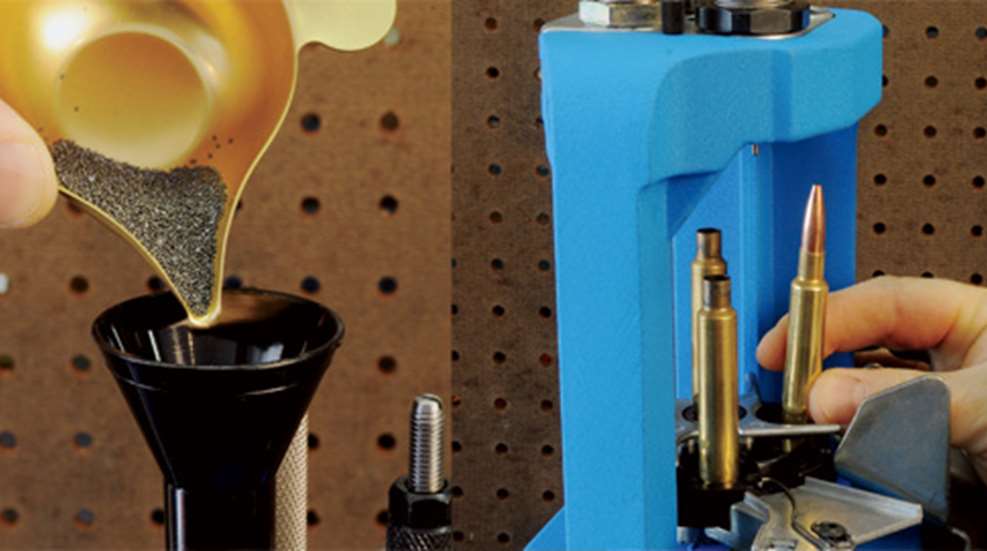
Once the BL 550 press is set up and all the dies are correctly adjusted, loading rifle ammo is easy. The first step is to insert the cleaned, empty, lubricated cartridge case into the shell holder. The first station will resize the case and push out the old primer. You insert a new primer into the holder and, when you lower the ram, the case is re-primed. Then manually advance the shell holder by pushing on the star lever, and the case is positioned at the next stage. Bottleneck cartridges only require two dies, so the next stage is used to charge the case with powder. Here is where this press works best.
I firmly believe in weighing every single powder charge when loading hunting ammo. This is particularly important with extruded, or "stick," powder because the larger kernels do not flow well through an automatic powder dispenser. Most full-blown progressive presses use a powder dispenser. They work very well with ball powders, but don't play well with extruded powders. With any powder, they are not infallible. I often load my competition ammo (when the competition calls for speedy, high-volume shooting) with a moderate powder charge to allow a little margin of error for the powder dispensing. Hunting ammo though, is usually loaded to peak performance, so there is a smaller margin of error for powder weights. Weighing each powder charge is slower, but it ensures safety, performance and accuracy. Weighing each charge is a big part of the control I insist on for hunting ammo.
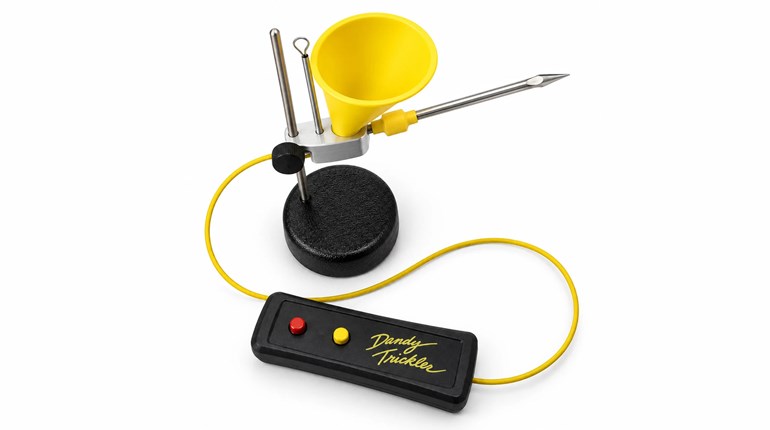
Simply use a bench-mounted powder measure to throw a charge that is slightly under your target weight and put it in the scale's pan. Then use a powder trickler to bring the weight up to the target. Then dump this precise powder charge into the case through the included funnel at station two. Advance the shell holder and the next stage will seat a bullet and complete the cartridge. This leaves one extra stage unused, but you will need it for loading straight-wall cartridges as they require three dies instead of two. Or you can use the Dillon Taper Crimp rifle die to ensure your bullets are locked into the case.
If you have the machine full this is how it would go: Advance the shell holder and place an empty case on it. Put a primer in the priming arm. Charge the case with powder. Place a bullet on top of the case at the seating station. Work the handle, including the priming stroke. Advance the shell holder and a completed case stands at the last station, ready for you to pluck it out. Repeat the process. It's simple, fast and the quality is superb.
The Dillon BL 550 will load any normal length cartridge that uses 7/8-14 reloading dies and it will work with any brand of dies. The interchangeable tool head allows you to switch cartridges quickly and without screwing in dies. The dies stay with the tool head and maintain their adjustment. The same shell holder is used for multiple cartridges; for example, most of the belted magnums use the same shell holder. Everything from .243 Winchester through .35 Whelen uses another shell holder. That includes .30-06, .308, .270 or any other cartridge with the same case head. If you want to load something with a different case head diameter, .223 Rem. for example, simply change the shell plate when you switch the upper tool head. That one works for .204 Ruger, .17 Rem. and other cartridges, too.
The press costs $259.99, without dies or shell holder. Dies are $65.95 and a shell plate is $33.95. Additional tool heads are $20.95.
The market price for a box of .300 Win. Mag. Federal Premium ammo with Barnes bullets runs about $60. You can reload the empty cases for about $23. That's a savings of $37 per box. That means you will pay for your tools after loading 10 boxes of ammo. But besides being economically rewarding, handloading can improve your hunting rifle's performance, and for many people, it's enjoyable.