Q: I would like to learn how to age whitetail deer. How can it be done by examining the teeth?
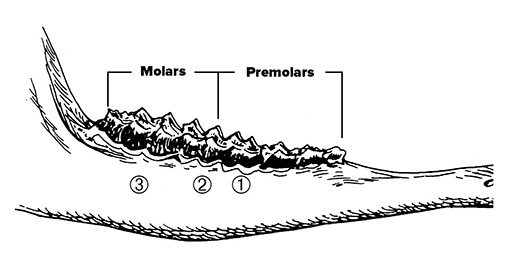
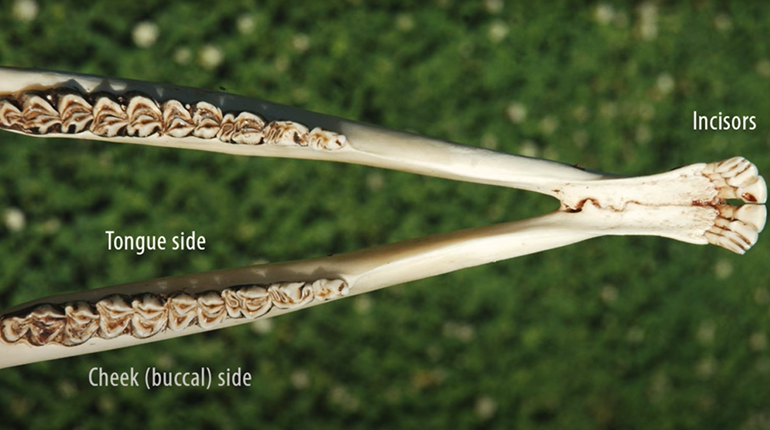
A: By the time a whitetail is 2 years old it should have grown its full complement of permanent teeth. On each lower jawbone this includes the four small teeth at the front of the mouth and six much larger teeth—premolars and molars—at the rear.The premolars and molars give best evidence of age. Up to six or seven months, yearlings will have only one molar; after seven months another will erupt, and the third will appear at about 13 months. At 18 to 19 months, the first set of temporary premolars is replaced by permanent ones. If the premolars are relatively stain-free and worn less than adjacent molars, the deer is likely in the 1½-year-old range. If staining is comparable, wear on the crests of the third molar reveals a 2½- year-old or older animal.As deer reach 3½ and beyond, the teeth's sharp, distinct cusps get ground down, first becoming rounded, then smooth. Also, as a tooth's enamel wears, more and more of the brown inner material, the dentine, is exposed, especially on the inside toward the tongue. The more dentine exposure, the older the deer. On a 3½-year-old, dentine showing on the first molar (1) only will be equal or greater the amount of remaining enamel. At 4½, both the first and the second molars (1) and (2 ) will reveal dentine equal or greater than the enamel, but the last molar (3) still shows as much or more enamel. All three molars on a 5½-year-old exhibit well-worn enamel, and if the center of the first (1) is worn smooth and virtually enamel-free, the deer is 6½ or even older.
It should be noted, however, that the foregoing are general guidelines. Tooth wear will vary by individual, and judging age by this method takes considerable practice and experience. Even then it is not an exact science.