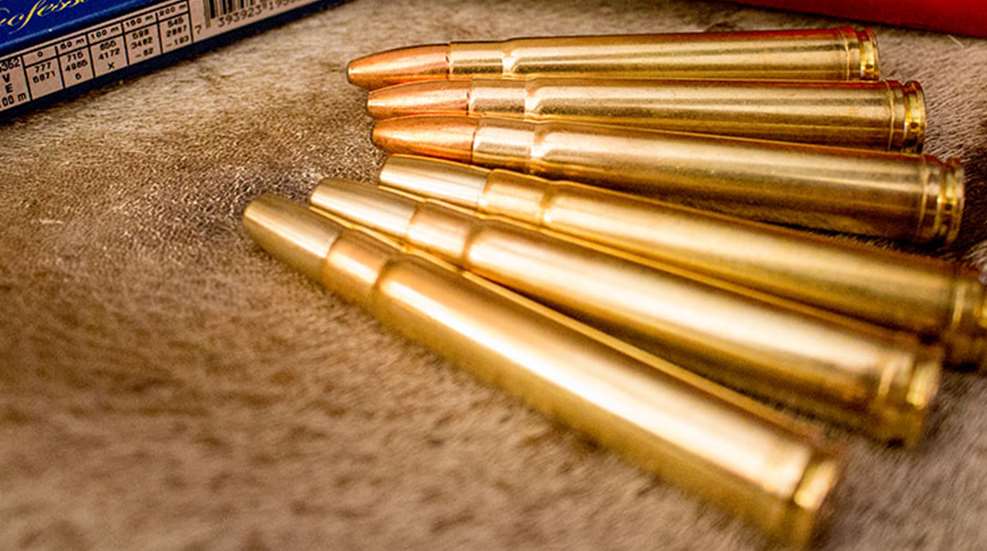
I wonder if the designers at Holland & Holland knew what they had when they released their .375 Belted Rimless Magnum in 1912. It was a volatile time in cartridge development history, with major players like the .30-06 Springfield, the .404 Jeffery, .416 Rigby, .470 Nitro Express and the .318 Westley Richards emerging on the scene within the previous decade. Holland & Holland was working on what the British then called a medium-bore, but would end up being the most useful cartridge ever invented, at least in the opinion of this author.
The .375 H&H—as it’s more commonly known—wasn’t the first cartridge to use that belt of brass for positive headspacing; and earlier H&H development called the Velopex, which used the same diameter bullets, but at a lesser speed. It did, however, go on to become the African standard; it is well known across that continent that when in doubt, you reach for a .375 H&H. That belt solved a couple of problems: one, it allowed for smooth feeding from a box magazine due to the absence of a rim, and two, it allowed the cartridge to use a low-angle shoulder, yet still headspace properly, almost like a rimmed cartridge. A wide case head gave plenty of area for extraction, an important feature in the heat of the tropics.
The original loadings used 235-, 270- and 300-grain bullets, at muzzle velocities of 2,800, 2,650 and 2,500 fps respectively. While the lighter bullets worked perfectly for medium game at a variety of ranges, those 300-grain slugs, with a Sectional Density of 0.305, made for a solid choice for all game, including elephant. Many Professional Hunters have told me that there are few bullets that penetrate as deeply as a 300-grain .375, and the modern developments in bullet technology have done nothing but improve the performance of this classic. John Taylor, in his African Rifles and Cartridges, had nothing but praise for the .375 H&H; in his opinion it was one of the very few ‘universal’ cartridges and I have to agree with him. It will work for the heavyweights, like the elephant, though I personally feel there are better choices, but it is a great cartridge for buffalo on any continent, and absolutely shines as a bear cartridge, regardless of color or species. With the lighter bullets, especially in the spitzer boat tail configuration, it actually makes a decent long range hunting cartridge, giving a trajectory very similar to the .30-’06, with almost twice the horsepower. Modern bullet companies have expanded the range of useful projectiles, with some of the lighter monometals weighing 200 or 210 grains, and some heavier bullets, like Woodleigh’s Weldcore, tipping the scales at 350 grains.
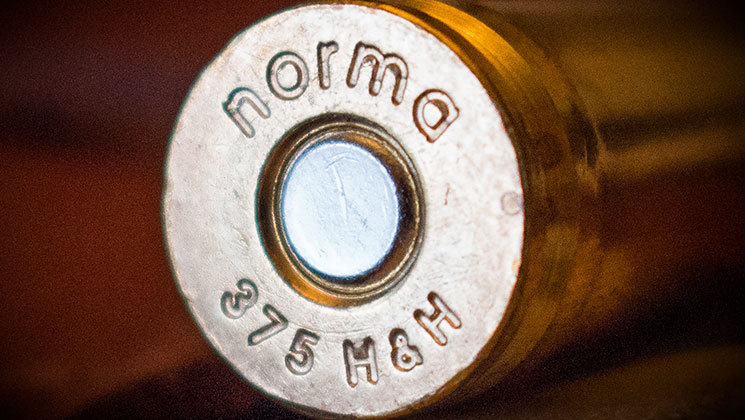
Yet, in spite of the heavy bullets and decent velocities, the .375 H&H has one of the most important attributes in a big bore rifle: it is relatively easy on the shoulder. The recoil of a .375 H&H is more than a .30-‘06, for certain, but off the bench I actually prefer to shoot the .375 H&H over some of the .338 Win. Mag. loads; and certainly much more than the .458 Magnums.
With this cartridge, I’ve taken animals ranging from the 25-pound steenbok and dainty springbok, all the way up to bison and eland, each weighing so close to a ton it’d scare you, with several species in between. I’ve used it at 30 yards—where it worked just fine, I'm happy to report—and I've used it past 400 yards, which I don’t necessarily want to do again. At both ends of the spectrum, it worked just fine, and that is exactly why I feel the .375 H&H is the most versatile cartridge ever developed: no matter what you point it at, it dies. Few cartridges can make that claim.
I’ve got several loads that I use regularly, and they all serve different purposes. The Cutting Edge Raptor, at 230 grains, prints subMOA at 2,800 fps, and makes a good bullet for African plains game. It has taken kudu, zebra, wildebeest, warthog and whitetail, and all have been one-shot kills. My own .375 H&H absolutely loves the Nosler 260-grain AccuBond, at 2,750 fps, as well as the 300-grain Swift A-Frame leaving the muzzle at 2,505 fps. The latter load has accounted for all kinds of game across Africa and North America. If you like the heavier choices, check out the Norma African PH load, using that 350-grain Woodleigh at 2,300 fps. It’s got all sorts of Sectional Density, and will give just a bit more when hunting Cape buffalo and Kodiak bears.
There have been some modern twists on the formula, like the .375 Ruger, and some hotter variants, like the .378 Weatherby and .375 Rem. Ultra Mag., but my favorite remains the H&H case, after all it did go on to inspire an entire generation of magnum cartridges, long, short and in-between. Without the H&H case, we’d have no .300 Win. Mag., no 7mm Rem. Mag. (though H&H did release a .275 Magnum that didn’t catch on, the same year as its big brother), and no Weatherby cartridges.
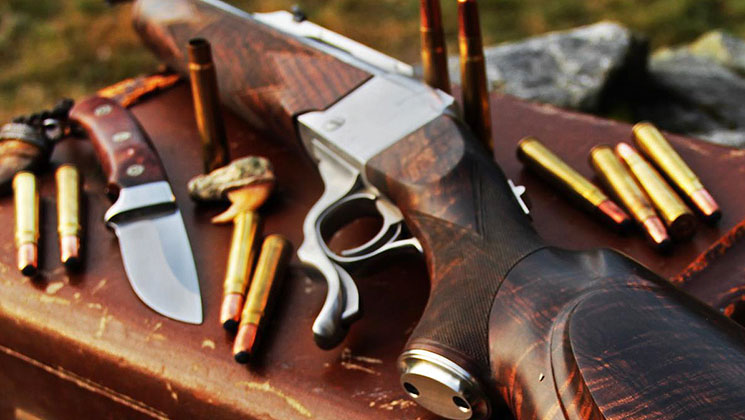
The .375 bore is the legal minimum for dangerous game in many African countries, and with good reason: it generates just over 4,000 ft.-lbs. of energy at the muzzle, and offers a bullet with enough Sectional Density to get the job done, and done well. For over a century, the .375 H&H has been routinely, consistently and reliably making happy hunters, and I wouldn’t be surprised if it did so for another century.
Looking for previous installments of Behind the Bullet? We've got you covered.