The bear came in silently, almost appearing out of thin air. I had just gotten comfortable on my stand—a little screened-in telephone booth kind of deal, barely able to combat the Canadian black flies—when the unmistakable glint of sunshine on jet black fur caught my eye. As he investigated the bait barrel, I brought the binocular up to verify that it was big enough to take, and shortly thereafter I exchanged them for the rifle.
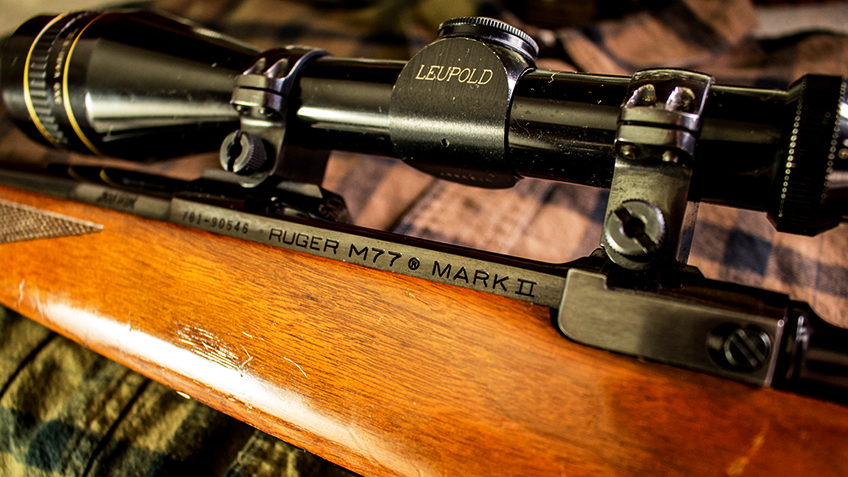
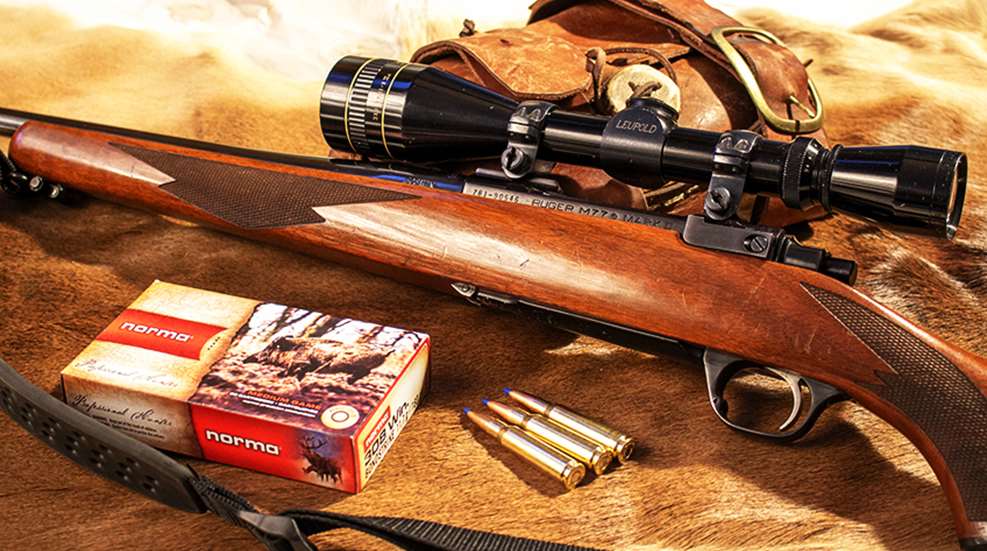
The first shot put him down, and the second kept him there, as I heard for the first time the death bellow that signals the final seconds of a bear’s life. Looking at the rifle—a well-worn Ruger 77 MKII chambered in .308 Winchester—I smiled to myself, as it and I had been on many adventures together, both at home and abroad. It was a Christmas gift from my father, and was the first seriously accurate big-game rifle I had owned. I use it to this day, happily collecting memories each season.
Sturm, Ruger & Co. released their bolt-action big-game rifle—dubbed the Ruger Model 77—in 1968, amidst a very competitive market. Though Winchester had heavily modified the prestigious Model 70 (to lukewarm reception) it was still a major player, Remington’s Model 700 was well on its way to superstardom, and the affordable Savage Model 110 was an effective and affordable rifle. Mind you, the lever gun was still extremely popular at this time, and the multitude of surplus Mausers, Carcanos and Arisakas were an incredible value.
Yet, William B. Ruger may have been one of the best judges of the firearms industry in the latter-half of the 20th century. He brought back the Farquharson single-shot rifle in an era where technology was all the rage; the Ruger No. 1 still has a cult following to this day. His Blackhawk, Redhawk and Single Six revolvers embraced the feel of the vintage Colt revolvers. His Ruger Standard .22 LR pistol and semi-automatic 10/22 rifle quickly became staples in the rimfire world. But, the bolt-action market was seemingly shored up by the big American makers, yet Ruger’s Model 77 muscled its way onto the stage, and has stayed there ever since.
The design was sound, with Ruger using its investment casting technique to produce a Mauser-like controlled-round-feed action with two locking lugs, a fixed magazine and a plunger ejector in place of the Mauser fixed blade ejector. Ruger used a two-position, tang mounted safety, a unique trigger design and an angled front action screw on the Model 77, to aid in bedding the action into the stock. The first models had a round top on the receiver, which required separate bases for scope mounting, but that was soon revised to the integral base/ring combination, a feature popular with many hunters. The Model 77 represented a good value to the hunter, giving a no-nonsense design that was equally rugged and reliable.
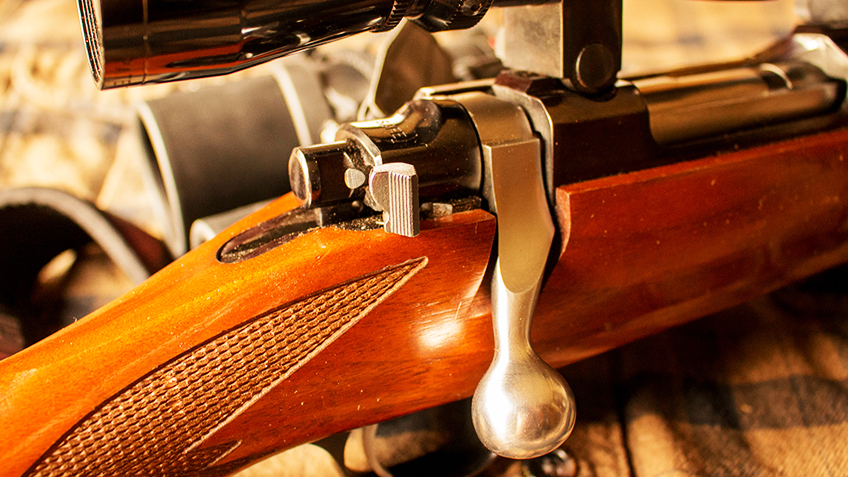
The rifle received a major facelift in 1991. When the tang-safety model became the Ruger Model 77 MKII, a couple important features were added, and though collectors may argue, I personally prefer the MKII models. A fixed-blade ejector—much like the classic Mauser design—was added, and I like the lack of moving parts when compared to a plunger ejector. Additionally, a three-position wing safety was added, allowing the shooter to block the sear yet operate the bolt for safe unloading of the rifle.
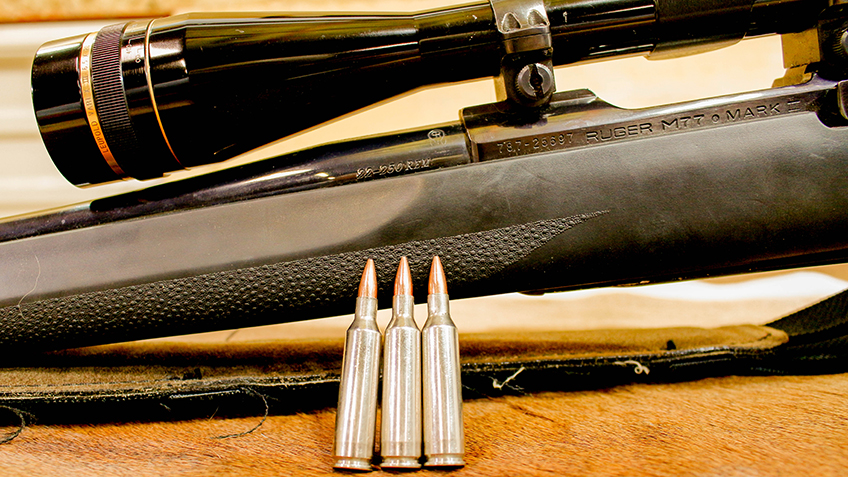
The MKII design has been very popular—I own the aforementioned .308 as well as another in .22-250 Remington—but they came with a rather lousy trigger; it is un-adjustable and rather creepy. I’ve had much better results in the accuracy department when I've replaced the Ruger factory trigger with a Timney drop-in trigger, but the Ruger 77 MKII has accompanied me on a good many hunts; I've probably shot more deer with that .308 than all my other rifles combined.
The next major iteration of the Ruger 77 was the Hawkeye model, with the only major revision being the redesigned LC6 trigger; the rifle was well received as a great value, in both the Standard Model and the Ruger Hawkeye African/Alaskan. The familiar feel of the Ruger receiver stayed the same, but I must say the new trigger was light years ahead of the MKII trigger.
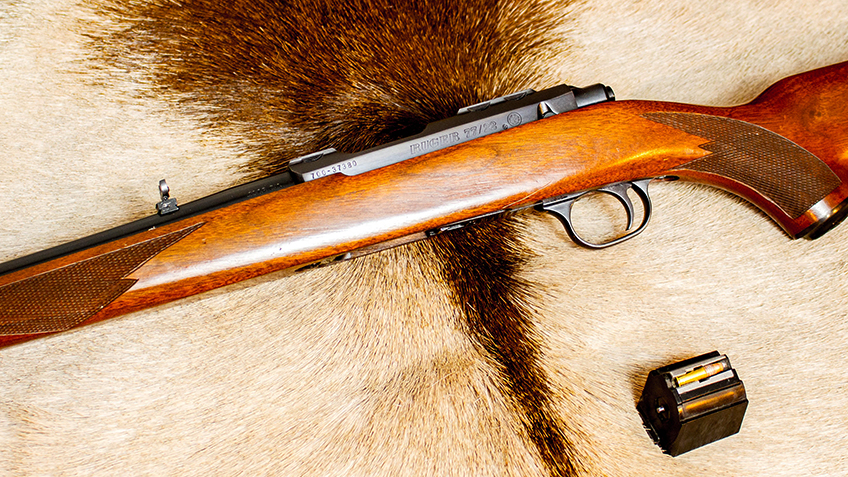
There have been many variants of the Model 77 throughout the years, including the big Ruger Safari Magnum (available in .375 H&H, .416 Rigby, .458 Winchester and .458 Lott), the Varmint Target model with a heavy barrel and big laminate stock, a Compact model with a short barrel, the FTW Hunter with its unique stock, and integral muzzle brake, rimfire models—I love my little 77/22 for wide variety of applications—and the list goes on and on. There have been a multitude of stock options – walnut, hardwood laminate, synthetic and that terrible ‘canoe paddle’ stock—as well as finish options like gloss bluing, matte bluing, stainless and matte stainless.
So what is it about the Ruger Model 77 that has been so appealing to hunters for half a century? I think it has to do with Bill Ruger’s knack for giving a shooter everything they need in a firearm, and nothing they don’t, at a fair price. I believe that has been Ruger’s approach from the beginning, and I look forward to many more seasons afield with a Model 77 in hand.