5 Things You Need to Know About the Savage Lightweight Hunter

by
posted on June 24, 2016
** When you buy products through the links on our site, we may earn a commission that supports NRA's mission to protect, preserve and defend the Second Amendment. **
savage_lightweight_hunter_f.jpg

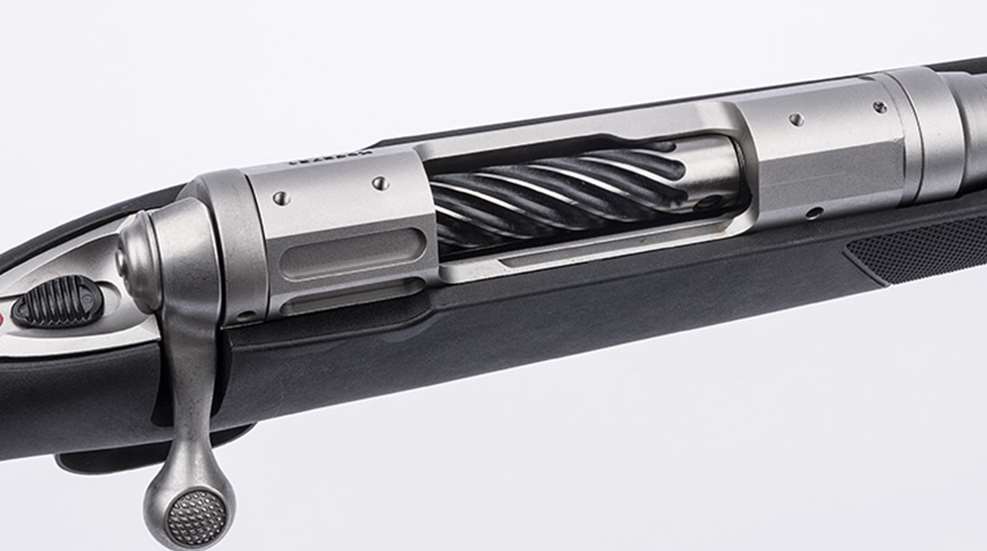
If you've hunted long enough, odds are you've wound up taking your rifle on some long, fruitless hikes. That's just hunting. And if you're the kind of hunter that often blazes new trails through the backcountry in pursuit of game, it's not a bad idea to pack a rifle that won't slow—or weigh—you down. For 2016, Savage Arms has a new offering available in its Specialty Series in the Model 16/116 Lightweight Hunter. Here are five things you need to know.

1. You've got options.
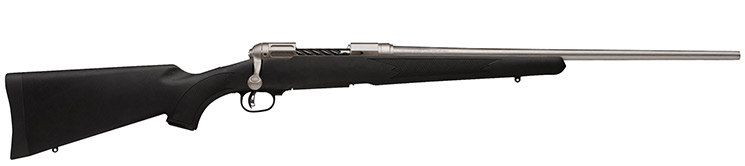
The 16/116 Lightweight Hunter is available in short- and long-action options in five calibers: 223 Rem., 243 Win., 7mm-08 Rem., 308 Win. and 270 Win.

2. It really is a lightweight.
This puppy lives up to its name, that much is certain. Your Lightweight Hunter will weigh somewhere between 5.65 and 5.8 pounds, depending on the caliber you select. If you're a hunter who's often on the move, you can't ask for much more. Savage managed to keep the weight low by borrowing the lightweight magazine and framework from its Trophy Hunter Series, replacing the standard heavy metal components found inside other rifles with a bulletproof base pad and rigid cross-bracing system that's crafted from polymer. 

3. It's compact.
As you might expect, the Lightweight Hunter is compact, too—it measures just over 40 inches long while sporting a 20-inch, light-contour barrel.

4. It's designed to take a beating.
Odds are, if you're looking for a lightweight rifle, you intend to take it into the mountains or backcountry—rugged environments. The engineers at Savage know that, which is why they've built the Lightweight Hunter to withstand whatever you may throw at it. The synthetic stock and stainless steel barrel are built to survive the elements. It's not a pretty gun, but it's not supposed to be.

5. It's affordable.
Did you expect it not to be? It's a Savage. The Lightweight Hunter ships with an MSRP of $729, and you'll find it on shelves for significantly less than that, I'd imagine. Considering the package the rifle delivers, it's a value.
Latest

LEDENRA YES Logo
LEDENRA YES Logo

NRA Announces 2026 Y.E.S. Grand Scholarship Recipients

The National Rifle Association has awarded $15,000 in college scholarships to attendees of the 2025 NRA Youth Education Summit (Y.E.S.) through the Y.E.S. Grand Scholarship program.

Recipe: Venison Empanadas

When Brad Fenson makes venison empanadas, the goal is simple. Keep the meat front and center, add enough flavor to complement it, and make a filling that stays juicy without overpowering the wild proteins. The filling is rich, balanced, and built to highlight venison, whether baked or fried.


Proof Research Unveils Shorter Barrels for Elevation 2.0 and MTR 2.0

Proof Research has announced shorter-barrel configurations for the Proof Elevation 2.0 and Elevation MTR 2.0. Both the Proof Elevation 2.0 and Elevation MTR 2.0 in shorter barrel configurations are available in Tactical Flat Dark Earth (TFDE) and the all-new Midnight color, offering shooters greater customization options alongside Proof Research's carbon fiber technology.

Range Review: Midwest Industries Bounty Hunter Revolver Brace

Thanks to Midwest Industries new Revolver Brace, you can easily mount a stabilizing brace to your favorite hunting revolvers. Check out B. Gil Horman's review of this game-changing product.

First Look: Marlin Mad Pig Customs Model 1894

Marlin has introduced its Mad Pig Customs Model 1894, a rifle developed—as its name implies—in collaboration with Mad Pig Customs. Built on Marlin's iconic lever‑action rifle platform, this model delivers modern, factory‑installed features previously found only on custom builds.

Funding Authorized to Conserve Critical Wetland Habitat

The Department of the Interior has announced that $44.79 million in North American Wetlands Conservation Act (NAWCA) funds have been approved by the Migratory Bird Conservation Commission. They will provide the U.S. Fish and Wildlife Service—and its partners—the ability to conserve, restore or enhance 185,203 acres of critical wetland and associated upland habitat for migratory birds across the United States.

Interests


Get the best of American Hunter delivered to your inbox.