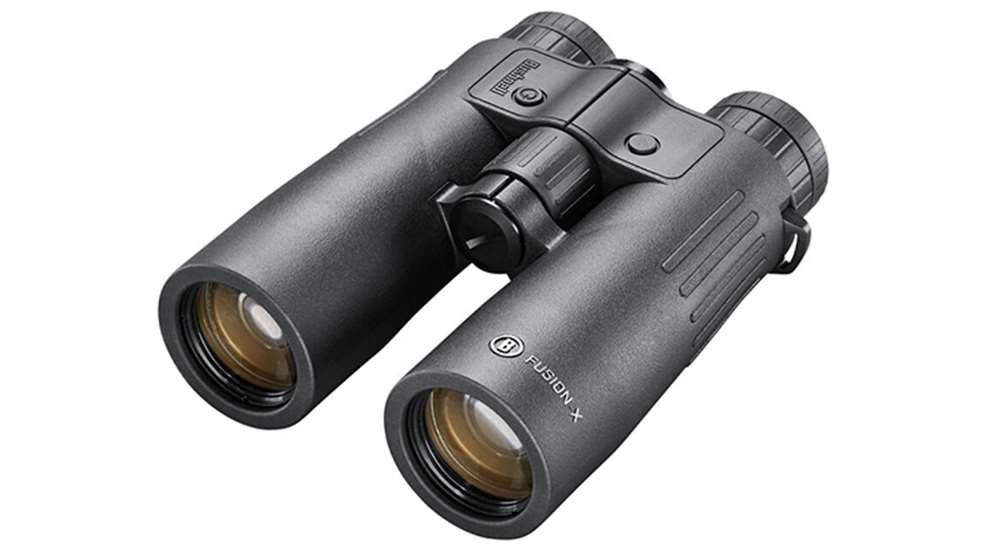
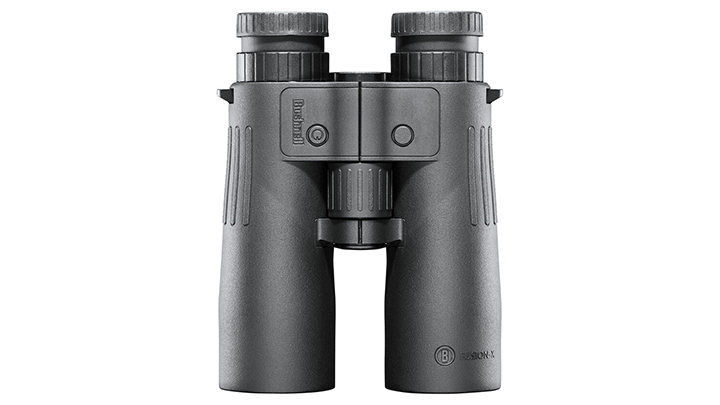
I appreciate subtlety, but I prefer most things black and white. Except laser rangefinder readouts. Those I’d rather see in black and red or, more accurately, black or red. Bushnell’s 10x42 Fusion X rangefinding binocular has 'em.
If you’ve ever tried reading red LED rangefinder data against yellow grass in bright daylight, you’ll appreciate the significance of a black readout option. The Fusion X provides it automatically with what Bushnell calls an ActivSync display. At a certain level of subject/background brightness, the unit automatically switches to the most visible readout color. It also automatically adjusts readout brightness.
Convenience like this is just one of the upgrades in this latest evolution of Bushnell’s affordable rangefinding binocular. At an MSRP of $699.99, Fusion X is likely the least expensive laser rangefinding binocular on the market. But at that price can it compete? My examination suggests it can.
Packed within the Fusion X's composite frame is just about every bell and whistle possible in a laser rangefinding binocular. There are the usual scan, bullseye and brush modes combined with Bow and Rifle modes. In the Bow setup an inclinometer measures degree of angle and provides that data along with line-of-sight distance and horizontal shoot-to distance. Because it allows me to adjust my holdover based on the ballistic curve of whatever cartridge/bullet I’m shooting, despite this being labeled the Bow mode, I find it perfect for rifle work.
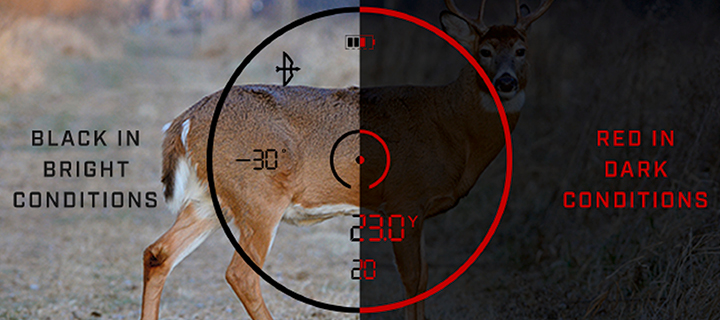
For shooters using one rifle/load consistently, the Rifle mode enables trajectory correction based on ballistic input data. Enter the data for your load then choose the Angle Range Compensation readout in MILs, MOA, inches or centimeters.
To test this unit’s rangefinding speed and precision, I raced it beside my benchmark unit, a first-generation Swarovski EL Range. The Fusion X spit out distance readings a split-second faster, but required two presses of the firing button to do it. Overall the two units read within a yard or two of one another, but the Fusion X read much closer, down to 9 yards.
When ranging in bright sunlight a small maple tree standing in a clump of shorter brush on a hillside at roughly 1,360 yards, the Swarovski needed two tries to read 1,374 yards. The Fusion needed four tries before spitting out 1,364 yards. The discrepancy could have been because one device was reading the tree, the other the brush slightly beyond it. I suspect the Fusion was hitting the tree because in its bullseye mode it more quickly and consistently hit smaller targets such as a bluebird box on a post at 264 yards.
After sunset both units read quickly and agreed within 1 yard out to an impressive 1,951 yards—the side of a pale blue building. Both quickly read trees at 787 and 788 yards, a black angus calf at 469 yards and a line of maple trees at 1,735 and 1,736 yards. Both units showed impressive performance measuring beyond a mile in low light, just under a mile in bright sunlight.
But measuring distance is just part of what a hunter hires a rangefinding binocular to do. Arguably its more important job is revealing game at high magnification. Ten-power is, in my experience, an ideal power range for general-purpose hunting anywhere but forests and woodlands. Here in the Rocky Mountain West, it’s perfect.
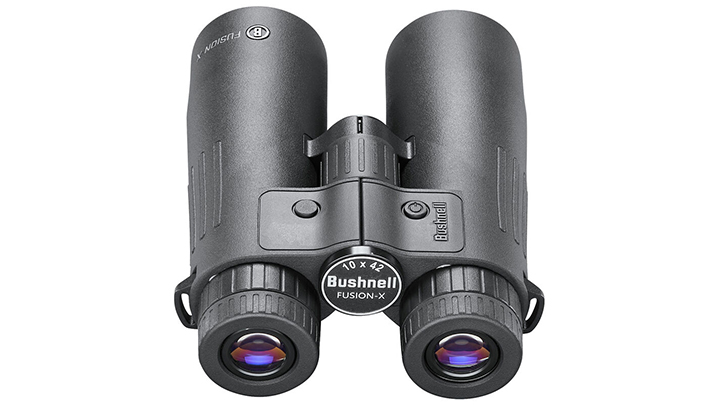
To maximize optical performance, the Fusion is built with fully multi-coated lenses. This assures minimum reflection loss and maximum light transfer through the instrument. Aiding this are dielectric mirrors on the BK7 glass roof prisms, the most efficient mirrors in binoculars.
But brightness isn’t the only measure of optical performance. Resolution is equally important, arguably more important, and here the Fusion stumbles a tiny bit, despite phase-3 coating for enhanced clarity on the prisms. Fusion X views show a strong yellow cast. This may be intentional to enhance the reds and browns of many game animals during the blue light of dawn and dusk, but could be a byproduct of coatings. Exterior lens surfaces are EXO barrier coated to resist oils, fogging and scratching. Many binoculars project noticeable hues from blue to yellow. If I remember correctly, the first Fusion rangefinding binocular had a strong blue cast.
To test sharpness, I tested the Fusion X against several binoculars including Swarovski, Tract, Leupold and Meopta by studying small text printed on a common cardboard shipping box as evening light deteriorated. All were remarkably close in resolving power, but the Fusion faded a minute to a few minutes before the others. One must weigh this against the costs of these instruments in deciding whether costs justify a few minutes more glassing.
More bothersome to me was what I call lash in the focus system. This amounts to “hunting” for sharp focus. It appeared when I focused past that sharpest point, dialed back to fine-tune it and discovered I had to run the focus wheel much farther than I had when going past. This may be intentionally built into the unit, but I prefer focus that snaps in to hit the sweet spot with minimum tweaking. When I did achieve the sharpest focus with the Fusion, it was quite good, though not, understandably, as good as that of instruments costing $600 to $2,000 more.
Ergonomically the Fusion X is comfortable and easy to use, the activation buttons falling naturally under my index fingers, the knurled focus knob under my middle fingers. The lightly textured armor coating provided good traction. Eyecups twisted up and held in three positions. Diopter rings turned easily to adjust, but were not easily bumped to mess up the settings.
All in all I find the Fusion X a worthy, affordable rangefinding binocular for all-round hunting and especially for long-range target shooting.
Technical Specifications
• Type: laser-rangefinding binocular
• Magnification: 10X
• Objective Lens Diameter: 42mm
• Eye Relief: .630"
• Exit Pupil: 4mm
• Field of View @ 1,000 Yards: 305 ft.
• Max Ranging Distance: 700 yds. (deer), 1 mile (reflective target)
• ARC Modes: regular, bow, rifle
• Target Modes: scan, bullseye, brush
• Coatings: fully multi-coated lenses; EXO Barrier, Phase-3 coated prisms
• Construction: composite frame; Roof, BK7 prisms; IPX7 waterproofing, fog-proof, armor-coated
• Dimensions: height 7”, width 5.5”, weight 35 ozs.
• Accessories: neck strap, nylon carry case, lens covers, CR2 battery
• MSRP: $699.99; bushnell.com