There are so many optics companies out there these days that I can barely keep track. And frankly, except for the most fly-by-night, most offer good stuff, so it’s tough to distinguish one from another. Regardless, most don’t last long in this ultra-competitive market.
There is at least one new company that’s making waves because its optics look so interestingly different. They’re also great to look through. The company is called Maven, a word meaning, “an expert or connoisseur.” I don’t know about all that, but when I looked into the company and its products, it’s clear that it’s is doing something a little different.
In fact, the Lander, Wyoming, firm is doing what couldn’t have been done just a few years ago without social media marketing. Like the vast majority of optics companies, it contracts its products through an overseas manufacturer, but it’s how it markets and sells them to U.S. consumers that’s different. Namely, it’s selling direct to consumers via its website. It allows customers to customize its optics with options and finishes. More notably, Maven claims most optics sold at traditional retail outlets are marked up by 50 percent or more before they reach you; but because Maven cuts out this middleman, it says its prices are much better.
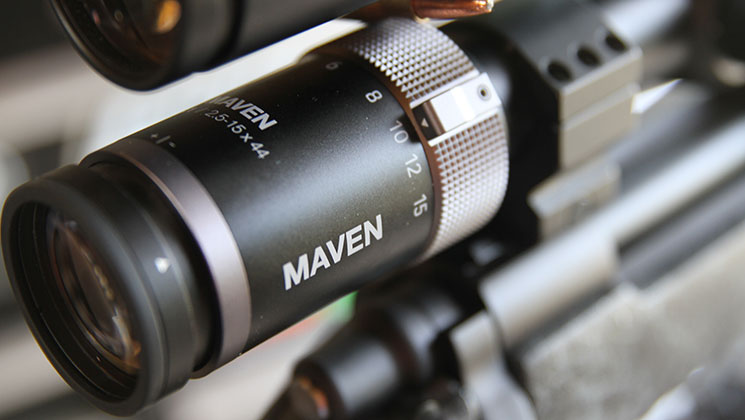
Company reps say this sales tactic has also kept it from playing the retail pricepoint game. This way it can control what price point it wants to meet with its models—and choose its materials and features based on that—rather than have its pricing be dictated by retailers.
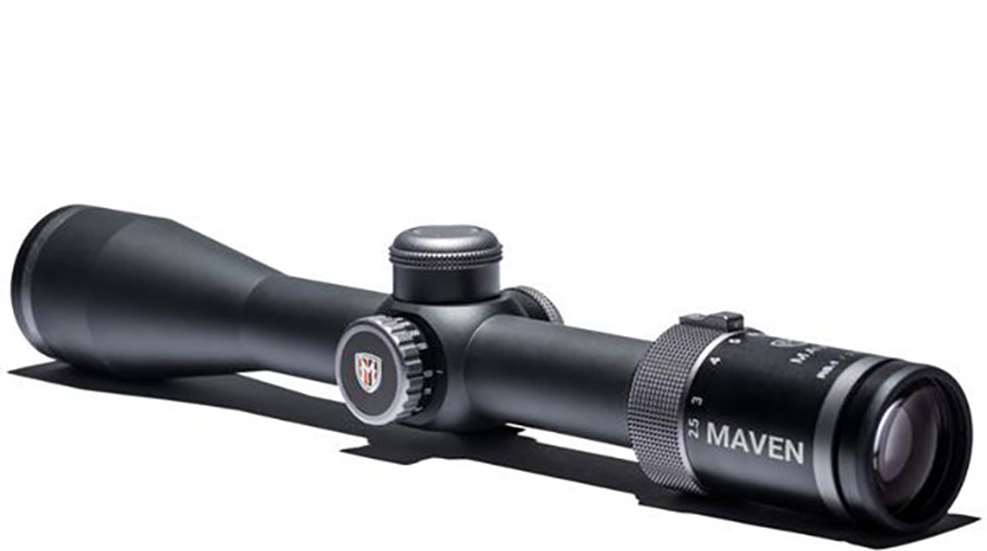
Back in 2014, Maven debuted its first optics with its flashy looking binoculars and spotting scopes. Now, for 2018, it introduces its first riflescope, the RS.1. It’s a 2.5X-15X-44mm riflescope with a 30mm tube that costs $1,200. That’s not cheap, but Maven says it performs as well as scopes costing much more. So I want to know if the RS.1 is legit, how it stacks up to comparable optics and whether Maven is actually passing the money its saving by skipping the middleman on to consumers as it claims. What follows is a full review of the Maven RS.1.
What Mavens Are Made Of
An optic can only be as resolute as the quality of its internal components and the precision of its assembly. As best as I can tell, (optics manufacturers and vendors closely guard these secrets) I believe Maven’s upper-end optics are made by the Kamakura optical manufacturing giant of Japan. This is a good thing, as Kamakura is one of the top precision optical manufacturers in the world; certainly in the top 10 by anyone’s standards, and possibly in the top 5 in terms of quality. It makes or has made optics for some of the biggest, most well-known players in the industry. Unlike Maven’s excellent binoculars and spotting scopes that are then assembled and tested at Kamakura’s MIL SPEC facility in San Diego, its RS.1 riflescopes are fully finished in Japan. All glass used is in the RS.1 is expensive ED (Extra-Low Dispersion) glass which is one of the two best types of glass for optics. (The other is Zeiss’ fluoride glass). All lenses in the RS.1 are fully multi-coated for maximum light transmission. Maven says transmission is 89 percent.
Coatings are a big deal. They’re expensive to apply, and absolutely necessary for top-notch resolution, brightness, color fidelity and sun flare mitigation. When I asked company reps about the RS.1’s coatings, they didn’t go into the normal marketing spiel as do most other optics manufacturers, many of whom have branded their coatings with a cute name. Maven told me that of course their optics are fully multi-coating with high-end coatings. That’s good enough for me, and in fact, appreciated. And I can tell that they are properly coated are when I peer through the glass.
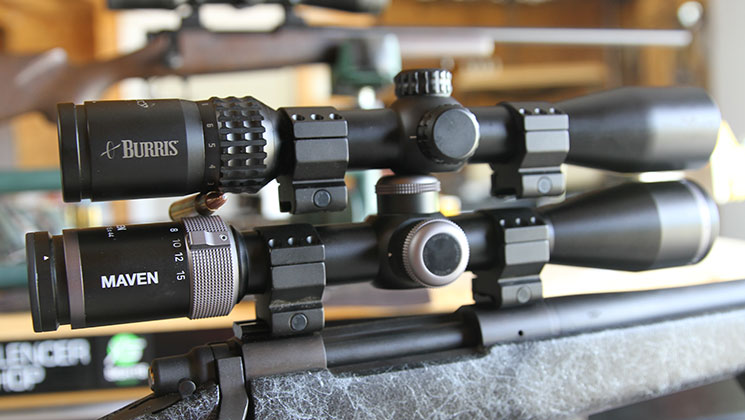
In terms of brightness and resolution, I compared the Maven alongside similar optics in terms of size (all 30mm tube optics adjusted to a common denominator power of 10X) and price. To my eye, the Maven was clearer and brighter than a Vortex Viper 4X-16X-44mm that costs around $700. It was slightly clearer than a Philippine-made Burris Veracity 2X-10X-42mm at $719. It was virtually the same, if not just a hair lesser than a Leupold VX-6HD 3X-18X-44mm that costs around $1,599. And I thought it was slightly less clear than a Swarovski Z5 3.5X-18X-44mm at around $1,300. At dusk, the Maven performed along the same lines; better than all but the most expensive European optics. All told, the Maven, optically, is legit.
Probably the most important factor of a hunting riflescope—even more so than absolute clarity—is the scope’s internal erector system that includes its reticle and its adjustments. It's what makes the scope precise and what prevents it from getting knocked out of zero while you’re crawling around the woods. The Maven’s reticle is glass-etched (the more expensive way of making a reticle) and resides in the first focal plane. First focal plane means that the reticle size stays the same in relation to the target. It stays constant so that an MOA holds its value (its relative size to the target) whether the scope is dialed to 3X or to 15X. It does have one disadvantage, and that is that at the low powers, the reticle’s holdover points are perceived by the eye as tiny, and therefore are almost unusable. But the upshot is that it doesn’t really matter; for long shots where the subtension lines are needed, the shooter will likely have the scope cranked up in power.
To test the Maven’s adjustments, I locked the scoped rifle in a vise and centered the crosshair on a 100-yard target with lines that measured 1-square inch. The scope’s dial required four clicks to traverse the square, both up and down, left and right. The adjustments were instantaneous—they did not hang up or require me to tap on the scope—and they were precise. Once I zeroed the scope to my rifle, I used the dials’ zero index by loosening the central screw with a flat head screwdriver and pulling up on the turrets. Then I spun the dials until both were indexed to “0” before re-tightening. Next I spun both dials fully in both directions. I found the 30mm tube allows an adjustment range of 110 MOA vertically, and 70 MOA horizontally—this is larger than most. Then I counted the rotations back to my original zero and shot the rifle. It printed to point-of-aim, which proves that the scope has repeatable adjustments.
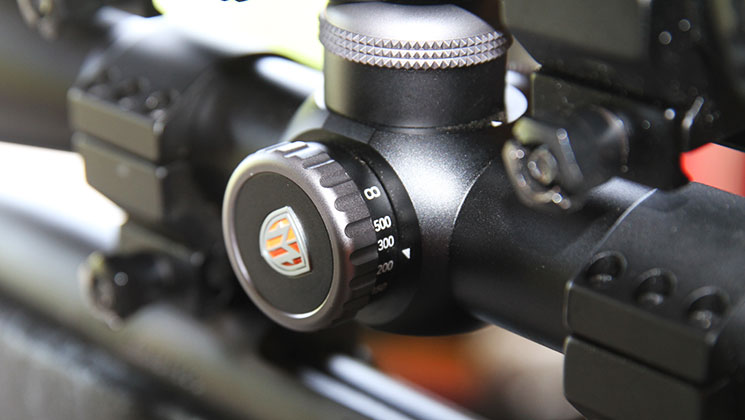
However, the capped, hunting-style turrets were not without complaint. While they are finger-adjustable and feature audible and tactile clicks, I found the individual clicks to be too easy to skip while adjusting with fingers. Often, when I’d try to adjust by one click, I’d accidentally dial two or three clicks. For a scope costing $1,200, this could be better. Also, I wish that for this type of money, the adjustments had a zero-stop. I found out that for $100 more, customers can add target turrets with a zero-stop. At any rate, the scope’s erector system is sound.
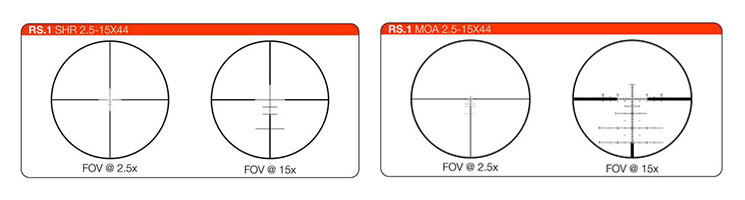
The RS.1 is available with one of two crosshairs. One is the simpler SHR (Simplified Holdover Reticle) that I love. It features a duplex reticle with three additional holdover points and basic wind compensation. I believe this is all hunters need for shots out to 600 yards, or more if used in conjunction with click adjustments. The other choice is the very complex MOA reticle that’s geared for target shooters. It’s an excellent reticle that accounts for wind and precise long-range holds. I could write book on this reticle alone, but may it suffice to say that it’s one of the better long-range shooting reticles available.
Although the scope is on the sturdy side at 24.5 ounces, Maven’s power range of 2.5X to 15X makes it extremely versatile. In fact, there’s not much this scope can’t do in terms of hunting and target shooting. It glides through its adjustment range smoothly via a precision machined, knurled knob with a machined-checkered flange for grip, but it’s not too easily moved. Its side parallax adjustment is the same way. It feels great. I tested its calibration by viewing targets at known distances, then making sure the focus was spot-on at those distances. It checked out.
Finally, a hunting scope must be durable. It must handle the elements, user blunders and recoil from large caliber rifles. To test this, I submerged the Maven in warm water for 30 minutes. It showed no signs of leaking. Then I froze the unit for several hours. It did not break or internally fog, a sign that it’s fully airtight and nitrogen purged. Finally, I dropped the scope 3 times on grassy ground by letting the heavy rifle fall over on it, and then shot it to see if it held zero (This is a very tough test—one that has broken or knocked many scopes out of zero—and I cringe each time I have to do it.) Miraculously, the Maven held zero. I shot it on several different calibers up to a .338 Win. Mag. and it held up and remained on zero. Therefore, I believe this scope is robustly made. But, if it does break, Maven offers what is basically an idiot-proof warranty. They claim that even if you drop it off a mountain or run over it with a truck, they will replace it without hassle. That is very rare for a product of this price.

So, what do I think about the RS.1 overall? I think it’s an excellent riflescope on its own, or when compared to others by cost. It’s just behind some of the best European optics (that cost twice as much) in clarity and features. In my view, it doesn’t have a lot of competition in terms of overall quality that is equal or less in price. From what I’ve seen, Leupold’s VX-6HD (more expensive), Swarovski’s Z5 (slightly more expensive) and perhaps the Czech-made Meopta Meostar (less expensive) are its stiffest competition. Frankly, I’m a little biased too, because these scopes have been around for ages and I know their stellar reputations. Maven hasn’t yet had time to match. For its first scope ever, however, the RS.1 is a home run; I believe that if you buy this scope you will be happy with it.
One of the coolest things about Maven is its new-aged approach to marketing. It realizes that since it doesn’t have optics at dealers for consumers to handle, it offers a demo program so folks can test them out for a two-week trial period. Simply go to mavenbuilt.com, click on the DEMO tab and select an optic. You’ll have to pay for it—but it’s discounted by 10 percent because it’s lightly used. After two weeks you can keep it, upgrade to a new-in-box unit or simply return it for a full refund. It’s a different way to buy a scope, and as an American hunter and consumer, I think it’s the wave of the future. To that end, I can’t wait to see some of Maven’s future models, because I think the company is here to stay.
Technical Specifications
• Type: variable-power riflescope
• Magnification: 2.5X–15X
• Objective Lens Diameter: 44mm
• Tube Diameter: 30mm
• Length: 14.5″
• Weight: 24.5 ozs.
• Click Value: ¼″
• Parallax Adjustment: 10 yds to infinity
• Exit Pupil: 28.5mm @ 2.5X, 2.93mm @ 15X
• Eye Relief: 86-100mm
• Field of View @ 100 Yds: 41.7′ (2.5X), 7′ (15X)
• Focal Plane: first
• Reticle: etched; SHR or MOA
• MSRP: $1,200; mavenbuilt.com