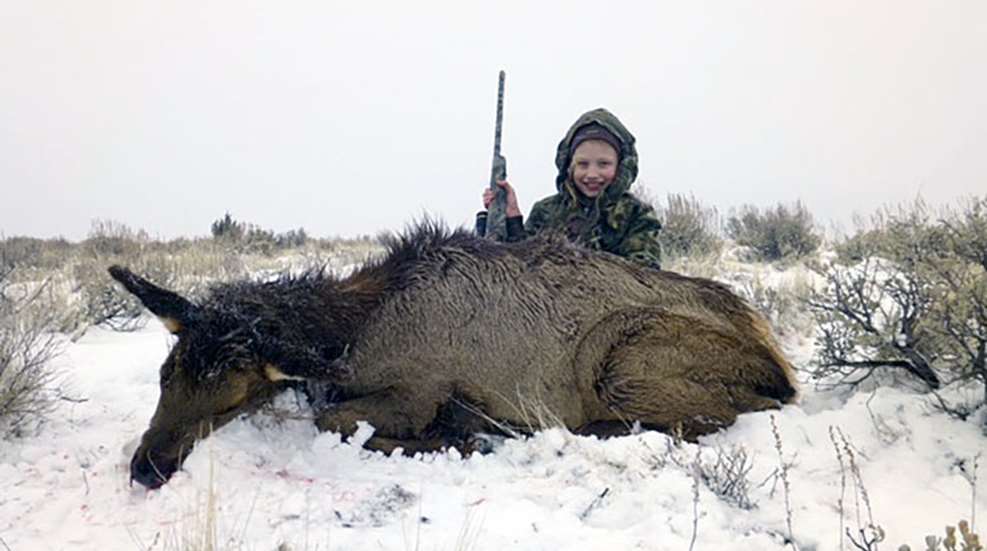
Pictured is 13-year-old Peyton Lesser, who killed this cow elk on a depredation hunt.
I didn’t get my elk this year. After months of scouting for the elusive and mystical Roosevelt elk, after hiking sun-up to sun-down during our short four-day season window through the densely wooded Pacific Northwest coastal range, and after hours of waiting and watching beneath sheets of icy rain—I didn’t get my elk. The season ended for me with the all too typical ‘what-ifs’ and plans for next year, possible changes to hunting locations, and a general feeling of dismay.
This dismal ending to the season, however, made me even more elated and grateful when a friend—a local ranch and farm owner—unexpectedly called and offered the opportunity to go on a depredation hunt on his property. His crops annually suffer serious and costly agricultural damage by local elk herds, so he is able to mitigate the issue by the use of depredation hunts. This particular tag was for a cow elk. It gave me a second chance at a failed season, but it can also provide hunters an opportunity to hunt a new or different type of animal. Either way, it makes sense to understand what depredation hunts are, and your specific state’s rules and regulations.
 What is a Depredation Hunt?
When a specific species of animal causes agricultural damage or poses an imminent threat to livestock or humans, state governments will sometimes grant tags for that type of animal to a limited number of hunters, for a short seasonal window—also known as depredation hunts.
Federal Depredation Permits
Most depredation tags are state-specific, although it is possible to obtain a Federal Migratory Bird Depredation Permit through the U.S. Fish & Wildlife Service. The permit costs $100, and is only needed to hunt birds protected under the Migratory Birds Treaty Act (MBTA).
• More information about Federal Migratory Bird Depredation Permits, including the application, can be found here.
• A list of protected birds can be found here.
State Specific Depredation Hunts
Rules and regulations vary significantly by state, so it’s important to check with your local agency. Some states use a pool system in which hunters submit an application requesting entry into the depredation hunter pool, with the restriction that a hunter may not obtain two of the same type of animal within the same year. Some other states issue permits for landowners to hunt, to bring in licensed hunters, or to request assistance from the local wildlife agency, to mitigate animals or species posing a threat to his/her property. Some states use both of the aforementioned processes. All states have different seasons and different rules for different species, so it’s critical to do you research.
You can find contact information for your local state agency here.
Whether you’re looking for a second chance at a failed season, an exciting challenge hunting a new species of animal, to assist in the conservation of our delicate eco-systems, or to protect your own property against predators, depredation permits can be invaluable.