A Beginner's Guide to Bowfishing for Gators

by
posted on December 15, 2017
** When you buy products through the links on our site, we may earn a commission that supports NRA's mission to protect, preserve and defend the Second Amendment. **
bowfishinggators_lead.gif

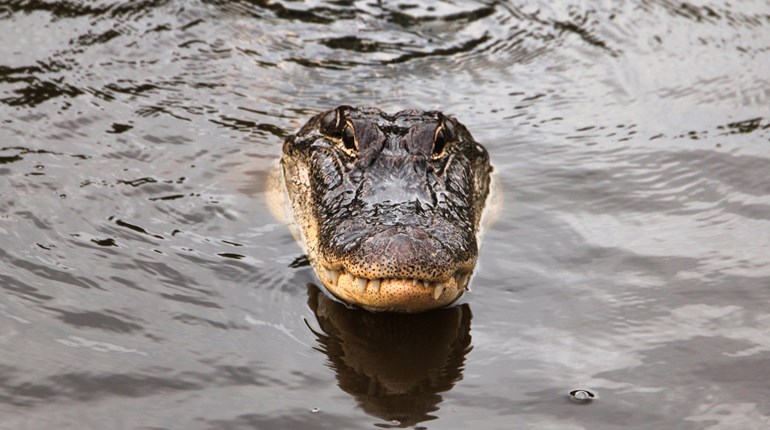
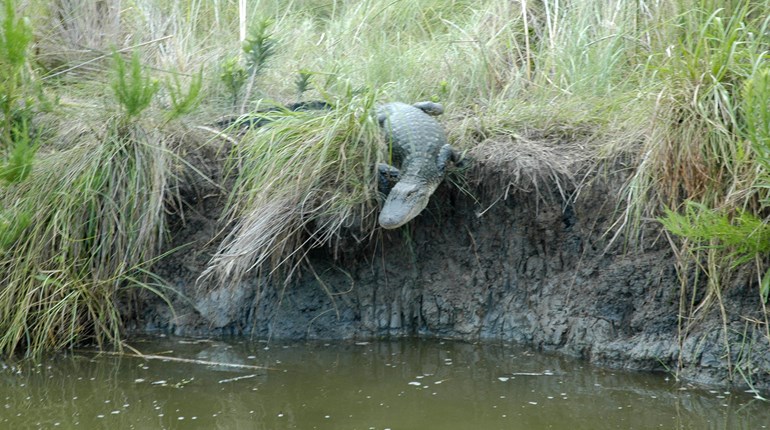
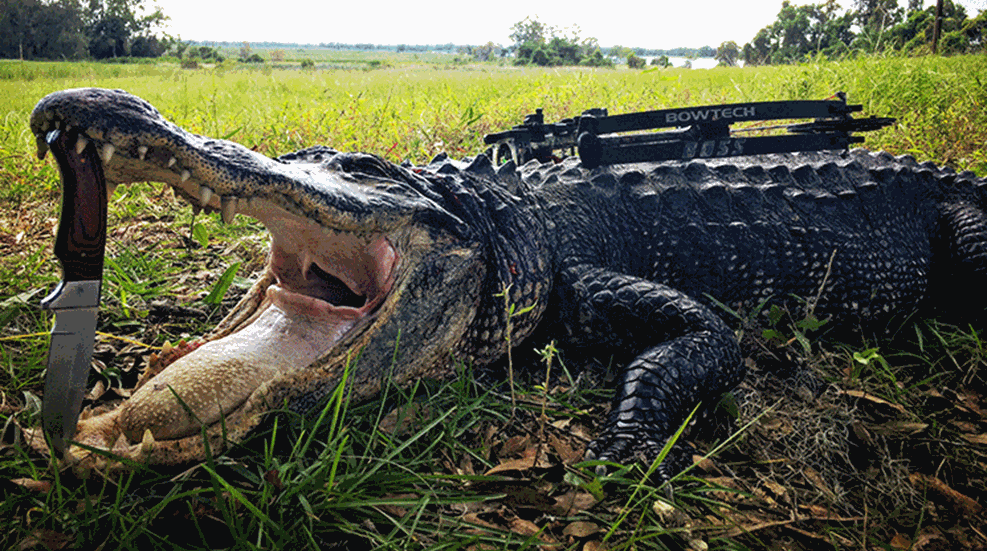
If you’re looking for a unique adventure in which you have the opportunity to harvest an apex predator with a stick and string, look no further than the American alligator. This more than 8-million-year-old species of reptile is native to southeastern United States, and can be legally hunted in Alabama, Arkansas, Florida, Georgia, Louisiana, Mississippi, South Carolina and Texas.
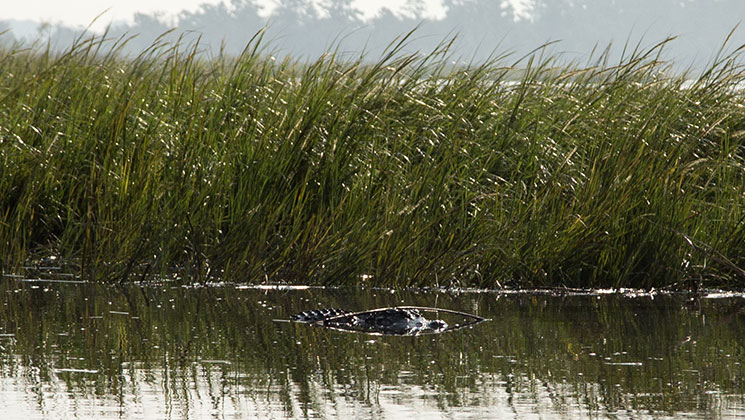
For the 2017 season, I was fortunate enough to draw a tag in South Carolina. To make sure I was best prepared for the hunt, I reached out to Mark Land with Muzzy Bowfishing to learn as much as I could about the equipment I would need for bowfishing gators.

For starters, Land strongly advised that I either hunt with someone who had experience hunting alligators, or seek out a guide, noting that alligator hunting can quickly go south if you don’t know what you are doing. Getting a bow set up to hunt gators with would be the easiest part.
 

Choosing a Bow Setup for Hunting Gators*

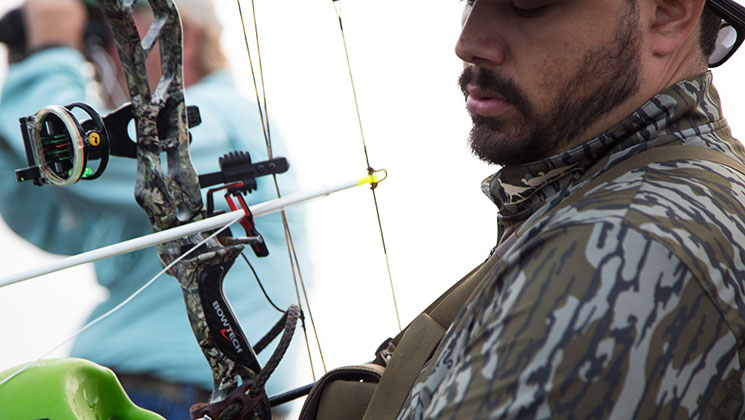
• Use what you have or buy new. According to Land, a “gator bow” only needs enough power to get the point under the hide of the animal, so most any compound bow in the 30 to 70 pound range can work great. If you buy new, Land advises using normal draw weights, but stresses hunters should stick to whatever they are comfortable with. Land knows lower draw weights can still get the job done, as he has taken several sizable gators using a recurve with a draw weight of 53 pounds.

• The bow is just the beginning. You’ll need arrows with gator points and a reel or spool loaded with at least 400 pound test line. Muzzy’s gator kit includes all of these items and features a rotomolded float/spool that easily detaches from the bow allowing the hunter to quickly “reload” for a second shot, something Land strongly recommends. He also suggests buying a bowfishing rest to decrease the likelihood of your line catching on conventional rests.

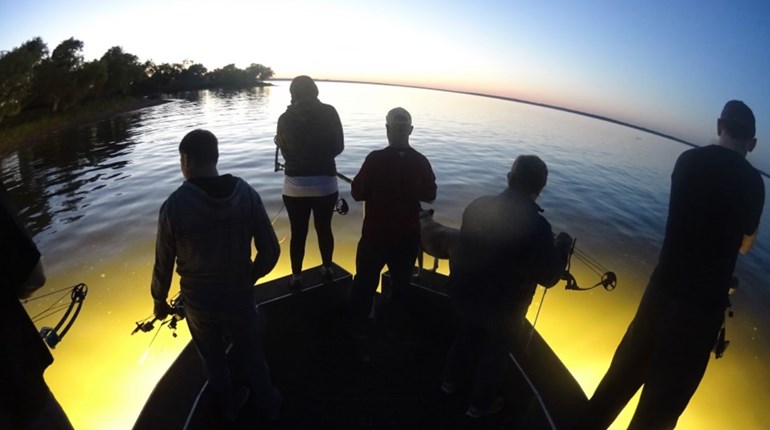
• Practice makes perfect. According to Land, “the majority of shots taken on gators are measured in feet, not yards,” since the arrow quickly loses speed due to its heavier weight. Land suggests purchasing an extra gator arrow, removing the barbs and gluing the detachable point to the shaft so it will be easy to pull from a block target. It also doesn’t hurt to practice shooting instinctively as the majority of gator hunting takes place at night, and it would be difficult to rely on a bow sight.

Ultimately, I choose to hunt with an older Bowtech Boss, and I also carried a Muzzy Addict Bowfishing Bow as a backup. Both were rigged with a Muzzy Gator Kit.

Depending on which state you hunt, the regulations for gators may vary. But after speaking with Land and also reaching out to Ron Russell with Gator Getter Consultants in Charleston, South Carolina, I learned that basic tactics for bowhunting gators remain the same.
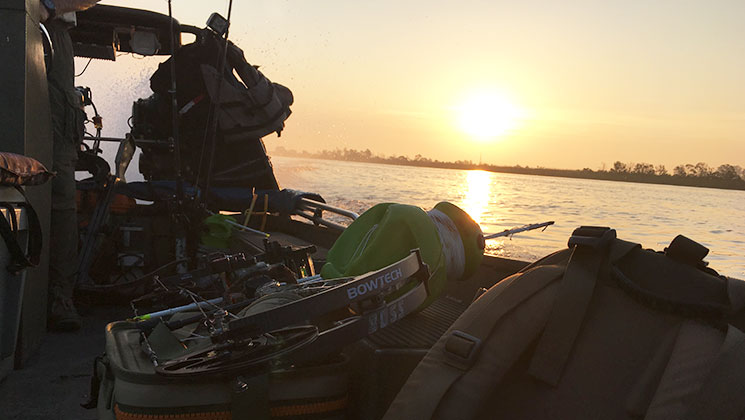


Basic Gator Hunting Tactics*


• Go where others aren’t. Just as you would do with any other type of hunting, finding a good gator is about preseason scouting and looking for gators where other people aren’t going. While Land hunts primarily at night, Russell has found that hunting during the day offers more success for his clients as he is able to avoid heavier pressure on gators.

• Judging a gator. When estimating the size of a gator, estimate the distance between the eyes and the nostrils to determine a rough overall length. If the distance is six inches, the gator will be approximately six feet. Both Land and Russell noted that gators really begin to pack on the weight once they hit the nine to 10 foot mark. Russell also mentioned that gators 10 feet and up will more than likely be males as females rarely reach that mark.

 Gator hunting requires patience. Just because a gator sinks below the surface and out of sight, doesn’t mean it is a lost cause. Gators, especially large ones, can hold their breath for periods of more than an hour. Russell’s philosophy is “if a good sized gator dives and reappears 25 to 30 yards away still swimming, it is scared and probably won’t be caught. But, if a good sized gator dives and doesn’t reappear right away, they aren’t going far and are worth waiting for.” Patience also comes in handy as you will most likely have a few blown stalks before you successfully arrow a gator.

• Dispatching your gator. The most common method way to dispatch a tethered gator is by using a bang stick. Russell prefers to use a knife to sever to spine, but gators also can be taken by dispatching them with a well-placed broadhead.
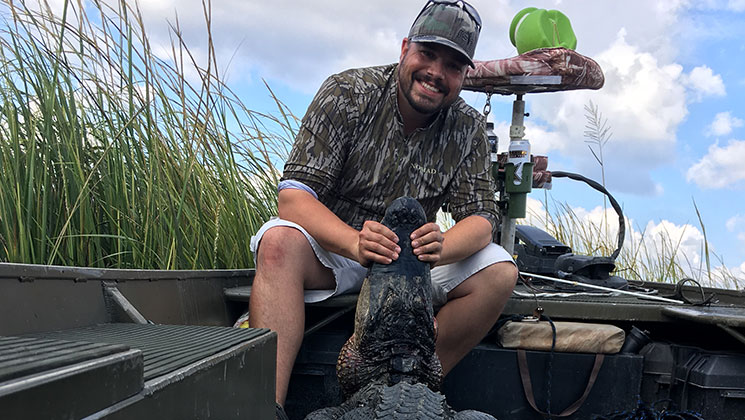
Russell put it best when he said, “gator hunting is a lot of down time that culminates with 15 minutes of pure adrenaline-pumping excitement.” After watching the water explode from a thrashing gator and also successfully punching a tag with him, I can assure you that statement is 100 percent accurate.

*As with any hunt, regulations vary by state, and it is best to check with the local state game and fish to ensure you are hunting within the law. 

Latest

Largest Crowd Ever
Largest Crowd Ever

Clemson University Conservation Program Reaches Endowment Goal

The Boone and Crockett Club recently announced the wildlife conservation program at Clemson University has reached its $5 million endowment goal. Thanks to more than a decade of fundraising and support led by club member Johnny Evans—and other key contributors—the studies at the school focusing on sound, scientific wildlife conservation will continue into the future.

Know How: First Guns for Junior Shooters

Curious what gun to start out a junior shooter on? Bryce Towsley is a man with experience. Read on for some tips on what to get the young hunter in your life.

New for 2026: Kent Cartridge Southern Reserve Dove

Kent Cartridge introduces Southern Reserve Dove, a purpose-built load designed for fast shooting and performance in the dove fields.

#SundayGunday: Springfield Armory SA-35 4"

Springfield's SA-35 4” maintains the “wood and steel” vibes of yesteryear, with a blued finish on the gun’s carbon steel, and checkered walnut grips. Curious about this updated version of a true classic? Check out this exclusive edition of #SundayGunday.

Will Grizzly Bear Management be Returned to the States?

When the grizzly bear in the Lower 48 was given Endangered Species Act (ESA) protection as a threatened species in 1975, it was supposed to be a temporary protection that would be lifted once populations met or exceeded specific goals. Now more than a half century later and with grizzly populations that have spread and met or far surpassed the goals set in 1975.

New for 2026: Leupold LCO Pro F2 Red-Dot

Leupold & Stevens, Inc. has launched its LCO Pro F2 red-dot sight, combining optical clarity, reliability and purpose-built features in a full-sized red dot.

Interests


Get the best of American Hunter delivered to your inbox.