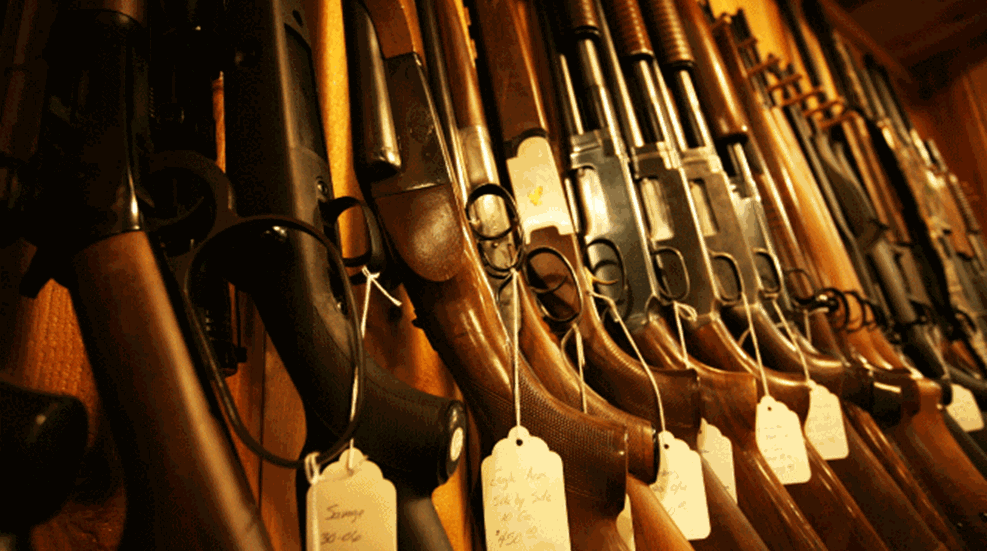
Hunters are increasingly turning to the used market when looking to purchase a rifle or shotgun. As with any significant acquisition, a little knowledge and forethought can go a long way to ensuring you make the correct buying decision. Here are a few tips to guide you through the process and assure you are ultimately satisfied with your used-gun purchase.
Appearance
General appearance is a good first indicator of the condition of any used firearm. A basic visual external inspection will tell you a lot about a gun and, much as it does when buying a used car, will provide you with some insight as to the level of care given by the previous owner. There’s no shortage of used guns on the market, so stay away from anything that looks like the previous owner has treated it with little respect.
Inspect the Bore/Barrel
When purchasing a rifle, the most important consideration is the bore. This should be your first stop in a more intensive inspection. Remove the bolt and look through the barrel from the muzzle end. Any imperfection on the inside of the bore should be treated with caution, as beyond all other variables, this can impact the ultimate accuracy of a rifle. The bore should be round and clean, with the grooves and lands sharp and bright. Any discoloration may be an indication the surface is pitted with rust, a firearm’s most lethal enemy.
For shotguns, check that the action is tight, and be wary if there is any significant “slop.” An internal inspection of the barrel will identify rust problems or other imperfections—these firearms should be avoided. If adapted for removable chokes, check that all the tubes come with the gun or are available from a local dealer. If it’s a fixed-choke model you’re considering, ensure that the choke is going to be suitable for your hunting needs. Be cautious about buying full-choked shotguns, which were common through the 70s and 80s, as there are few appropriate field applications for them today. Of course, most full-choke guns can be bored out to a more open choke, though you should talk to a gunsmith before you buy if you’re considering this option.
Check Function
Externally, ensure that the barrel is straight—it’s not unusual to find them slightly bent. Make sure all factory-installed sights are intact and solid. Check the stock for signs of cracks or repairs, especially around the action, and stay away from any significant damage unless you understand that a replacement stock is likely in your future. Work the action several times to ensure it’s functioning smoothly and, again, look for signs of rusting on the bolt or in the action. Inserting ammunition and cycling it through the action will confirm that there are no feeding problems. Check the safety to ensure that it’s fully functional, and dry fire the rifle or shotgun a few times to help gain insight as to whether there may be any trigger issues.
With autoloaders and pump shotguns, disassemble the firearm and inspect for signs of regular cleaning. As with a rifle, run a few shells through to ensure that the action functions smoothly and as designed. If you plan to shoot waterfowl, be sure that any shotgun you’re considering is steel-compatible and the bore is sized to fit the common shell lengths you’ll be hunting with.
Proper Fit
Proper fit is more important with shotguns than with rifles. Check the fit of a shotgun while wearing clothes of similar bulk to those you’ll wear hunting. Long stocks are easily cut down and if the stock is slightly short, a couple spacers can be inserted at the butt—other fit problems can be expensive to remedy. Be aware that an improperly fitting smoothbore is the surest route to accuracy difficulties in the field.
Gunsmith Inspection
I strongly recommend that any prospective rifle purchase be vetted through a qualified gunsmith’s shop to check for appropriate headspace. Excessive wear through use or poor cleaning practices can reduce headspace and will most assuredly affect accuracy. Poor head spacing also becomes a safety issue for the shooter and provides further, more practical reasons for having any used rifle examined by a gunsmith. This is even more important if you’re considering purchasing a rifle that is relatively old or appears to have had many rounds through it.
Parts Availability
Parts availability is an issue to consider when purchasing any rifle, but especially a used one. For that reason, I recommend sticking with the major manufacturers and/or relatively recent models, as finding parts for old or obscure rifles can be a nightmare. Consider your choice of caliber, too. If you’re a hand-loader, I advise selecting one of the more popular calibers to help ensure availability of components.
Above all else, safety should be your first priority when buying a used gun. A thorough check by a qualified gunsmith of any potential firearm you’re considering purchasing is cheap insurance, especially considering that a quality firearm, if well cared for, can last several lifetimes.
When evaluating the price of used firearms, the bible of pricing guides is widely-known as the “Blue Book of Gun Values.” For more information, go to bluebookofgunvalues.com.