Dick is a family friend who enjoys hunting ducks and deer as much as the next guy. But it’s difficult for me to describe just how badly this man desires to kill a wild pig. Constantly he plots to stalk them, take them over bait or any way he can. And the ranks of hunters just like him are growing like the feral pig populations that mangle our pastures.
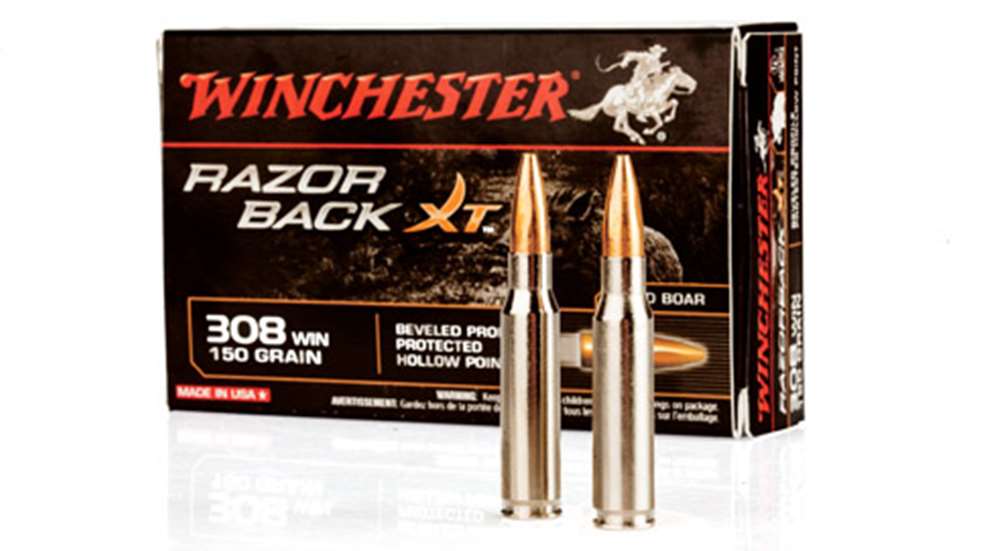
Whether Winchester Ammunition introduced its new Razorback ammo specifically for hogs, or for people like Dick, I didn’t know. I thought it possible the “new load” was simply a repackaged deer hunting round stuffed in an edgy new box and branded Razorback XT to take advantage of a growing market. Winchester calls its Razorback bullet a “lead free, beveled profile protected hollow point.” Translated, it’s an expanding, monolithic bullet like the venerable Barnes X, Nosler E-Tip and Hornady GMX. So it should make a wonderful round for tough hogs with their mud-and-gristle armor. But specifically for them? I raised an eyebrow.
Then I read that it’s specially made to have less muzzle flash, supposedly so it doesn’t ruin your night vision if you hunt in the dark. Mmmhmm. What’s more, the ammo’s case is nickel-plated for slicker cycling in semi-autos.
After phone calls to Winchester engineers and hunting pigs and deer with it, here’s what I found: Razorback XT isn't just for pigs, but it works like magic on them. It’s a super-premium load that features a bullet designed to expand to a set diameter across all velocities, average 99 percent weight retention and penetrate like a DeWalt drill. It’s available in .308 Win. and .223 Rem., obviously for AR-style rifles. For wary pigs where killing as many as possible is the goal—even at night—an AR in .308 caliber, like my Rock River LAR, can’t be beaten. Once I decided on the AR for hunting pigs, the Razorback’s features began making sense. But first, the facts:
The 150-grain .308 bullet has a BC of .344. Winchester touts muzzle velocity of 2810 fps from a 24-inch barrel. It averaged 2606 from my 16-inch AR. (Figure 25 fps less per each inch less than 24.) The 64-grain, .223 bullet has a BC of .247 and leaves a 24-inch barrel at 3020 fps.
Its point is hollow and it's beveled on top (flattened in four places), a design engineers say allows the bullet to fold back onto itself in a controlled fashion. I was concerned with its lack of cannelure around the shank—rings that are proven by Barnes TSX bullets and others to enhance accuracy by giving a place for the bullet’s shank metal to go when displaced by the rifling. Winchester says it accomplished the same thing by beveling and deepening its hollowpoint past the ogive. They say it allows the bullet to give a little to accommodate displacement. I found the bullet in general was accurate in the .223 (1 MOA) and in my .308 (1.6 MOA). Of course this has much to do with the rifle. (Note that a .308 AR has a heavy action spring; if you experience a jam check whether the bullet has been pushed down into the case.)
I shot a 250-pound axis buck at 200 yards with the Razorback .308 and it succumbed within seconds. The bullet hit the front shoulder, penetrated the lungs and heart, broke the off shoulder and came to rest in the off-side skin. I recovered it and it looked like a catalog model. Another shot fully exited a 125-pound axis doe at 30 yards—killing it instantly—and another did the same thing on a 150-pound boar shot at 65 yards—both testaments to the bullet’s toughness. The mud-matted old boar just keeled over and died. My buddies took a dozen other animals, and of the few bullets recovered, even the .223s, all looked the same: perfect.
I still believe a .223 with a regular softpoint is too fragile for deer and hogs, and an FMJ bullet is too zippy. But an expanding monolithic bullet can turn a .20- to .24-caliber rifle into a bona fide hunting round. It will penetrate through the shoulders of deer while expanding to 1.5 times its original diameter. I wouldn't hesitate to shoot an elk in the shoulder with the .308 Razorback.
Concerning the “special powders” that lessen muzzle flash, engineers informed me that the U.S. military has demanded the stuff for years. It’s proven to work: A chemical coats the powder to retard burning as it becomes ejecta. It only has one drawback: It raises cost. I shot various types of premium .308 ammo, including Razorback, on an unlit indoor range, and all of them exibited surprisingly little muzzle flash. Basically, it is a real advantage if hunting at night (or for self-defense scenarios) but it's nothing new.
Concerning the pretty nickel-colored case: It is certainly slicker than brass and it oxidizes less. I experienced zero failures to feed or extract while shooting more than 400 rounds in both .223 and .308.
All in all, Razorback is excellent ammo for all medium to big game. You can kill hogs and deer cleanly with the .223 at average ranges, but I always err on the side of over-bore when in doubt, so I prefer the .308. Both calibers do all the things Winchester claims. Of course it was named in part to appeal to the surge of pig hunters, but it was also designed for pig hunting. At any rate, I’m buying a box for Dick.
Technical Specifications:
Bullet Type: expanding monolithic
Construction: hollow point, flat base
BC: 150-grain, .30-cal. .344; 64-gr. .223 cal. .247
Calibers/Weights Available: 64-gr. .223 Rem., 150-gr. 308 Win.
Uses: medium to large game (small pigs to large deer and exotics)
MSRP Per Box of 20: about $35