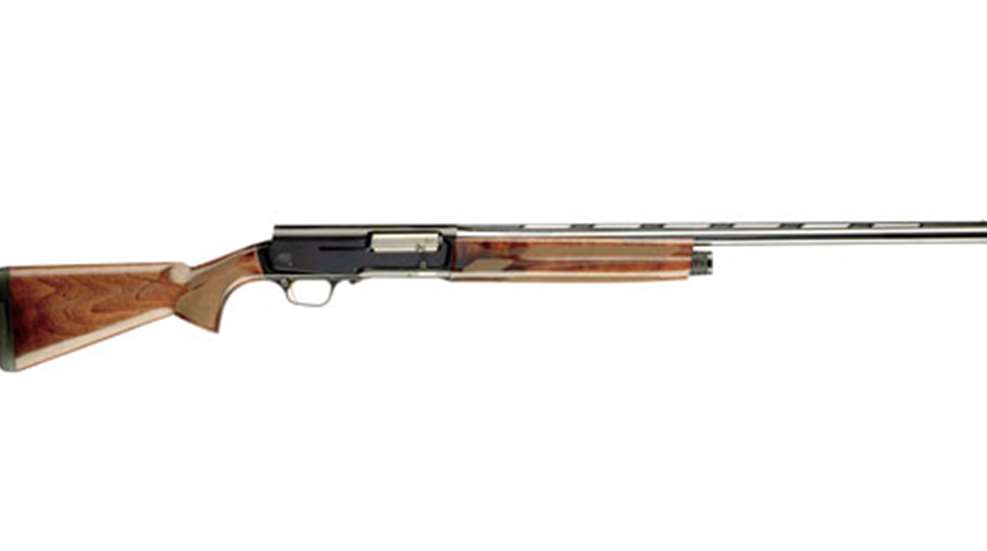
My grandfather didn’t own a Browning A5, nor did my father. But my friend’s did. I remember comparing my Remington 870 Wingmaster—a well-used shotgun my father gave me when I was 14 years old—to the Browning A5. Even then I thought the A5’s “humpback” design was distinctive, cool looking and, even at that impressionable age, I knew the gun was backed by a reputation of reliability. That impression came flooding back to me at an unveiling of the new Browning A5 at a writer’s seminar in South Dakota.
“But wait,” said Scott Grange, Browning’s director of public relations, “this isn’t your grandfather’s A5.” He wasn’t kidding—that phrase has now become the company’s slogan.
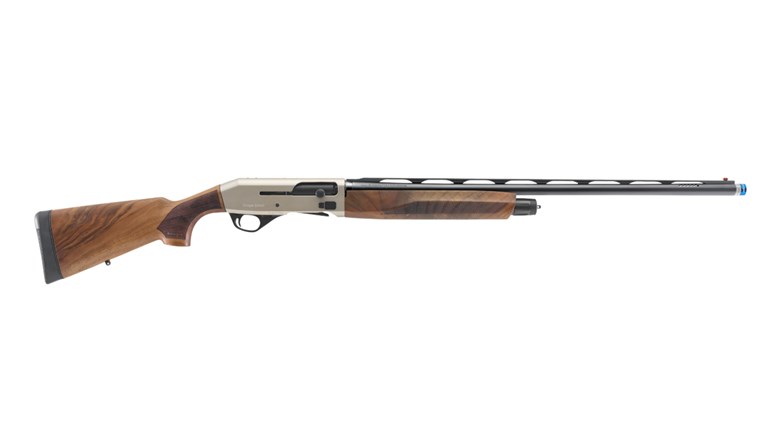
This shotgun would please John Moses Browning’s innovative spirit. This incarnation of the Auto-5 no longer has the long-recoil (recoiling barrel) system of the classic A5. It has a new short-recoil system. Named the “Kinematic Drive System,” its engineering is very similar to Benelli’s Inertia Driven action.
The A5’s Lineage
The Browning A5 was the first mass-produced semi-automatic shotgun. The name of the shotgun was derived from the fact it was designed to be an autoloader that had a capacity of five shots—four in the magazine and one in the chamber. Designed by John Moses Browning in 1898 and patented in 1900, it was produced continually for almost a century by several makers with production ending in 1998. Its receiver’s distinctive rear end (its “humpback”) allows the top of the action to go straight back toward the shooter’s cheek, level with the barrel before cutting down sharply toward the grip. The A5 was produced by several manufacturers from 1902 to 1998.
tJohn Browning presented his design to Winchester in 1900. When Winchester didn’t like his terms, Browning went to Remington. Tragically, the president of Remington died of a heart attack as Browning waited to offer them the gun. Browning then took the design to FN, which started making A5s in 1902. Browning would later license the design to Remington; they produced it as the Model 11, the first auto-loading shotgun made in the United States, from 1905-1948. Savage Arms also licensed the design from Browning and produced it as its Model 720 from 1930-1949, and as its Model 745 from 1941-1949.
With that taste of its history in mind, we should now note that its engineering is much more modern.
Paolo Benelli invented the Inertia operating system in the 1980s and was granted a patent in 1986. It uses the recoil from the shell, in combination with a floating bolt that resists movement (inertia), and a stout “inertia” spring hidden within it, to operate the action. So while it can be called a recoil-operated action, it’s different from traditional long-recoil-operated systems that rely on a rearward-moving barrel to cycle the action. Benelli’s patent prevented other manufacturers from using the technology for two decades. During that time Benelli shotguns earned a reputation for extreme reliability. By not using gas from a shotshell to cycle the action, a recoil-operated (inertia) gun sends all gas and grime out of the barrel, keeping its mechanical parts cleaner and thus less likely to fail over time.
Along with its inertia-operated system (Browning spent five years getting this gun right), the A5 also features Browning’s new Invector DS (Double Seal) choke tube system. The DS system has threads at the top of the tube and a brass band around the bottom that act as a seal to keep fouling from getting in between the choke and the threads.
The shotgun also has a handy new feature Browning calls the “TurnKey” that allows hunters to install or remove the magazine plug with the use of an ordinary car key.
The Field-Test
We began with five-stand. After I cycled 200 shells through the A5, I pulled the choke tube. It was so clean I had to look down at the pile of spent shells at my feet to make sure I’d shot as much as I’d thought. While shooting the 1-ounce loads the gun failed to cycle once for me.
Next we took various iterations of the A5 out for pheasant. No one experienced a malfunction with pheasant loads. Being a short-recoil-operated gun—not a “gas” gun—it does kick harder than a gas semi-auto, but less than a fixed-breech gun. To tell you the truth, I couldn’t tell the difference, though I did notice that a Browning over/under I also used certainly had more recoil than the A5. Waterfowl hunters will likely notice a little more recoil than they would get from a gas gun, but to me it’s negligible. Part of the reason is that Browning fit the A5 with the Inflex II recoil pad. (Waterfowlers from the bygone days who had steel buttplates on their A5s would probably call anyone who complained about this new A5’s recoil a “wuss.”)
The Final Analysis
The A5 is a light, 3-inch, 12-gauge gun weighing a hair over 7 pounds with a 28-inch barrel. Its stock comes with shims to adjust fit. I found it to be an easy gun to carry, point and shoot.
The A5 also has the speed-load feature that has become a Browning characteristic. When you push the first shell most of the way up the magazine tube, the shell is loaded into the chamber and the bolt slams shut to lock it in. This is a handy feature when your gun is empty and the geese are still circling.
I found that the carrier stop button is big and easy to find on the bottom of the receiver—even when I wore gloves. I also found the safety, much like the Gold and Silver shotguns, to be big and easy to use. It is also simple to reverse to left-handed.
The A5 will be available in 26-, 28- and 30-inch barrel lengths. It will come in a wood-stock version (Hunter), synthetic (Stalker) and camo (Camo). The suggested retail price will range from $1,399 to $1,599.
I’m sure people will pull it off shelves and run their thumbs over its humpback, maybe with visions of geese cupping wings and setting out their landing gear dancing through their heads. And that’s good, because a hunting gun should be romantic (or nostalgic) as well as practical and infallible. This one is all that.
Technical Specifications:
Gauge: 3", 12-gauge
Barrel: 26", 28", 30"
Magazine Capacity: 4
Sights: fiber optic front bead
Safety: reversible
Stock: wood or synthetic; LOP 141/4"; drop at heel 2"; drop at comb 13/4"
Overall Length: 475/8"-515/8"
Weight: 7 lbs., 3 ozs. (wood stock, 28" barrel)
Finish: blued, camo or matte
MSRP: $1,399-$1,599