Today's thinking-man hunter can take advantage of multiple-crosshair riflescopes that compensate for bullet drop and wind drift and can help determine the distance to big-game animals. One needs a little training and practice with such scopes, along with the presence of mind to employ the reference marks in a key moment. Or if you're like me, you might prefer a new class of "optronic" instruments-which marry optical and electronic components-that do the thinking for you.
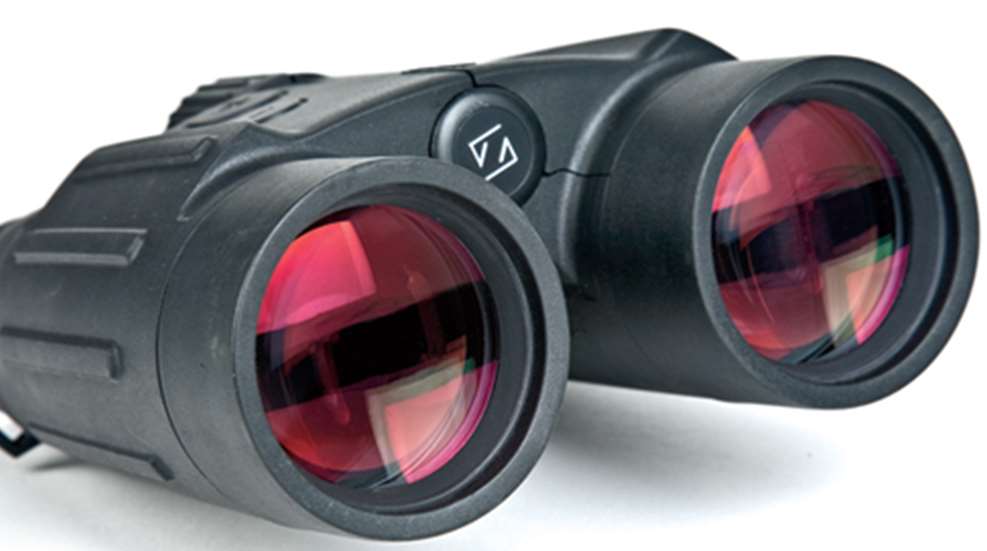
A prime example is the new Victory RF (rangefinding) series from Zeiss. Including excellent binoculars and a handy rangefinder, these units contain lasers and mini onboard processors that not only range the game, but also instantly calculate the necessary holdover when shooting at a distant target.
As stated in this magazine's January 2006 issue, Zeiss Victory binoculars are as good as they come. For the most demanding users, their ability to transmit bright, clear images justify prices that can exceed $2,000. And no wonder: The lenses and prisms are made from the world's finest optical glass treated with Zeiss's exclusive T* and LotuTec lens coatings. Those elements come in a handy, lightweight, rubber-armored glass-fiber housing equipped with easy-to-use controls. In our extensive field use, Victory binos have earned straight As both for optical performance and durability in harsh conditions. The Victory RF line offers 8x45, 10x45, 8x56 and 10x56 models.
The Victory PRF rangefinding monocular marks Zeiss' first entry into this specialized category, and it appears the company made a conscious effort not to try replicating trendy micro units. At 11 ounces, the sandwich-sized Zeiss rangefinder is bigger, but compensates by being a superior optical tool. Boasting the same glass and coatings as other Zeiss optics, the 8x26 monocular transmits such superb images it can be counted on as a backup to one's binoculars.
Where all Zeiss RF and PRF models really distinguish themselves is their ability to range targets fast and at longer distances than other rangefinders I've used. The "1850" reading I got from the Victory 10x45 RF bino when ranging a shiny tin roof far exceeded any previous readings. Even more impressive was a performance at dusk as my partners and I glassed a wide-open Texas floodplain for whitetail bucks. Along the far edge of the timber we spotted a huge, spotted feral hog. I had already been teasing the others by calling out yardages to various deer that their rangefinders failed to "find." So I lasered the big pig, failed to get a reading on the first go, but then got "1519" on the second push of the button. Incredible! In fact that proved to be a realistic indication of Zeiss units' long reach.
There are no competitors when it comes to Zeiss' Ballistic Information System (BIS) that's found in the RF and PRF units. BIS is the internal calculator that immediately follows up the range reading with a holdover correction. Based on target distance, the rifle's zero and a user-programmed ballistic setting, the RF models will inform how high or low the shooter must hold to hit dead-on.
The BIS can be synched to 12 different ballistic groupings keyed to specific load trajectory and sight-in distance (six each corresponding to 100- or 200-yard zeros). To determine the proper setting, a user needs to cross-reference bullet trajectory data of his load with tables in the manuals supplied with all Victory RF equipment.
Often that trajectory info will be printed right on the ammo box, but if not, it's easily obtained online. Say a hunter is shooting .30-06, 180-grain Remington Core-Lokt SP, zeroed at 200 yards. Remington says point of impact will be minus 4.4 inches at 250 and minus 11 at 300, which matches up with the US3 "curve selection" designation published by Zeiss in the Victory RF manuals here.
For the RF binoculars I fired a Hornady .300 Win. Mag. 165-grain Interbond load and for the PRF the test load was a Federal Premium .243 Win. 100-grain Nosler Partition. Both loads were zeroed at 100 yards, then bullet drops were observed on paper targets at 300 and 400 yards. The .300 magnum load fit the US1 group profile and the respective 300- and 400-yard holdover cues were H9 and H23. Measuring to the approximate center of my five-shot groups, my mean point of impact was minus 9.6 inches at 300 and minus 22.2 at 400, thus a close correlation. The .243 Win. loading fell into the US3 group, and the readings from the PRF told me to hold over 14 inches at 300 and 33 at 400. Actual firing showed the load shot somewhat flatter than the Zeiss programming indicated, as the centerpoints of my respective groups measured minus 13.1 inches and minus 29.8.
Because of the size of my groups at 300 and 400 yards, I'm not sure how much to make of the disparity between the instruments' calculations and the actual results. Certainly it could have been skewed by the random spread of hits, and a truly definitive comparison would require more extensive shooting. For me, this exercise reiterates the importance of verifying equipment performance with as much real-world observation as possible. It nonetheless confirms just how well Zeiss did its homework in designing what truly are innovative tools for hunters.
Type: rangefinding binocular
Magnification: 8X (tested); 10X
Objective Lens Diameter: 45mm (tested); 56mm
Focusing Range: 18' to infinity
Eye Relief: 16mm
Exit Pupil: 5.6mm
Field of View @ 1,000 yards: 375'
Power Source: 1 (CR2) battery
Coatings: T*, LotuTec
Dimensions: width-5.3"; length-6.6"; weight-35 ozs.
Construction: glass-fiber housing, rubber armor
MSRP: $3,222 (bino)