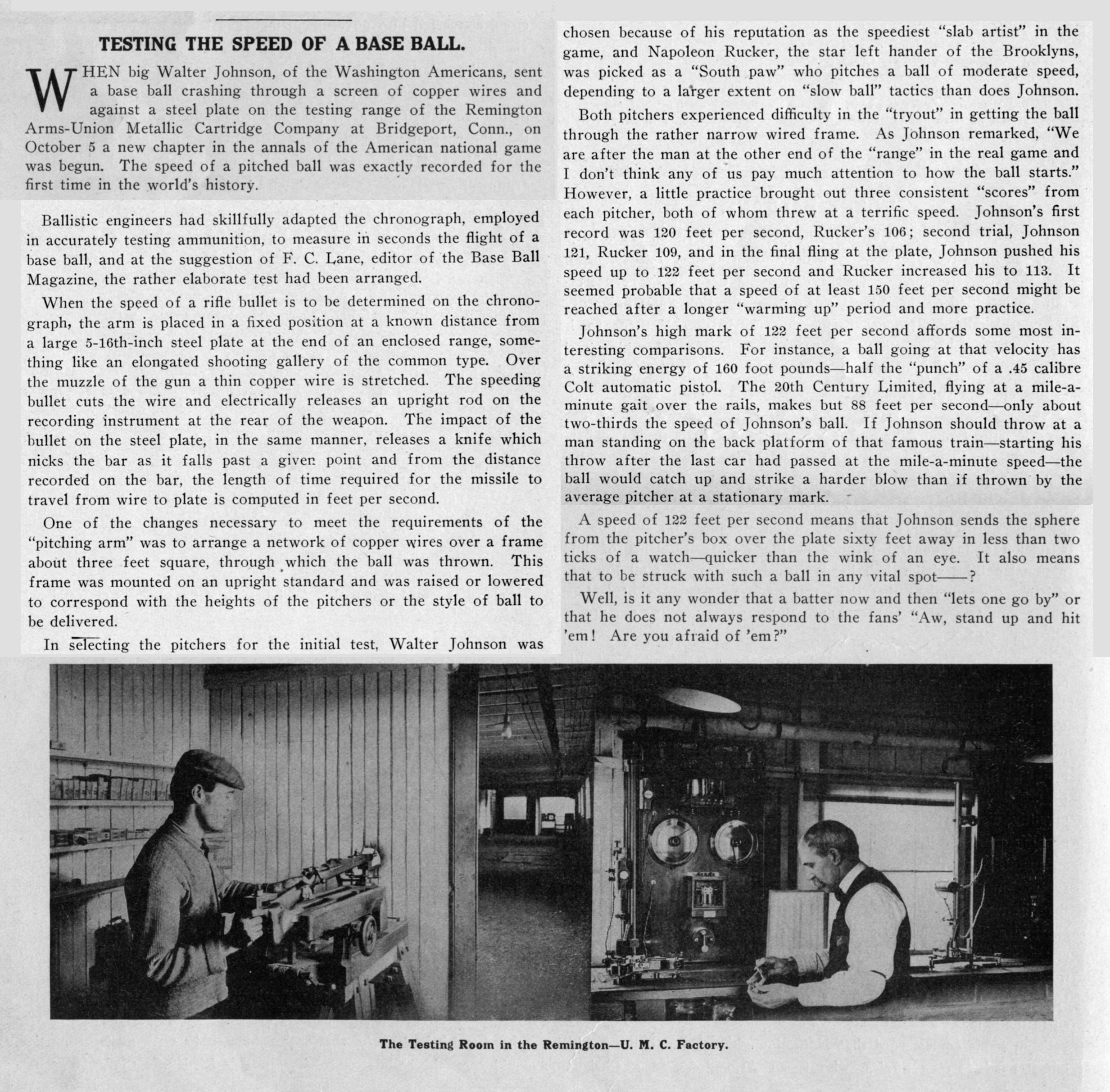
What’s more American than hunting? Well, nothing, except maybe shooting in general, but baseball is a close second. And with baseball season coming to its climax, it was of particular interest to us here at American Hunter to discover that Remington, which is currently celebrating 200 years of manufacturing some of America’s greatest firearms, actually got involved in another sport far from the shooting and hunting realm most associate with the firearm giant.
Roughly a century after Eliphalet Remington entered the firearms business, baseball powers turned to Remington Arms in hopes of conducting an important experiment for the sake of the game. Using an early chronograph, Remington Arms-Union Metallic Cartridge Company in Bridgeport, Connecticut, undertook a project that would ultimately become a fascinating piece of baseball history.
Nearly 104 years ago, Remington used equipment it normally reserved to measure the velocity of bullets to officially measure and record exact pitching speeds for the first time in history. The story, according to V. 53, No. 3 of Arms and the Man—a periodical that was the precursor to our sister publication American Rifleman—goes like this.
On October 5, 1912, at the request by F. C. Lane, the editor of Base Ball Magazine, ballistic engineers at the Remington factory had cleverly and carefully modified the facility’s chronograph to measure the speed of a pitched baseball in feet per second. The main change required that a series of copper wires be arranged in a three foot square that the baseball needed to pass through, and could be moved to compensate for the varying heights of the pitchers and the type of pitch that was thrown. The pitchers selected to measure throwing speeds were Walter Johnson and Napoleon Rucker, the former for his speed and the latter for his arsenal of pitches.
They both had slight difficulty "hitting the target," which Johnson even commented on in his own firearm analogy. "We are after the man at the other end of the ‘range’ in the real game and I don’t think any of us pay much attention to how the ball starts." After a few practice pitches, however, each pitcher recorded three throws. Johnson threw every pitch over 120 FPS (which was his slowest pitch. His high was 122 FPS, or just over 83 MPH, giving his recorded results an “extreme spread” of 3 FPS, which is more consistent than any rifle I’ve seen). Rucker easily threw over triple digits consistently, regardless of the pitch type (a low of 106 FPS, which is slightly more than 72 MPH, and a high of 113 FPS, or roughly 77 MPH). The results were estimated to reach into the 150 FPS (at least 102 MPH) range if they were able to throw as accurately as they could fast, but weren’t capable of producing those results under the given conditions. Based on the math, Johnson’s fastest pitch recorded went from his hand to the catcher’s mitt in under two seconds. Quite a feat even now, let alone back then.
To put this in perspective of the technology available at the time, the 20 Century Limited, a train that traveled at 88 FPS (60 MPH), was only going two-thirds the speed of any one of Johnson’s pitches, and about 20 percent slower than Rucker’s most sluggish pitch. Energy was also calculated, and Johnson’s fastest pitch of 122 FPS produced half the energy of the then-new .45 ACP round that was created only a year before (after its introduction in 1911), or around 160 foot-pounds.
Because of the chronograph technology Remington had made available to the baseball community at the time, the world of baseball was changed forever.
Excerpted from V. 53, No. 3 of Arms and the Man