My little (inner) voice was insufferable this morning and it was ticking me off.
If it shows up at all, most days it takes a passive aggressive approach: “Hey, I am just saying, you can do what you want.” But this morning it was cranky.
The day was late in a long and discouraging deer season and I was tired. The hike in seemed to grow longer every time I did it and I am not a morning person anyway, so I was more than a bit late getting to my stand. I climbed the ladder in good light and settled down to what all modern hunters do in this circumstance: I started looking at my phone.
That’s when my little voice turned cranky.
It’s a trait I inherited from my paternal grandmother. I can’t control or predict it, but over the years it’s developed a good track record. That little voice has kept me out of bad situations in life, and when it comes along on a hunt it has resulted in success far too many times to think it’s not real. Still, I was being stubborn and petulant that morning, trying to ignore the intrusion on my foul mood.
“Go away,” I thought. “I want to sit here and pout. I want to wallow in my bad luck and have a sour morning where I can hate deer hunting and the world.”
The little voice did what it rarely does and it overrode my demands and began to crank up the volume. Finally I came to my senses and I put the phone in my pocket.
Right away I noticed that the morning had become unusually still. There was no wind and no sound, no birds, no squirrels and no trees moving. Even the dogs in the distance had gone quiet. It was as if I had been struck deaf. (No, my hearing aid batteries were not dead.) I have seen this happen in the North, usually on a very cold morning. But this was Mississippi, and even though it was January all I had on was a thin liner jacket. Still, for a few moments, everything stopped and the world just shut off. This always seems to happen just before sunrise and it becomes almost like a sensory deprivation moment. I had barely noticed that I had stopped breathing in solidarity when a flash of movement to my left drew my eyes.
This stand is an old friend from which I have enjoyed many days of hunting over the years. Each year the deer seem to act a bit different and tend to travel new routes not used in years before. This year they were sticking to a thick patch of brush, in front and to my left. This deer was on that path, one several deer had used in the days earlier that week without giving me a good look at any of them.
It was not a good path from my perspective. Often the deer granted me just a flash or two of movement through the branches. A few days earlier, that flash included a brief look at a good set of antlers. They were gone as soon as the image registered, which left me wondering later if I had imagined it.
Then another glimpse of swinging leg told me the deer was moving closer and on a slightly altered line than the others had taken.
I picked up my rifle and got ready, looking through the dialed-down scope rather than past it. I learned a long time ago that when it happens, it can happen very fast. Often these little things make a big difference.
The buck stepped out on the narrow woods road and was looking straight at me when he stopped. As has happened many times over many decades of hunting whitetails, I could see in his eyes he was going to bolt. That happens so fast that deer always get away. All they need is the brief time needed to move the eye’s focus to the sights. This time, my focus was already there. I pulled the trigger. Time lapse from seeing the deer to the shot was a fraction of a second.
The blood trail ran though some thick and thorny brush. As I walked it I remembered my expensive down liner jacket erupting into a snowstorm of feathers while tracking a deer shot from this very stand a year earlier. The liner was made to be worn under a protective top layer and the shell is thin to reduce weight. It now had an ugly patch on one arm, and I thought that one patch was enough. I had walked around the thorns the blood trail had passed through, trying to get back to that blood trail, when I saw the buck lying in a little depression at the bottom of the hill.
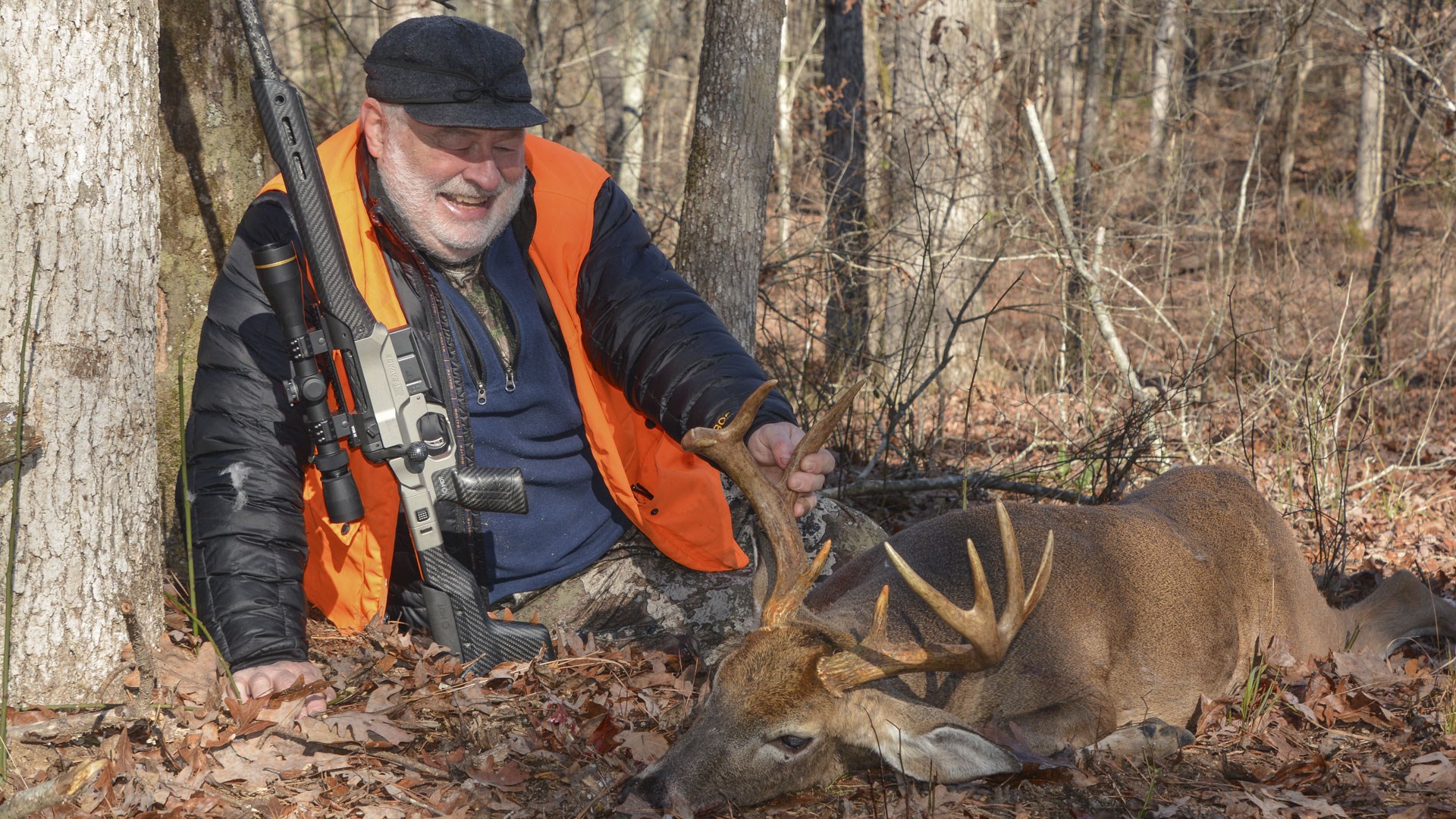
There had been no time to judge antlers before the shot. I was not being picky; any adult buck would be fine. This part of central Mississippi is not known to be full of huge trophy bucks anyway and all I wanted was a legal, adult representation of the deer that lived here. My impression was that it was a young buck with a modest rack, which was fine as I wanted meat more than inches. I had made all the calculations and decisions well before he showed up and I was good with what I expected.
Most experienced hunters know about ground shrinkage all too well. When we first walk up on the critter of our attention, often there is a moment of disappointment as things are suddenly smaller than expected. But, sometimes, not often, the opposite occurs. My best whitetail from Arkansas years ago springs to mind. His antlers grew bigger with each of the 409 steps I took to get to him. So too did a brown bear on Chichagof Island in Alaska that morphed into the best the outfitter had taken in decades of hunting. Still, I could provide a hundred tales when critters grew smaller in contrast to these two anecdotes.
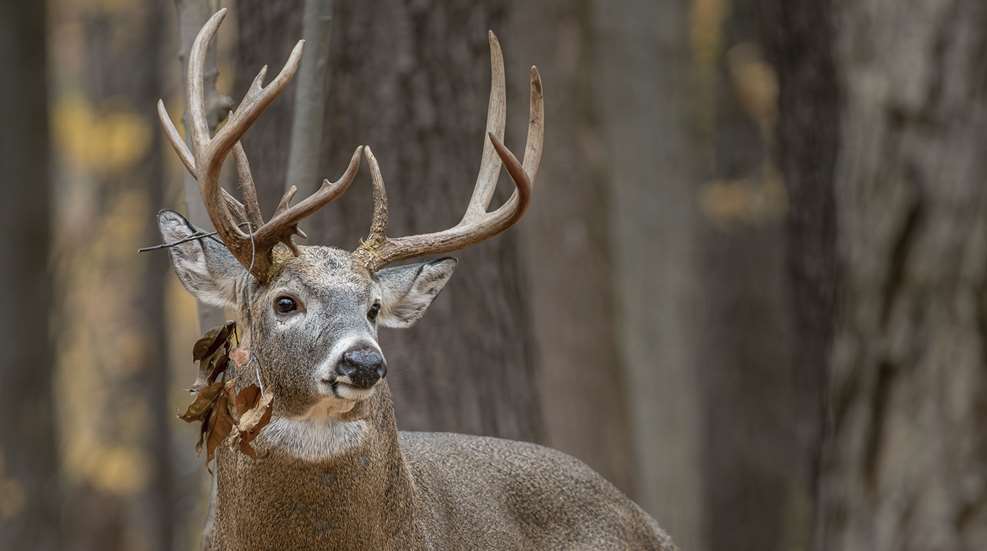
I could see the curve of a main beam above the ground litter, and as I approached the antlers grew thicker and larger than the flash image still fresh in my mind. This was a pleasant surprise and a good ending for months of hunting.
It was the last day of deer hunting for a season that had started in New England in October. Several states, many cold mornings and a lot of miles on these tired bones ended here. It turns out that it was not a bad place to stop and call it a year.
He was not a huge buck by whitetail standards, but he was bigger than I expected. While I am honest enough to admit that I covet big antlers like any other hunter, I am also experienced and jaded enough to understand reality. Besides, my priorities have changed with the years and now I desire the experience far more than the score. Experience is hard to brag about. It doesn’t hang on the wall or develop a big taxidermy bill. Experience is fleeting and sometimes tough to define, but a hunter recognizes its value once deer hunting turns personal.
This buck was a result of experience and knowledge, which makes it important. I heard that little voice reminding me to be ready and half a century of hunting to know how to be ready. Small things, like watching through the scope and being quick with the shot, made the difference. Had I taken any time at all to look over the antlers, he would have escaped. The knowledge that I did right is my trophy.
The antlers will be a reminder of that and a catalyst to remember a great hunting trip. As the years flash by, it’s become evident that there are far too few of those left ahead of me. The joy of this hunt with all the little pieces and parts combine to make it memorable and a trophy.
Of course I was lost in those thoughts when I noticed that my jacket was leaking white feathers again. It seems that somehow I had torn another hole in the nylon. The path behind me was littered with down. It would have not taken a very bright Indian to track me.
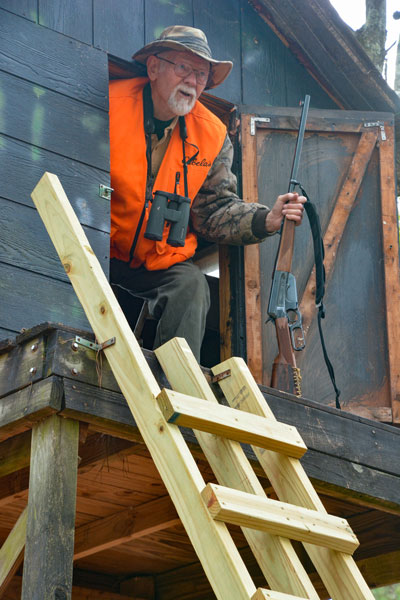
Long-time readers recognize that I hunt in Mississippi pretty regularly. My good friend Tony Kinton lives there and these days we try to do two hunts each year. He comes to Vermont to hunt woodcock and see the fall foliage and I go south to escape the brutal winter and to shoot a deer or two. We don’t make it every year, but when we don’t there is a good reason. There are simply too few nights around the campfire remaining for both of us and it’s a sin to waste them.
While we had been hunting in the Mississippi Delta for several days prior, this day we were back on Tony’s farm in central Mississippi. In the Delta we had chased squirrels with dogs, which is an adventure that will be in another feature article. I also shot a few does to help with the management program of the deer lease where we were and to get some meat for the freezer. For the first time in as long as I can remember I was nearly out. I had one package of stew meat left that I refused to use as it would be a threshold I didn’t need to cross. As long as I had that package I was not out of venison.
Part of that shortage was because I was experimenting with making pemmican for an expected article that didn’t pan out. Pemmican takes a lot of meat and was another reason I was hunting does as I was planning to make a lot more when I got home.
I filled a large cooler with the best cuts of the three deer and donated the rest to Tony’s friend Neil Boler. If you really are a long-time reader you will recognize him from the story on coon hunting a few years back. He is a Chuck Berry lookalike and a longtime friend of Tony’s. Neil grinds the meat then donates the finished product to the many needy families in the area.
The only thing consistent in deer hunting is the inconsistency. I have had the privilege of hunting on Tony’s farm for several years. It’s not a huge place, a couple of hundred acres, and I have become well acquainted with it.
The very first morning I hunted there I witnessed a parade of bucks, each one a little larger than the one before. I have seen this phenomena a few other times, almost always in the South. I have experienced it in Alabama, Louisiana, Texas and more than once in Mississippi. I have painfully learned that there is always an end to the chain. If you keep waiting for a bigger one to show up, sometimes you realize that the best one has already passed.
That morning a nice 10-point buck was the fourth antlered deer to come down that same trail. He almost got away when he moved off the trail and into some thick brush. I had a quick shot at him quartering away a split second before we walked down the hill and out of sight. That was the year that, at my insistence, Barnes introduced the 200-grain TSX load in the .35 Whelen. For a while they had a sign at the SHOT Show calling it the “Towsley load.” I had some early samples and shot that buck nearly end to end.
While over the years Tony has moved the stand around a bit for better positioning, the basic location has remained the same. The travel routes of the deer have not, and their changing preferences is why we moved the ladder stand. I have hunted most of the farm, but have come to realize that “spot” is in sync well with me and it’s become a favorite. I have collected several more deer and missed a few over the years while perched in that steel tower.
Then came January 2024.
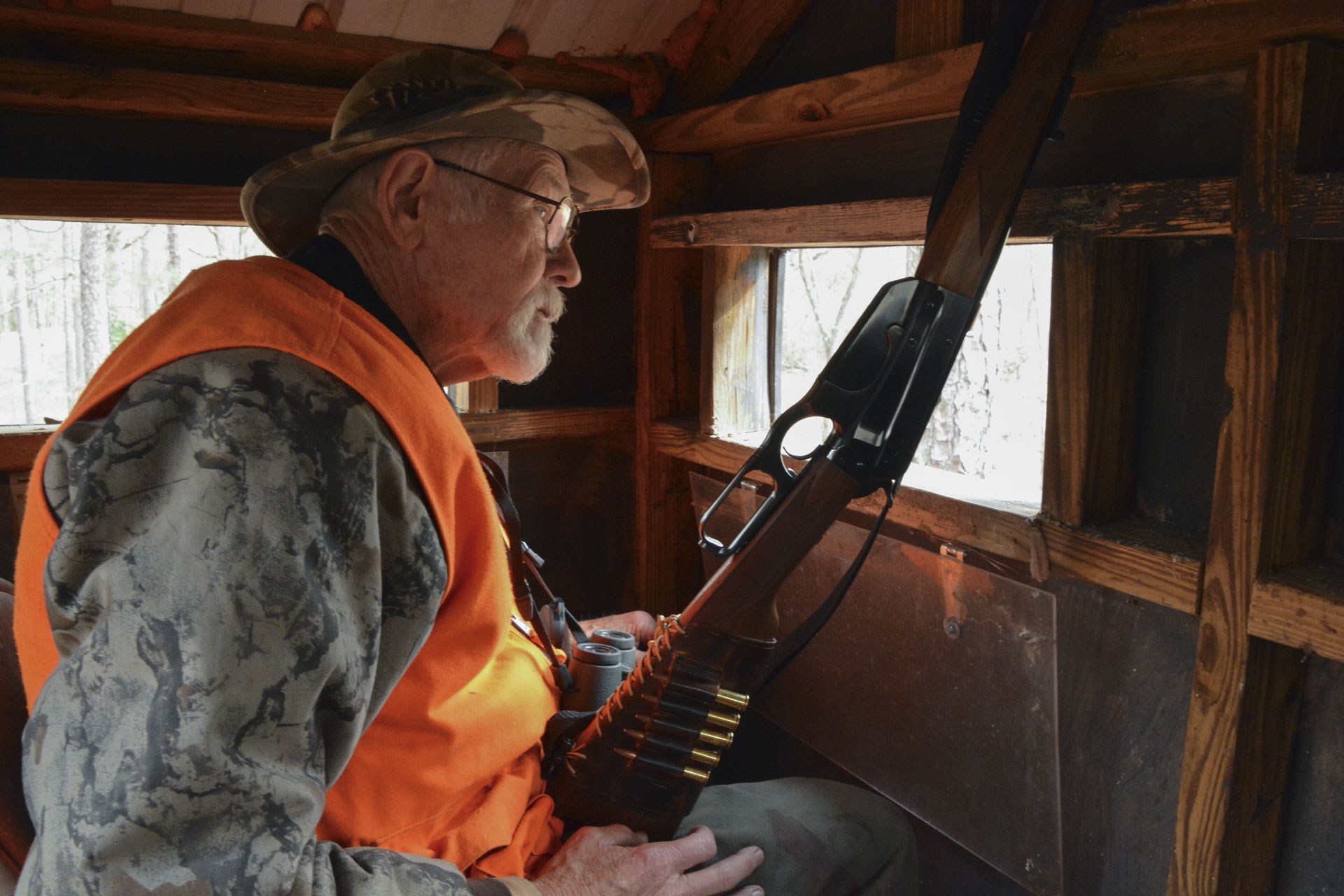
Three of us hunted the farm for several days then and concluded the deer had all left before we got there. Tony’s cameras showed a lot of deer and a bunch of bucks, up until a day or two before our hunt. It was as if aliens had abducted all the deer on the place. Well, except for two does that were hanging out daily by my stand. In several days of hunting they were the only deer anyone saw, in a place that is usually infested with whitetails. I ended up shooting one of the does late in the hunt. It was the source of that package of stew meat living lonely in my freezer and how I ripped my jacket.
We never solved the mystery of the disappearing deer, except that other hunters all over the state were experiencing the same thing. It’s that inconsistency thing I mentioned.
In January 2025 I was back in “my stand” early on the first day we hunted the farm. Right at first shooting light I saw a big doe standing on the overgrown woods road in front of my ladder stand. She looked accusingly at me and I wondered if it was the other one from last year. After a while she wandered off and about the time I got bored that possibly imagined buck I mentioned earlier filtered like smoke through the brush to my left.
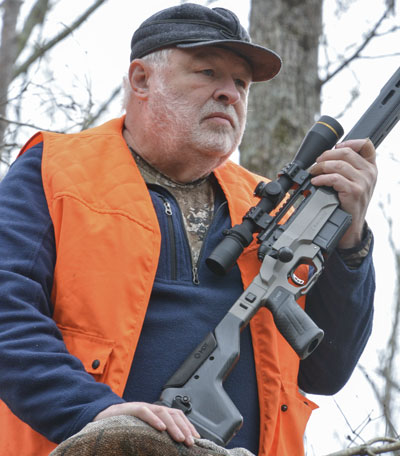
I was seeing just enough deer to keep my attention. Most were in that thick brush and were just flicks of movement. Enough to know they were deer, but not much more. I tried a few more stands, saw some deer, but my little voice kept telling me to go back to “my” stand.
That last day I woke up in a foul mood, induced no doubt from fatigue and a growing hatred of deer hunting. I puttered at the truck, taking too long to organize my gear, and I sauntered when I should have hiked the mile or so to the stand.
The rest is detailed at the outset. Clearly, the inconsistency of deer hunting can move in multiple directions. Somehow whatever is controlling it has a sense of timing that is amazing. That inconsistency, call it fate, can tell when it’s messed with a hunter enough and it’s time to drag him back into the fold.
That’s then when it presents a gift, one that solidifies the foundation of why we as hunters come back every year to the sport we love.
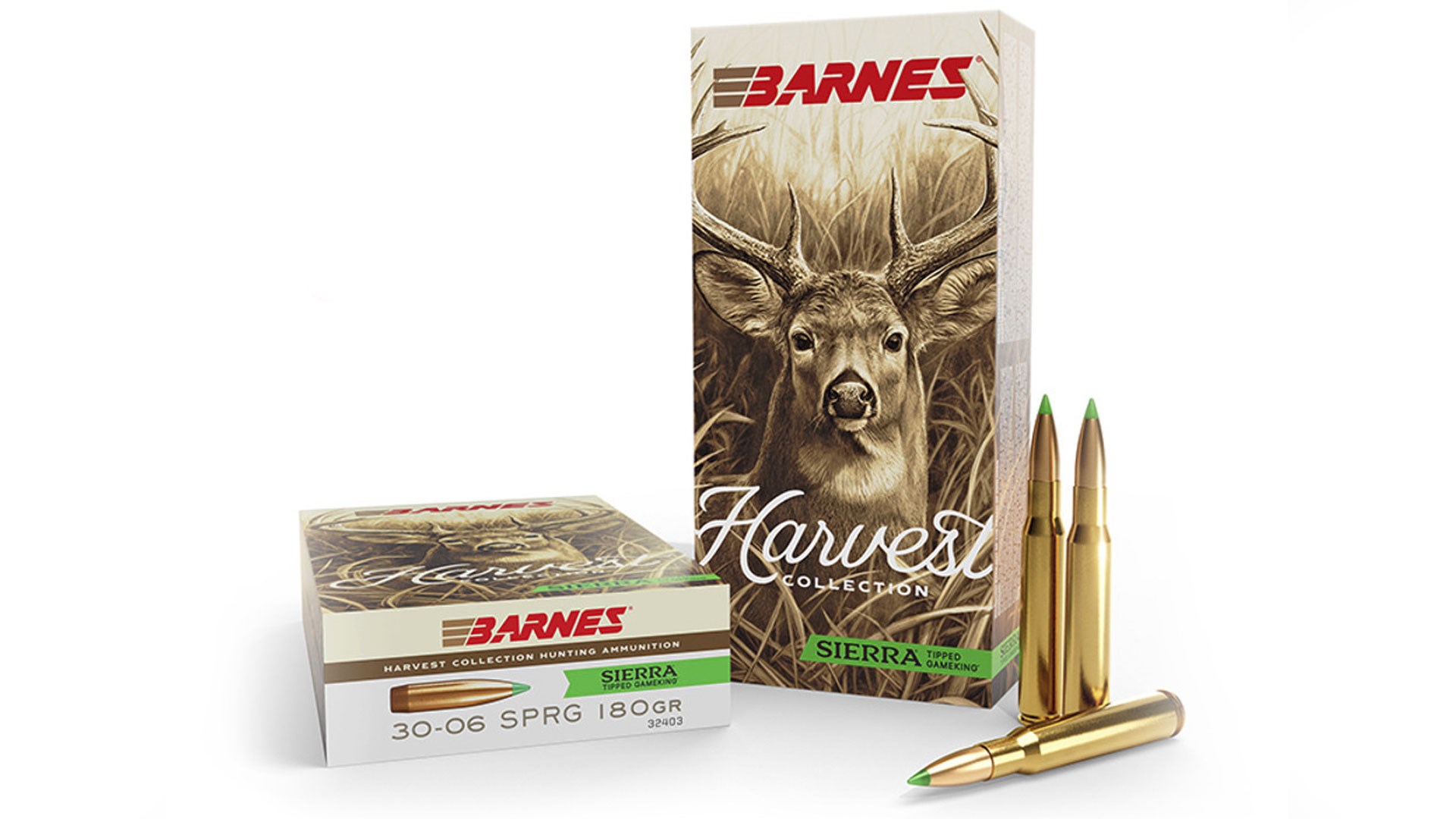
Barnes Harvest Collection
When the Remington group declared bankruptcy a few years back the various divisions were sold off. Sierra Bullets bought Barnes Bullets and the first product of the marriage was a bit of a surprise as they loaded Sierra bullets in Barnes ammo, rather than the other way around.
Sierra sent a few boxes of ammo for my January 2025 Mississippi hunt marked “confidential.”
Harvest Collection uses Sierra Tipped GameKing boattail bullets in ammo loaded by Barnes. These boattail bullets have a very high ballistic coefficient and of course are extremely accurate.
I was hunting with a Savage 110 Ultralite Elite rifle in 6.5 PRC fitted with a suppressor. The rig shot this stuff into tiny groups averaging .51 inch, with the best measuring .25 inch.
This is perfect ammo for long range. I had expected long shots in the Delta, but all three of the deer I shot were relatively close, the longest 125 yards. That’s good from a bullet-testing point of view. It’s difficult to make bullets that perform well at long range and hold their integrity with the higher velocity of close-range impacts. I am a bit of a bullet snob and was prepared to find fault with this design, but I could not. The performance on all three deer was nothing less than perfect. I had complete penetration, large wound channels and no indication of the bullets shedding parts or pieces. While I didn’t recover any bullets, it was clear that they held together while expanding and penetrating well. Knowing Sierra bullets, I have little doubt that they will still expand at any ethical range on deer.
Harvest Collection is initially offered in nine different cartridges: *.223 Rem.; .243 Win.; .270 Win.; *6.5 Creedmoor; *6.5 PRC; 7mm Rem. Mag.; *.308 Win.; *.30-06 Springfield and .300 Win. Mag. I tested the cartridges with an asterisk for accuracy using nine rifles. The 100-yard average for 27 groups was .73 inch. Many groups were sub half-inch and the best were in the .2’s. I used a 30-year-old .30-06 that averaged 1.36 inches, which is as good as that rifle has ever shot. If I throw out that data and use only newer rifles, every rifle shot under an inch with the average being .65 inch for 24 groups.
Remember this is hunting ammo. Those groups show better accuracy than most match ammo can produce. It seems like I say this every time I am testing new ammo these days, but in an adequate cartridge this might well be the best deer-hunting ammo currently on the market. barnesbullets.com
Most Popular