I was on the ground and fully drawn, mere feet from a doe, when my attention shifted away from her chest and to the sound of crunching leaves. A 10-point buck was bird-dogging her with his head down, oblivious and coming directly at me. I had no shot. Fifteen yards... 10 yards...
When my scent overwhelmed his libido like smelling salt, the buck wheeled and high-tailed it. But all wasn’t lost—I’d driven to suburbia for deer meat, so I mentally shrugged then re-focused on the doe. Smitten but now confused, she paused. I guessed 18 yards, so I put the triangular point of the single, vertical pin on her heart and released. My arrow stitched through the animal as neatly as a Singer sewing machine. In my mind that’s much neater than death-by-SUV.
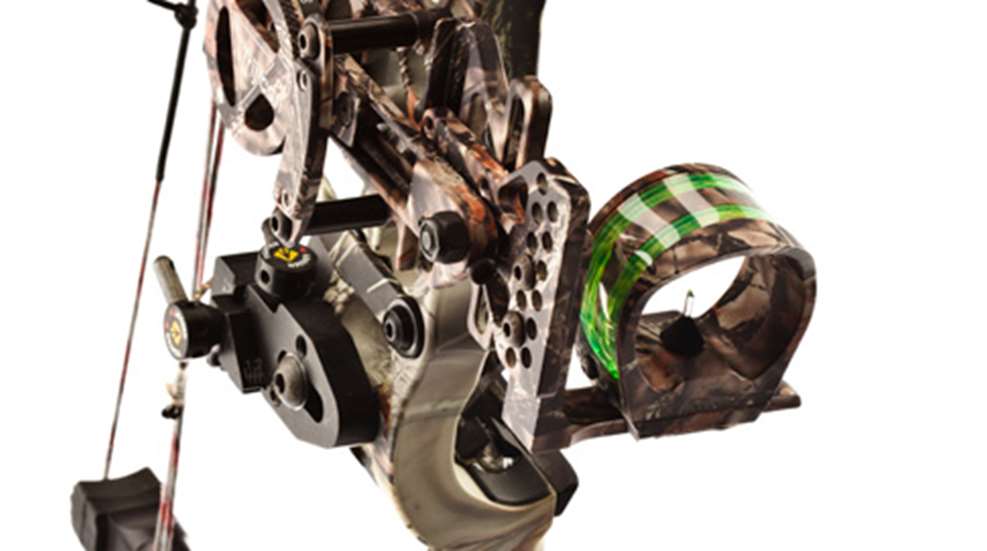
Later that day, when leaving work, a friend spied my bow in the shadowy back seat of my truck. “Wow,” she marveled, “that thing sure doesn’t look like something the Indians used. What’s that?” she asked, pointing to the large wheel of the AccuPin amid a host of other bow-mounted gadgetry. When she peered closer at the bowsight, she noticed its soft green glow.
“Oh, that?” I said. “It’s a radioactive sighting apparatus that’s adjustable from 10 to 75 yards. Kinda romantic, don’t you think?”
“Kinda high-tech, don’t you think?” she said.
Indeed it is, and that’s why I installed it. If Trijicon’s stuff is high-tech and tough enough for our SEALS, I reckon the company’s stuff will work for me in the deer woods or in a back yard where I must put a deer down as efficiently as legally possible before it reaches the neighbor’s swing set.
Trijicon is best known for its tritium-filled Night Sights for handguns and its ACOG rifle sights. A few years ago it introduced its AccuPoint riflescope for hunters. Now it has developed perhaps the world’s most advanced bowsight, the AccuPin system.
The AccuPin refers to the actual sight pin, fiber optics and the machined aluminum ring that houses them. It’s used in tandem with the company’s mount/range adjustment unit called the AccuDial. Both can be purchased separately, but they’re meant to go together.
I’m confident the AccuPin system is the product of more engineering and designing than any bowsight in history. More than 33 inches of .080-inch-diameter optical fiber is coiled in a serpentine fashion over the aluminum sight ring and sheathed in clear plastic. Typical fiber-optic bow sights use .010- to .019-inch fibers, so Trijicon’s are much tougher and brighter than the norm. Since nowhere is the fiber exposed, it is unlikely to break or come unwound. After winding around the sight ring to gather ambient light, the fiber enters a chamber in the bottom of the sight ring where it’s exposed to a tritium-phosphor lamp. Tritium is the name of a hydrogen-based, radioactive (3H) gas that glows. Then the fiber transmits both the natural light it has collected and this artificial light in the tip of the sight pin so you can see it even in no-light situations.
This sight pin itself is cut in a triangular shape—only the tip of it glows—and this is one of the AccuPin’s advantages: Unlike a traditional round pin that covers a relatively large portion of the target, Trijicon’s design, much like the chevron-style reticle of many of its scopes, utilizes a pointed post the shooter places directly under the bullseye. It takes some getting use to, but I believe it’s a more accurate system, because the point is more precise than a dot, and the vertical orientation obscures less of the target.
In bright sunshine, the pin appears brighter, so it stands out. In low-light or no-light situations the tritium takes over. It glows softly so it doesn’t ruin your night vision. (According to the EPA, tritium is safe enough to use, but it’s heavily regulated and expensive—one reason for the $189 price of the AccuPin alone.)
The AccuDial is expensive for another reason—machining and engineering costs. Its BowSync system uses a geometric formula—you set it once manually via the “calibration adjustment knob”—to coordinate the engraved numbers of its range ring to the specific point of impact for your bow-and-arrow combination. It took me about 30 minutes to install and zero the AccuDial system for my bow. It works.
But it isn’t perfect: There is a tradeoff for using the neat looking engraved yardage dial and the calibration system that comes with it rather than the write-in-your-own-yardages-system of other units on the market. That tradeoff is more weight and more engineering—which translates to more cost for you. Budgets aside, the only flaw I could find was that after multiple shots, bow vibration would cause the dial to rotate slightly. So I learned to check the range dial before each shot.
That said, I do believe it’s the best low-light bow sight available, because its dual illumination system can be used in total darkness (provided there’s enough legal light to see through your peep sight and at least a silhouette of your target), and it doesn’t rely on batteries. It’s mil-spec-type tough, and its triangular sight pin is durable yet very precise. Also, it can be set to your bow to hit out to 70-100 yards, depending on your bow’s speed. I found that while hunting, I can keep the pin dialed to 25 yards and hold slightly lower for 10-yard shots, and slightly higher out to 40. Past that, I use the dial out to 75, where it maxes out for my 60-pound bow. This system eliminates any shot-time confusion of having multiple pins to choose from, and I have a fat suburban doe in my freezer to prove it.