As fans of the .410-bore shotgun shell well know, it's a relatively niche option for hunting and sporting applications. This in turn has lead to many of the platforms chambered for this slender shell being more specialized in their configurations. Among them are the single-shot, break-action hunting models, like the top-notch Henry Turkey Gun.
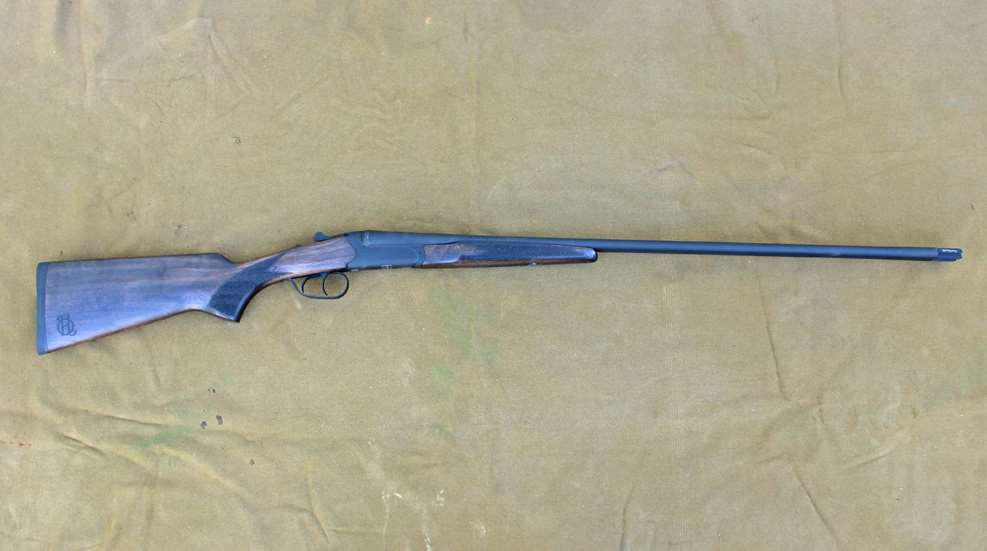
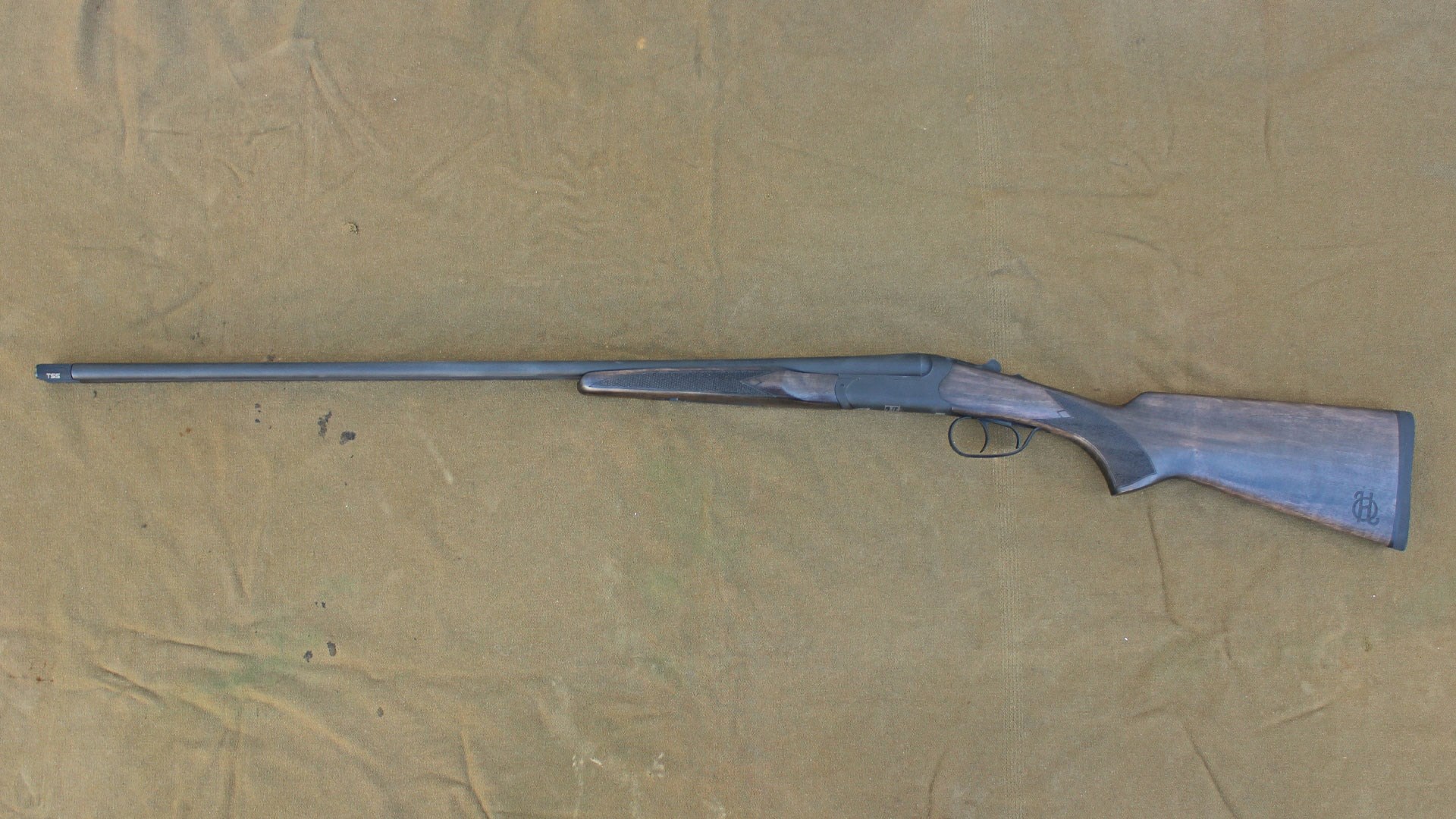 The Heritage Badlander Field series sports 28-inch barrels and interchangeable chokes.
I came away from the evaluation of the Henry a fan of that model in-particular, and .410-bore turkey guns in general. These single-shots are light weight, reliable and simple to operate. Throw in the low levels of felt recoil along with some effective turkey loads, and you have yourself a winning combination.
However, I recognize that some folks are looking for greater flexibility in their .410 bores. This is especially true when the prices slip up to and over the $900 mark. I've been keeping my eye out for a break-action that can be used to harvest turkeys, but also fill a variety of .410-bore roles.
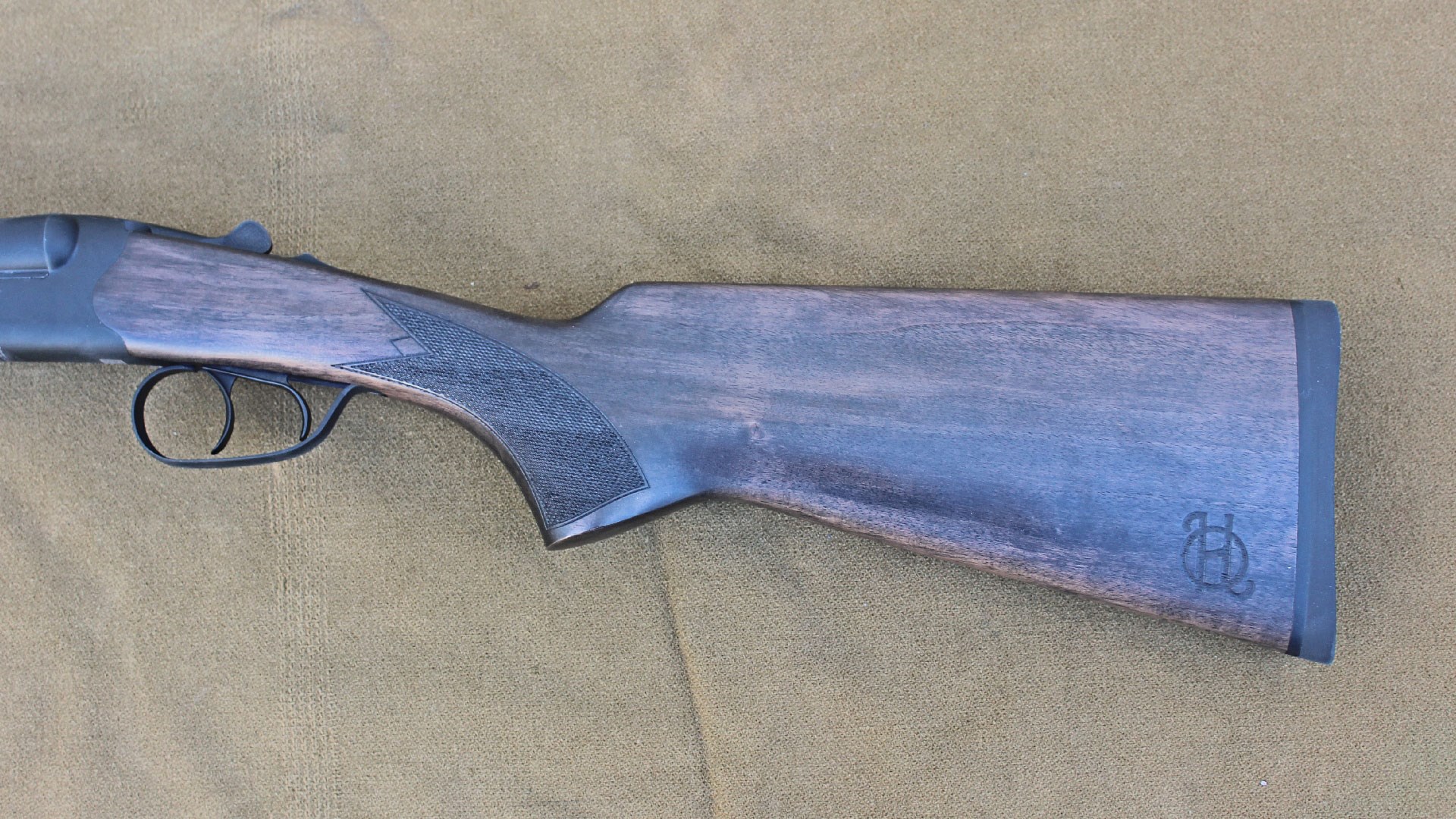 The checkered pistol-grip shoulder stock features the Heritage logo and a rubber buttpad.
The gun I was looking for cropped up this year with the release of the new Heritage Manufacturing Co. Badlander Field series of side-by-side, double-barrel shotguns. The first series of Badlanders, released last year, were all coach-gun configurations with 18.5-inch barrels and fixed chokes. The Field series is based on the same design. However, the barrels have been lengthened to 28-inches and outfitted with removable chokes. Tucked in amongst the 12-gauge, 20-gauge and 28-gauge options was an uncommon .410-bore version. Since double-barrel .410s tend to be rare and expensive, I was eager to give this one a try.
A Field-Ready Heritage .410
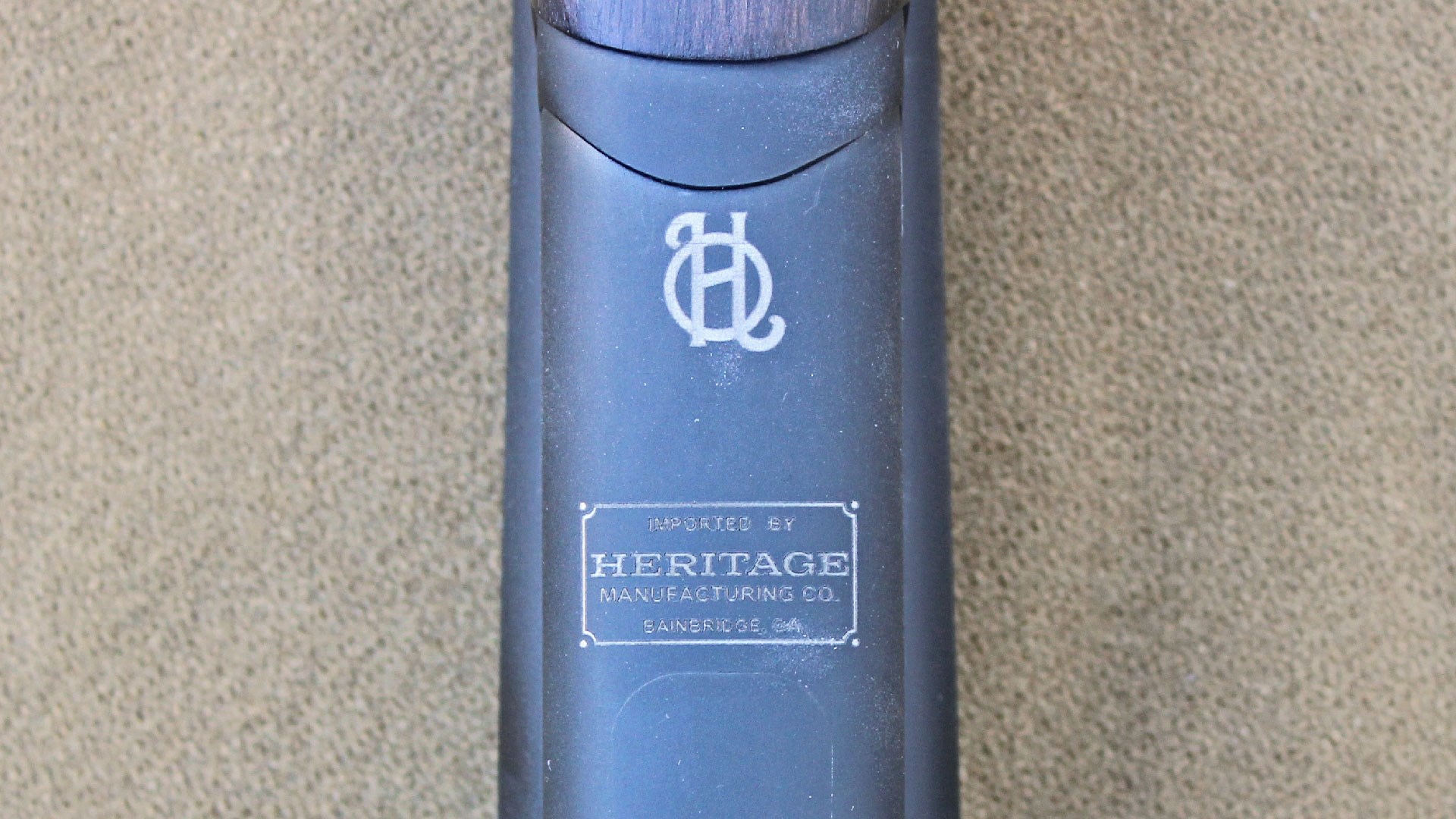
The Heritage Badlander Field model is made in Turkey by Büyük Huğlu for importation by Heritage. This side-by-side, break-action shotgun is built around a nearly embellishment-free box-lock action. The only ornamentation is the Heritage logo and importation markings that are found on the underside of the receiver.
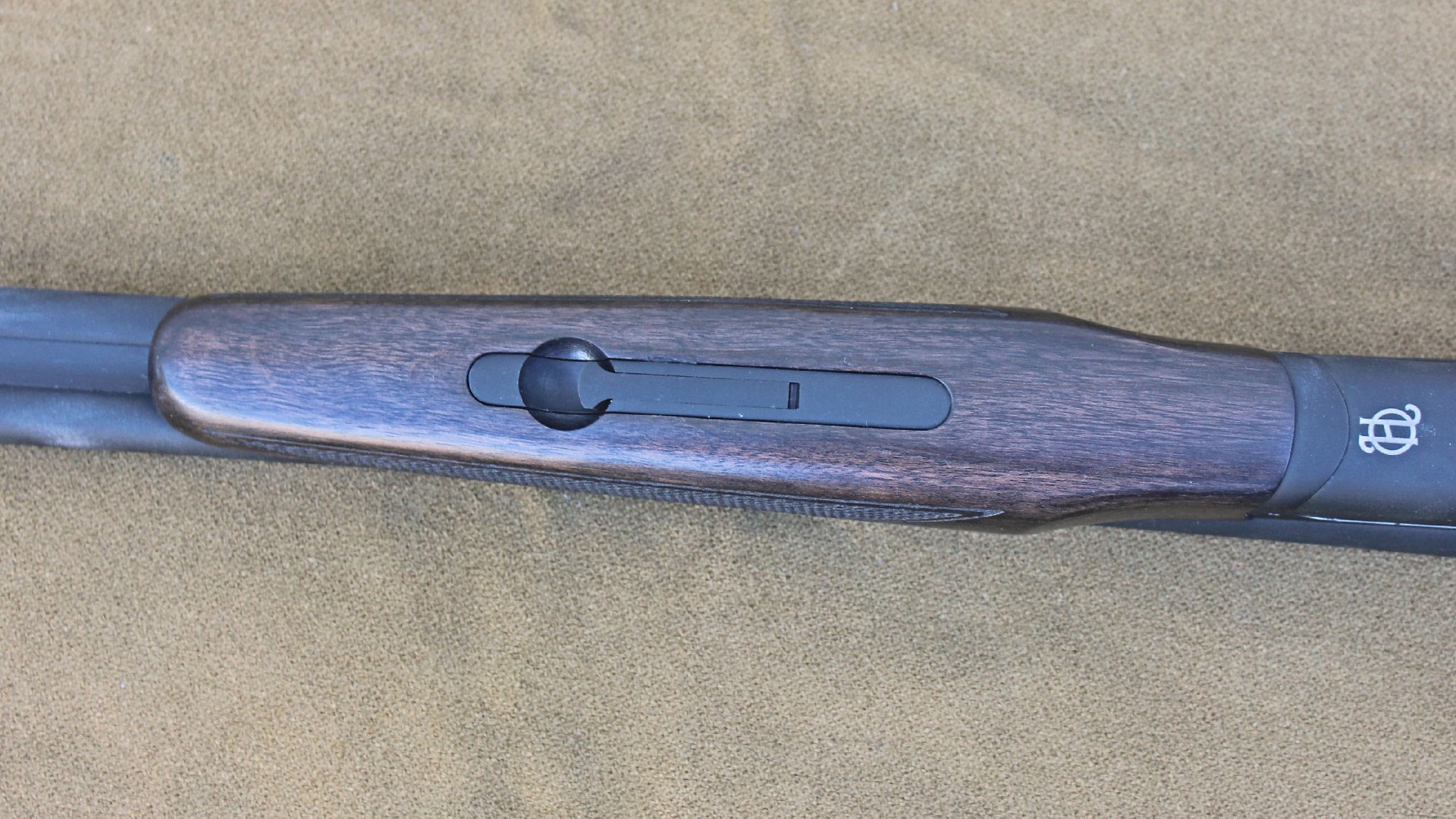 The Turkish walnut fore-end is outfitted with a blued-steel takedown lever.
This shotgun employs concealed hammers and a top-mounted release lever. The receiver's serial number is neatly concealed under the lever. It should be noted that this gun's dimensions have been scaled down to fit the slim shape of .410-bore shells. This gives the gun a svelte, lean footprint and an unloaded weight of 5-pounds 7.3-ounces. The Field model's barrels, receiver, controls and trigger guard are all made from a carbon steel alloy that is treated with a non-reflective, matte-black chrome finish. This finish provides the appearance of a traditional matte bluing but with notably improved durability and corrosion resistance.
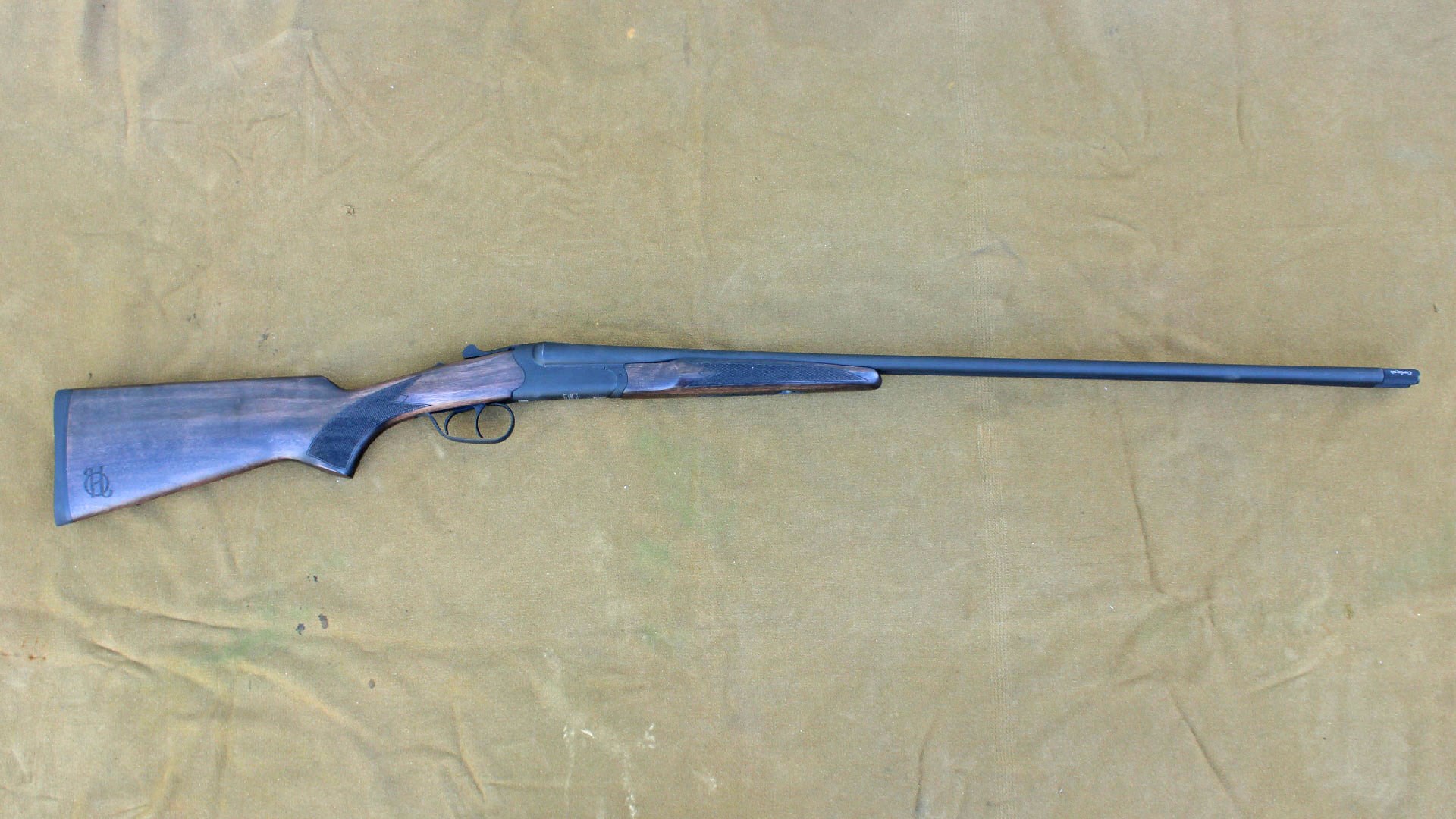 The author appreciates the slim, svelte profile of this double-barrel shotgun.
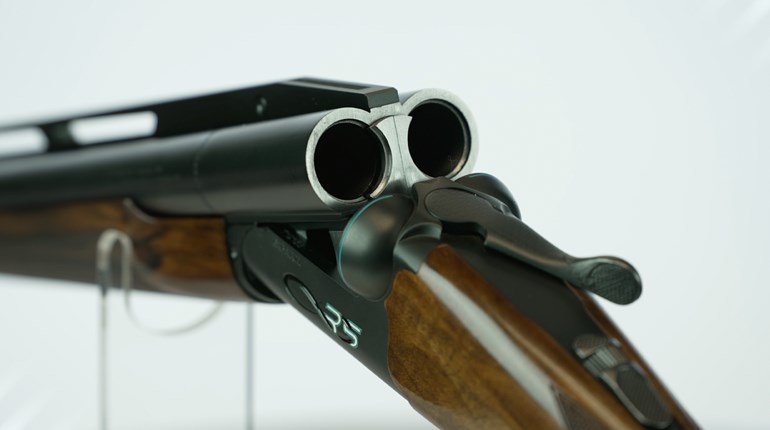
The barrel lever swings to the right to open the action, tip the barrels downward and expose the twin 3-inch chambers. Opening the action completely will cock the internal hammers. The extractor presses against both shotshell rims to lift them up and out of the chamber by about a quarter of an inch so that they can be manually extracted. The dual curved triggers are housed inside of a traditional, rounded-steel trigger guard. For those who are less familiar with double guns like this one, take a moment and note the positions of the triggers. The front trigger rests slightly to the right of the rear trigger which usually indicates that the front trigger sets off the right-side barrel, and the rear trigger the left side.
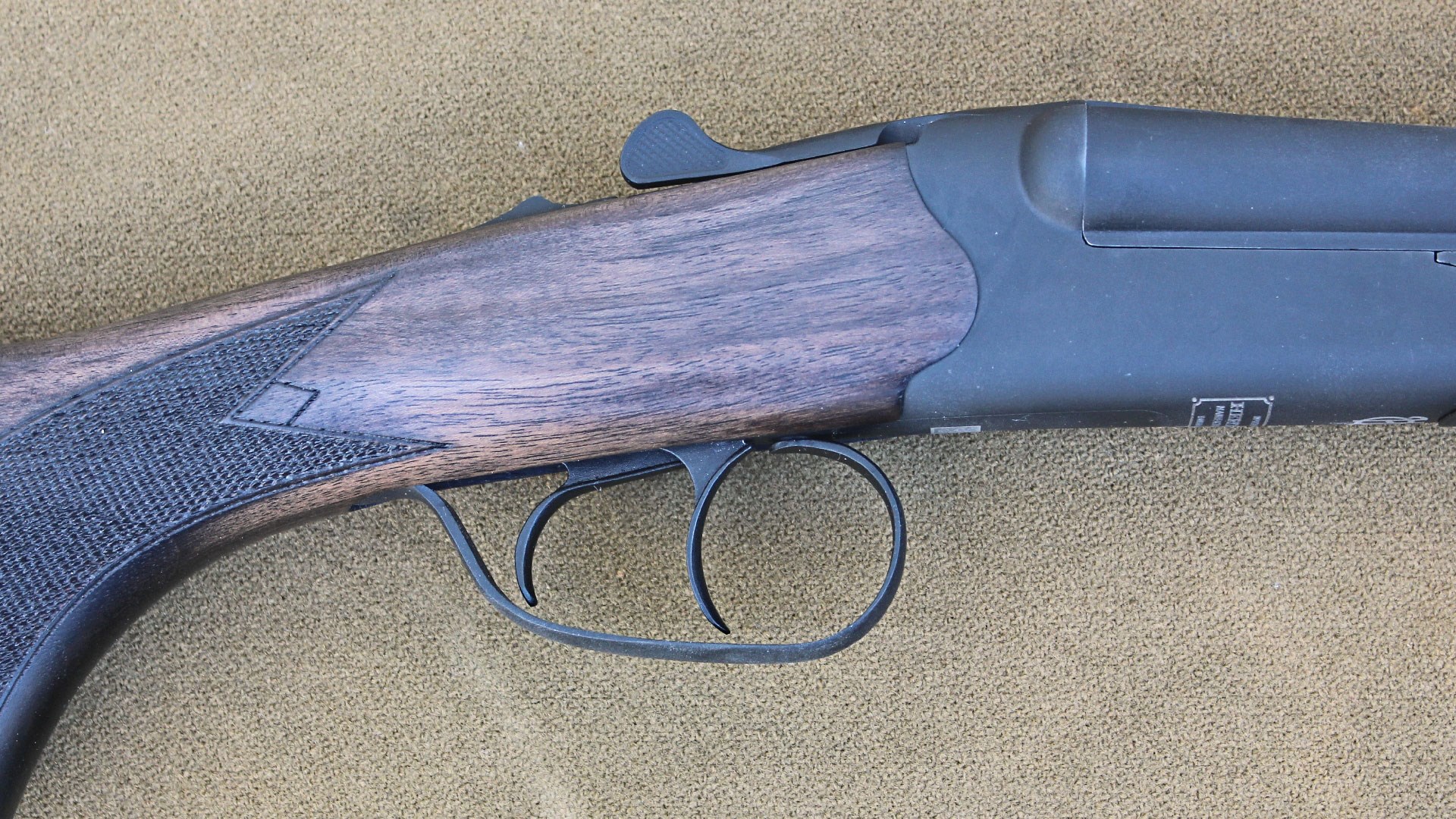 The forward trigger touches off the right-side barrel.
But just to make sure, I conducted a paper test. With the shotgun completely unloaded and pointed in a safe direction, the action was closed with a thin sheet of paper set in between the barrel chambers and the receiver. Just the front trigger was pulled (don't pull both) and then the paper was removed. The firing pin released by the front trigger marked the paper inside of the right-side barrel chamber. This verified that my assumptions were correct.
The triggers on this Badlander were noteworthy for two reasons. Yes, they had the same smooth feel and short arch of travel as the Badlander 12-gauge coach gun I worked with previously. However, both of the 12-gauge triggers exhibited a pull weight over 7-pounds with the rear trigger weighing 14-ounces more than the front. The .410-bore Field model's triggers exhibited just one ounce of difference in trigger pull, and they were two pounds lighter. The front (right) trigger weighed in at 5-pounds, 1-ounce and the rear (left) trigger gauged in at 5-pounds, 2-ounces.
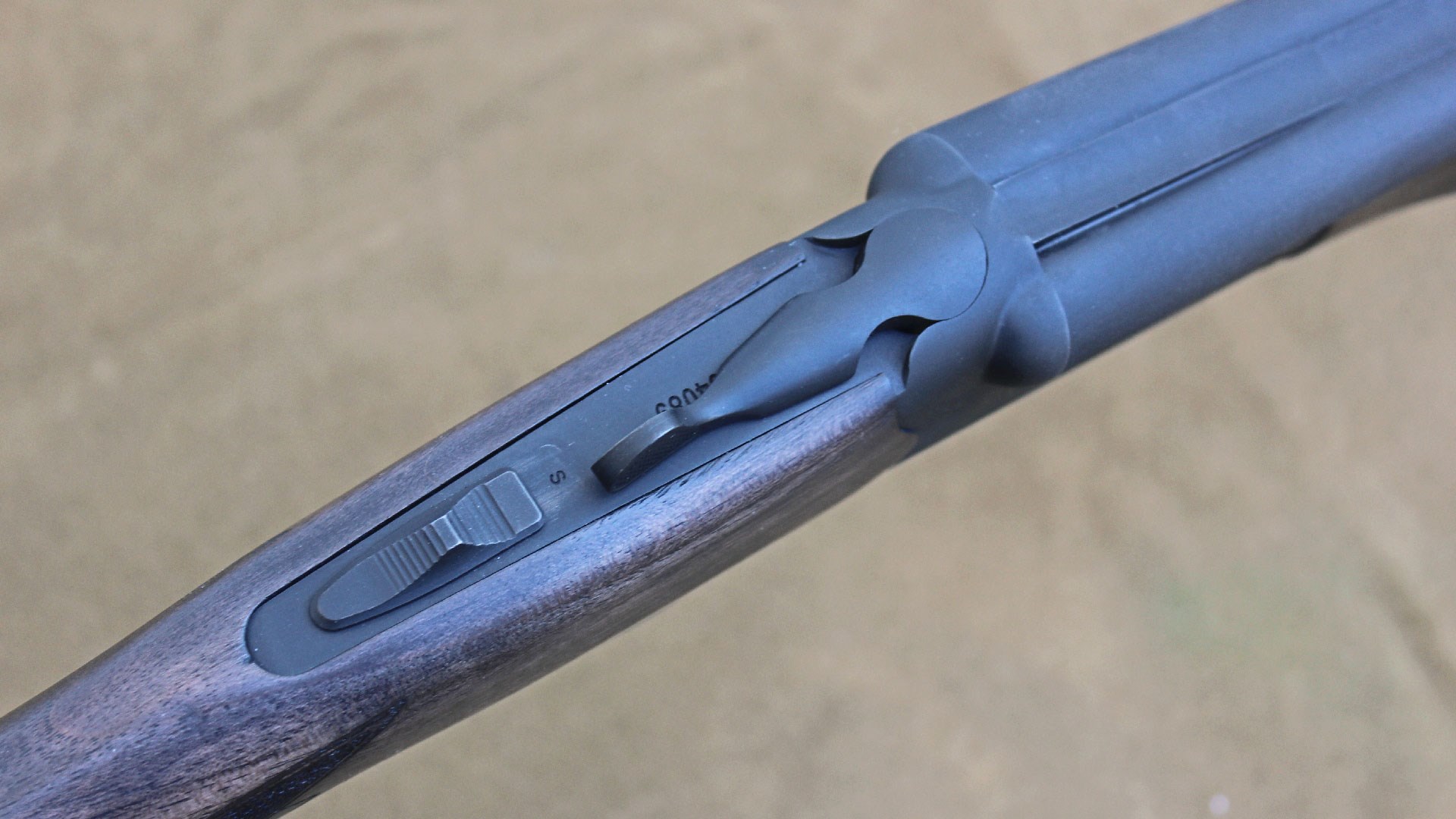 The barrel release swings to the right to open the action.
The slender, high-grade Turkish walnut furniture, including the lever-release fore-end and pistol-grip shoulder stock, has been darkened and treated with a satin finish. The touch points of both pieces feature neatly cut checkering for improved purchase. The Heritage circle H logo is laser engraved into both sides of the shoulder stock which is capped off with a black polymer plate and a black rubber recoil pad.
Carlson’s TSS Turkey Choke Tubes
It's not uncommon for the more utilitarian .410 shotguns to be outfitted with barrels that have fixed Full or Cylinder chokes. One of the reasons I wanted to work with this version of the Badlander is that both barrels are threaded to accept Benelli Mobile type interchangeable chokes. This model arrives with a total of five flush-fit choke tubes including Full, Improved Modified, Modified, Improved Cylinder and Cylinder options. A polymer storage case and choke wrench are also provided. The gun arrived with the Cylinder choke installed in the right-side barrel (front trigger) and the Improved Cylinder installed on the left. That's ideal for the wider shot patterns.
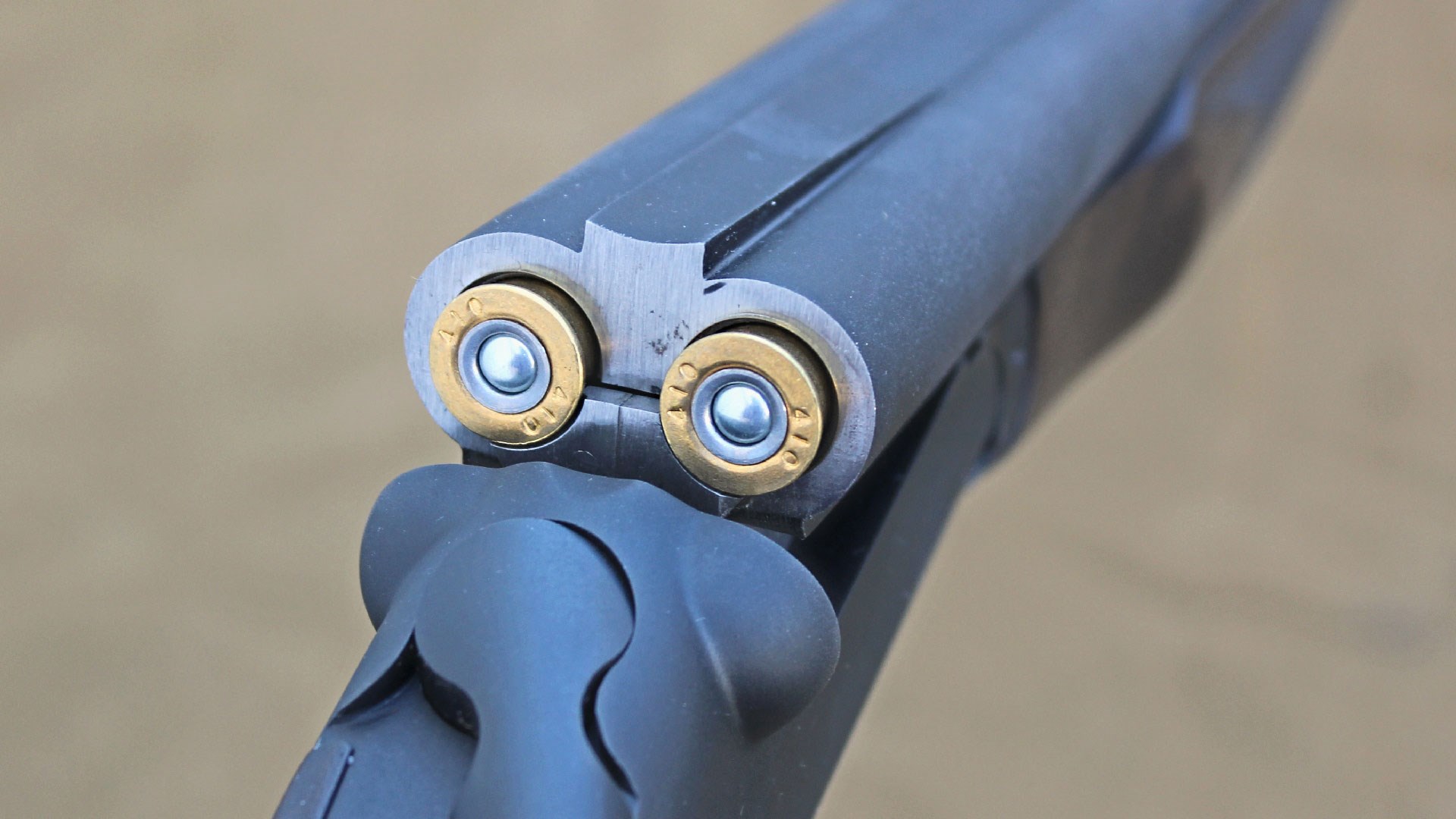 An extractor lifts the shell out of the chambers for manual removal.
Chokes with a tighter constriction can provide a dense pattern better suited for turkey. In this case, Carlson's Chokes had just what I was looking for. This company's Beretta/Benelli Mobil TSS Turkey choke series includes 12-gauge, 20-gauge and an uncommon .410-bore option tuned specifically for used with Federal TSS and similar #7 to #9 size shot pellets.
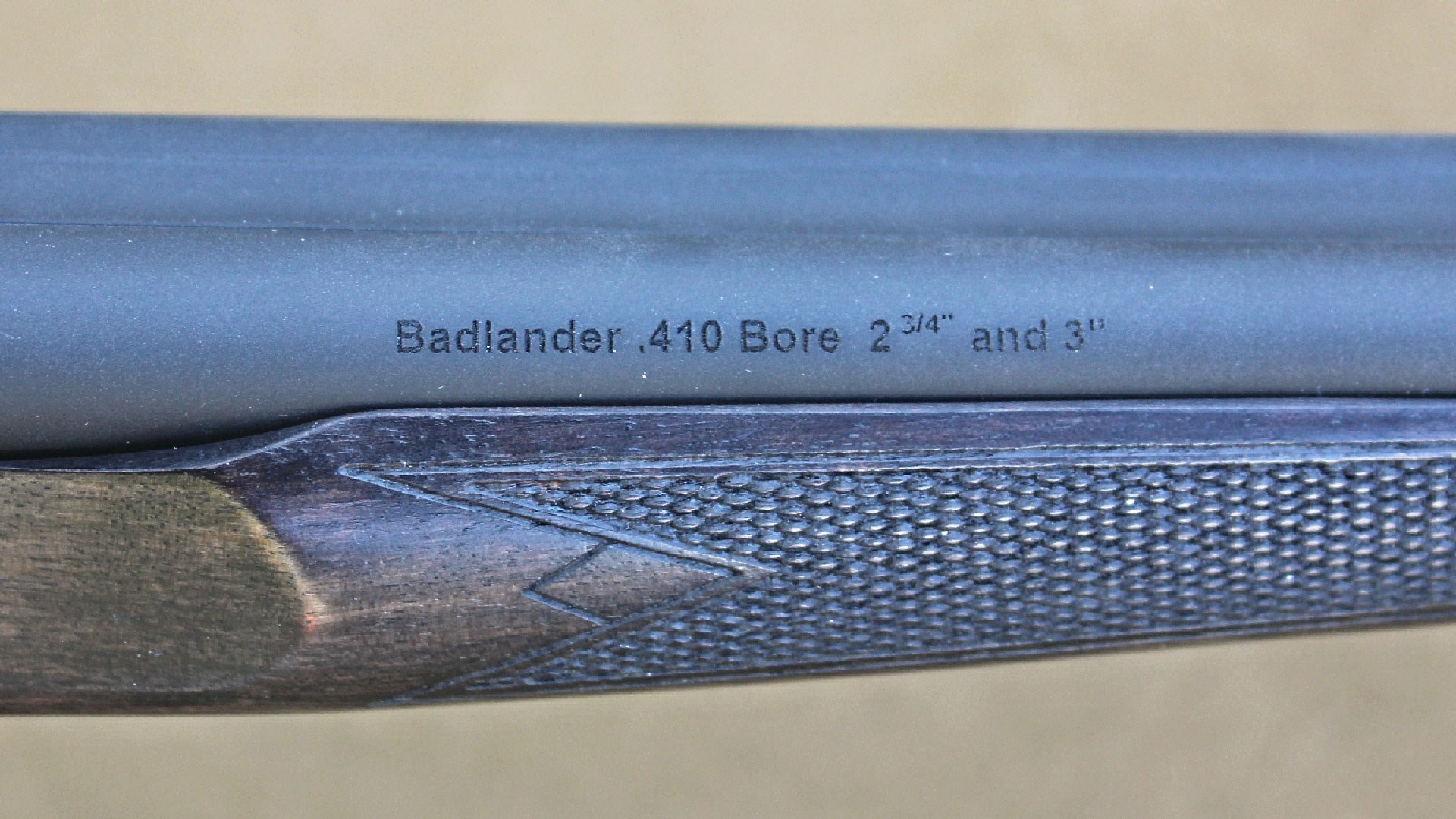 The chambers are sized for up to 3-inch shells.
Carlson's Choke Tubes’ .410 TSS chokes (#38031; $71.50 per tube) feature 1.25-inch long extensions notched for a choke wrench and knurled for manual tightening or removal. A .410-bore Full choke diameter is usually around 0.395 to 0.398 inches. The chokes sent for this review measured 0.331 inches according to the digital calipers I had on hand. With this tight of a constriction, Carlson's does not recommend using these tubes with slugs, rifled slugs, sabots, buckshot or steel birdshot with pellets larger than #4.
A pair of the TSS chokes were requested for use with the Badlander for a couple of reasons. First and foremost, I wanted to verify that the extensions would not rub up against each other or overlap the neighboring barrel. They both fit properly with a visible 0.1-inch air gap between them. But it is also a matter of added utility. For many turkey hunters, only one shot is needed. But since the gun has two barrels, there's no harm in having a second shot ready to go, just in case.
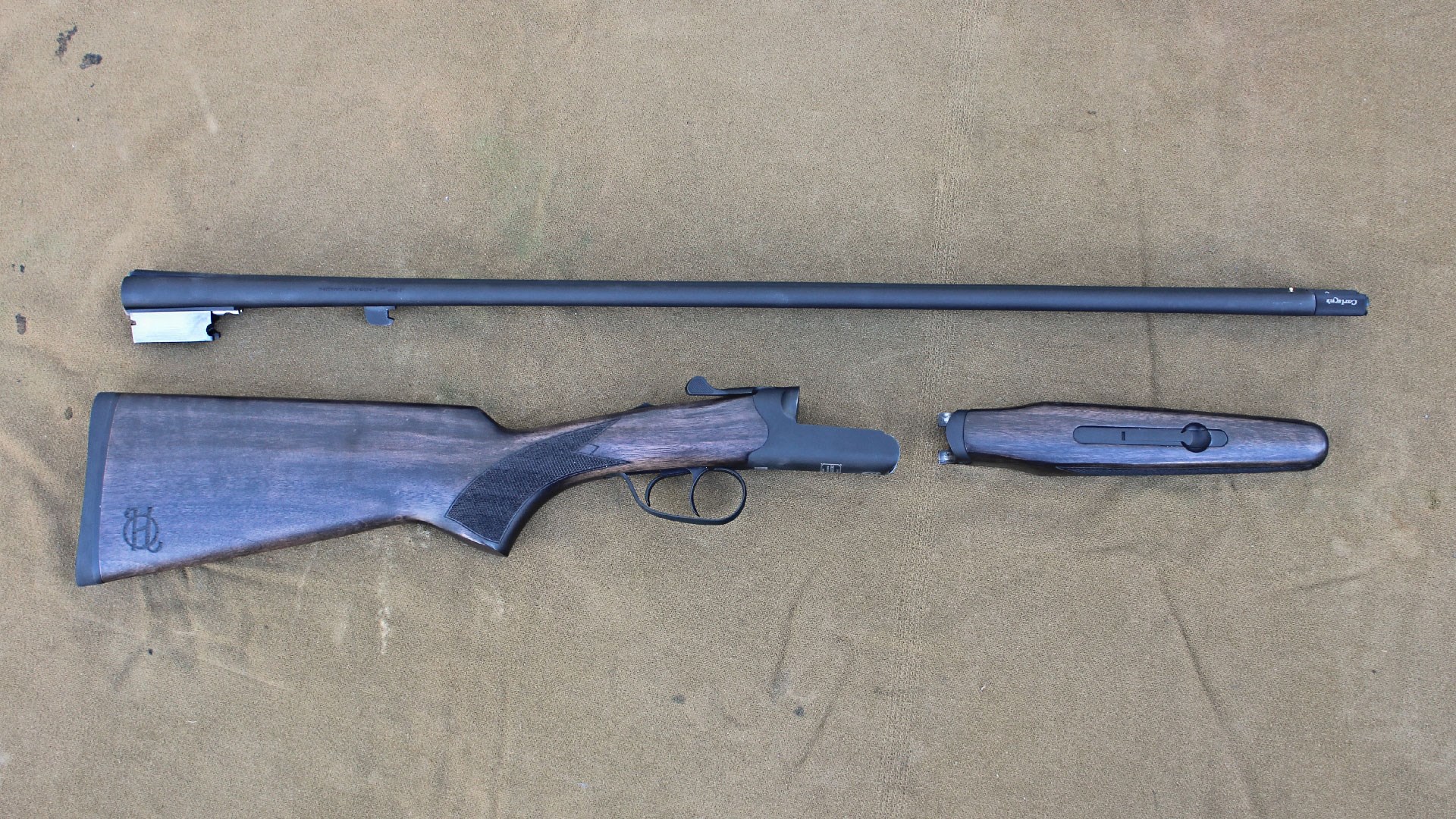 Like most break-action, double-barrel shotguns, the Badlander separates into three major components for routine cleaning.
Federal TSS Loads and Lead Birdshot Options
If you are going to stalk gobblers with a .410 shotgun, one of the most highly recommended loads available is Federal Premium's 3-inch Heavyweight Tungsten Super Shot (TSS) load. However, the TSS load is not exactly bargain-priced ammunition. As of this writing, 5-round boxes are listed for real-world prices of around $40, or about $8 per shot. And yet it’s popular enough that companies like Carlson's are making chokes tuned for it. What is it that makes it stand out from the lead birdshot crowd?
The TSS shell is filled with 13⁄16 oz. of buffered #9 size pellets launching at a listed velocity of 1100 fps. The pellets are 95 percent tungsten. This gives them a density of 18 grams per cubic centimeter (g/cc) which means they are 20 percent more dense than standard tungsten pellets, or, 56 percent more dense than typical lead pellets. As a result, the smaller #9 pellets hit hard and penetrate more deeply than lead pellets.
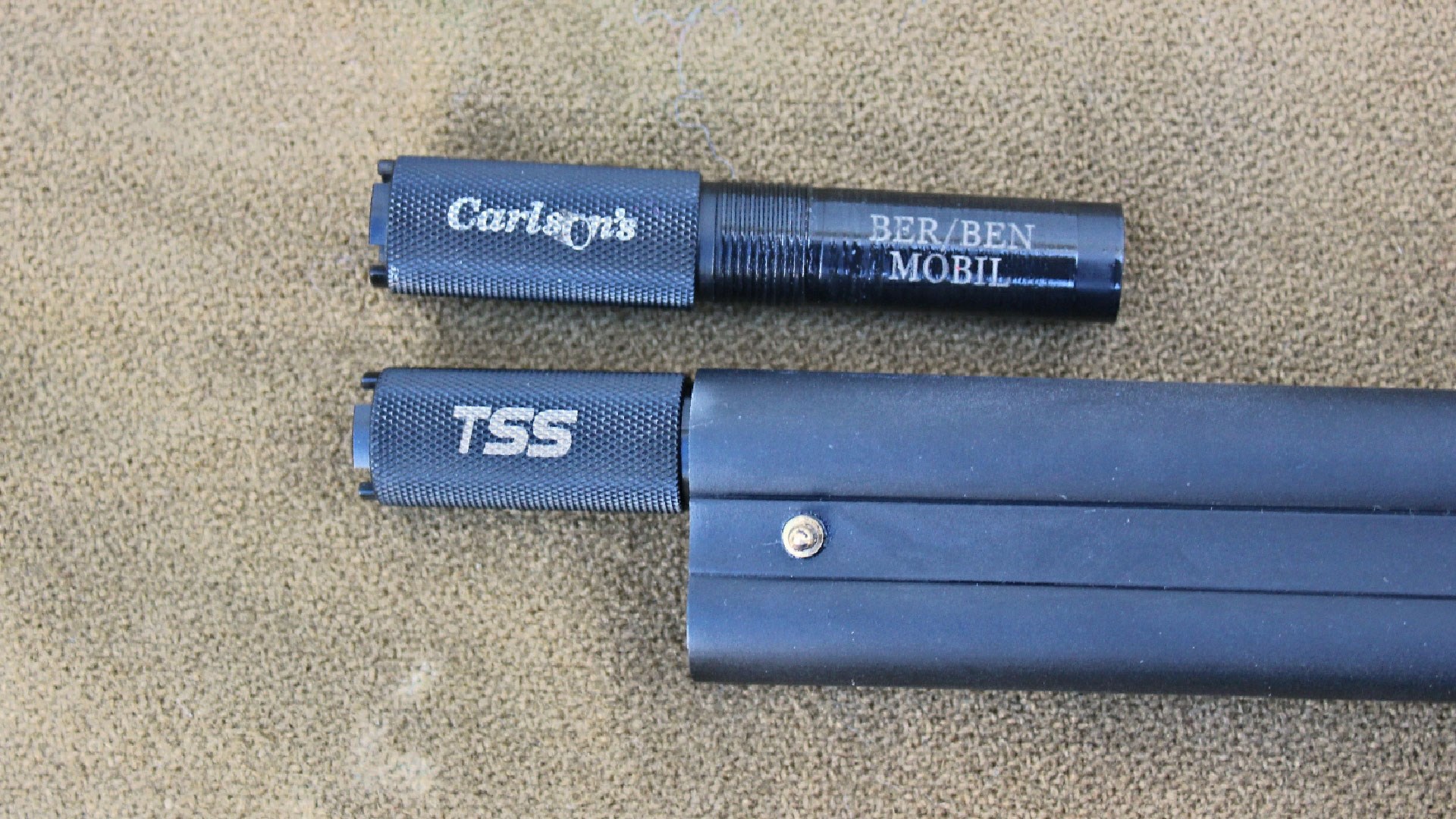 Carlson’s Chokes provides a wide variety of options, including the pair of .410-bore TSS tubes shown here.
Reducing pellet size also allows for a higher pellet count, which in turn contributes to increased pattern density potential. Before going to the range, I cut open a TSS cartridge, counted the pellets and it contained 285. How does the TSS pellet count compare to sporting lead loads?
Winchester's Super X 3-inch shell is filled with 11/16 ounces of #6 lead birdshot, approximately 155 pellets, with a listed muzzle velocity of 1135-fps. Federal's 3-inch Hi-Brass shell launches 13⁄16 ounces of #7 ½ lead birdshot, around 238 pellets, which is also listed at a velocity of 1135-fps. These loads contain fewer pellets but they cost between $0.75 to $0.95 per shot fired.
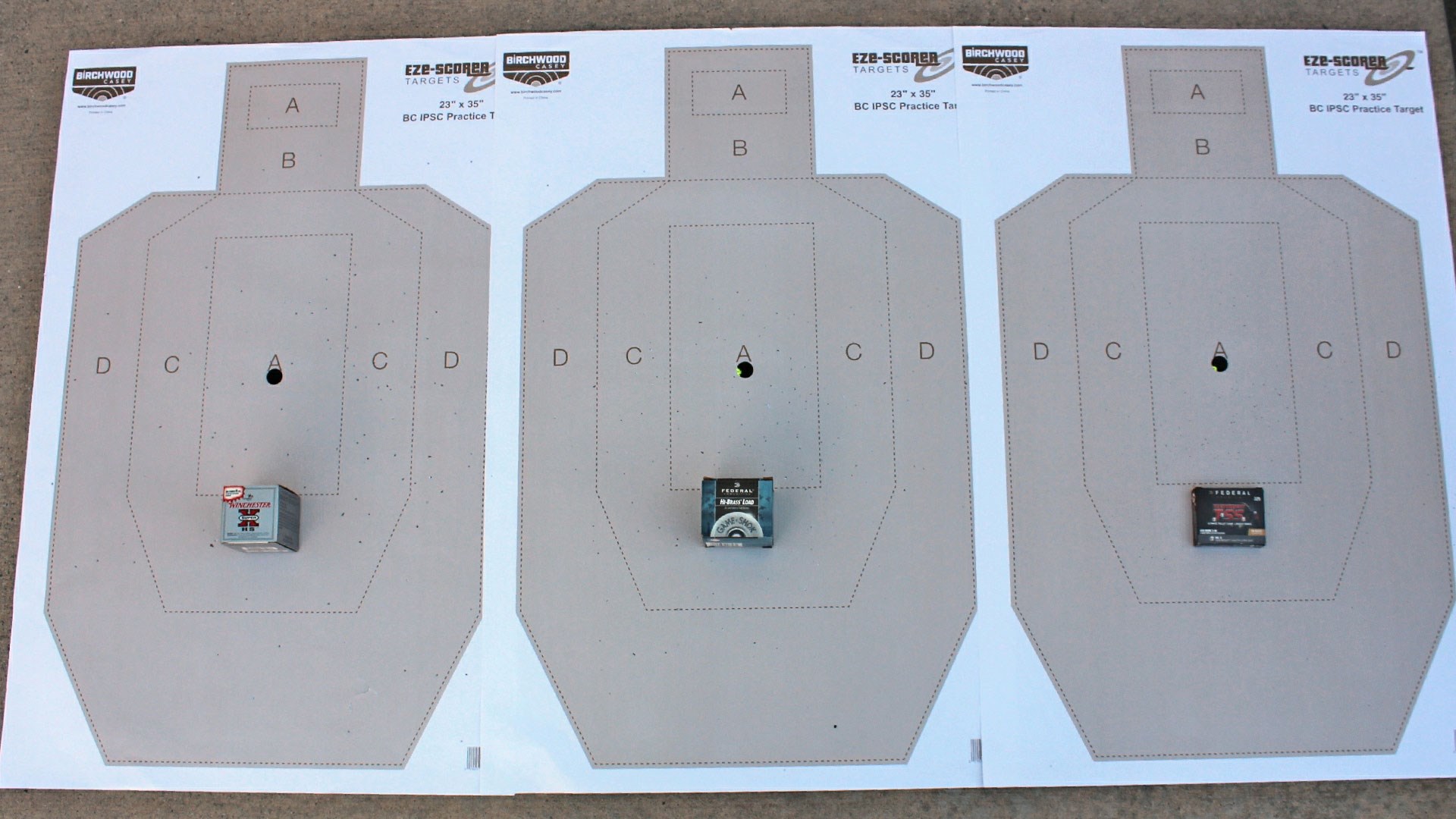 Three birdshot loads were patterned at 25-yards using the Carlson’s TSS chokes.
To verify the performance differences between these three loads, pattern testing was conducted at 25 yards with the Carlson turkey chokes installed. Individual shots were fired into 23x35-inch BC IPSC Practice Targets with a black dot sticker placed just below the central 'A' used as the aiming point. The targets were then flipped over and an 8-inch circle was drawn around the center of the pattern. The pellet marks inside the circle were counted to work out the pellet strike averages.
At this distance, the Winchester #6 lead load landed 28 of its nominal 155 pellets inside of the circle for about an 18 percent strike rate. I think it’s safe to say that this gun, choke and ammunition are not an optimal combination for this application. But the Federal #7 ½ load fared better. It placed 80 pellets out of the 238 in the strike zone for an average of about 34 percent.
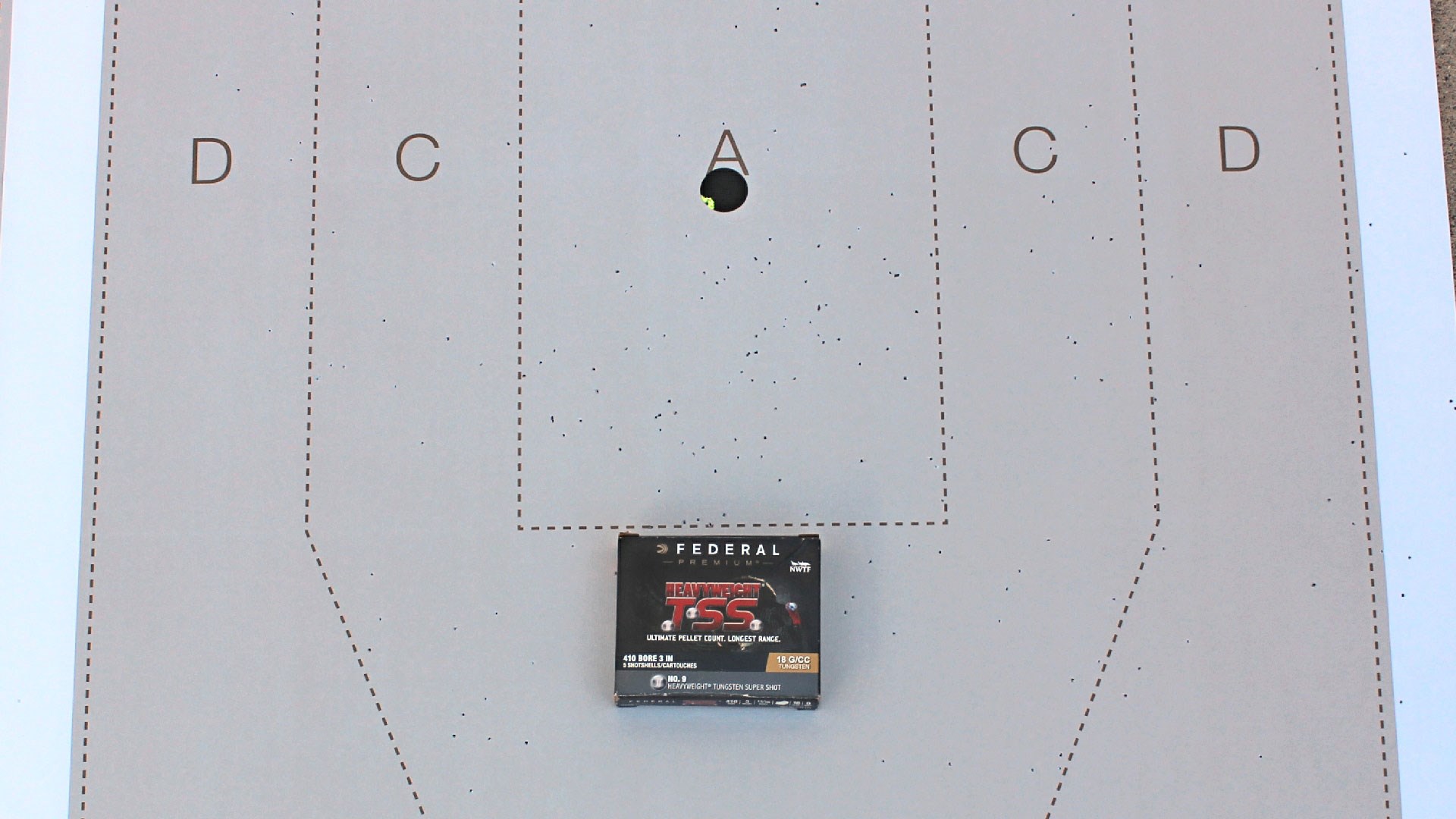 The Federal TSS load provided the densest pattern with 35 percent of the pellets landing in the 8-inch strike zone.
Now it was time to see what the TSS round and its optimized choke could do. For this round, there were 99 of the 285 pellets in the strike zone, or, an average of 35 percent. And so, the TSS load proved the densest pattern of the three loads. But the Federal Hi-Brass was a fairly close second and it looks like a solid option for hunters in regions that allow the use of lead loads for turkey.
Parting Shots
The Heritage Badlander Field series successfully harkens back to the days when side-by-sides were working and hunting guns instead of expensive showpieces reserved for the gun clubs. Although this shotgun is designed and finished for use as a field piece, the fit and finish throughout are top notch. In fact, the barrel to receiver fit is so tight it resisted closing and locking up for the paper test. Thanks to the provided choke set, along with aftermarket options, this slender double-barrel is a handy option ready for just about any sporting .410-bore endeavor. For more information about the Field series, visit heritagemfg.com.
Heritage Bandlander Field Specifications
- heritagemfg.com
- Type: break-action; double trigger; side-by-side shotgun
- Gauge/Chamber: .410 bore; 3-inch
- Capacity: 2-rounds
- Barrel: 28" carbon steel alloy; interchangeable choke tubes
- Front Trigger: 5-pounds, 1-ounce pull weight
- Rear Trigger: 5-pounds, 2-ounces pull weight
- Sights: brass bead front sight
- Safety: tang-mounted slider
- Stock: darkened Turkish walnut; satin finish
- Length of Pull: 14.25-inches (measured from front trigger)
- Drop at Comb: 1.5-inches
- Drop at Heel: 2-inches
- Metal Finish: matte black chrome
- Overall Length: 44.85-inches
- Weight: 5-pounds, 7.3-ounces.
- Accessories: choke tube case, five chokes (Imp. Cyl., Mod., IM, Full), choke wrench, owner's manual
- MSRP: $946.99