The old frontiersmen liked to brag, “If I can see it, I can hit it,” but I’ll bet a big pile of buffalo hides that what they really meant was, “If I can see it—and know how far away it is—I can hit it.”
Accurate range estimation is the key to hitting beyond what’s known as “maximum point blank range,” the longest distance at which your crosshairs will deliver a bullet to a given size of target (usually an 8-inch circle for big game). If you’re shooting, say, a .30-06 with a typical deer load zeroed for 100 yards, your maximum point blank range will be around 250 yards, meaning your bullet will drop about 4-inches.
You can tweak your maximum point blank range with your zero. Setting your riflescope for 1.5-inches high at 100 yards with that same set up will stretch your range out to 300, maybe 325, and still be within an 8-inch circle with a dead-on hold.
However, anything beyond the maximum point blank range requires an aiming adjustment (or a sight adjustment, which is not practical in the field). For this you need a rangefinder.
I’m primarily an African hunter and the ranges I encounter are not usually long, unlike when on those rare occasions when I find myself in Alaska or the Rockies, facing an across-the-canyon shot. Nonetheless, my day pack contains a rangefinder and having played with most of the major brands, I’ve finally found one I like.
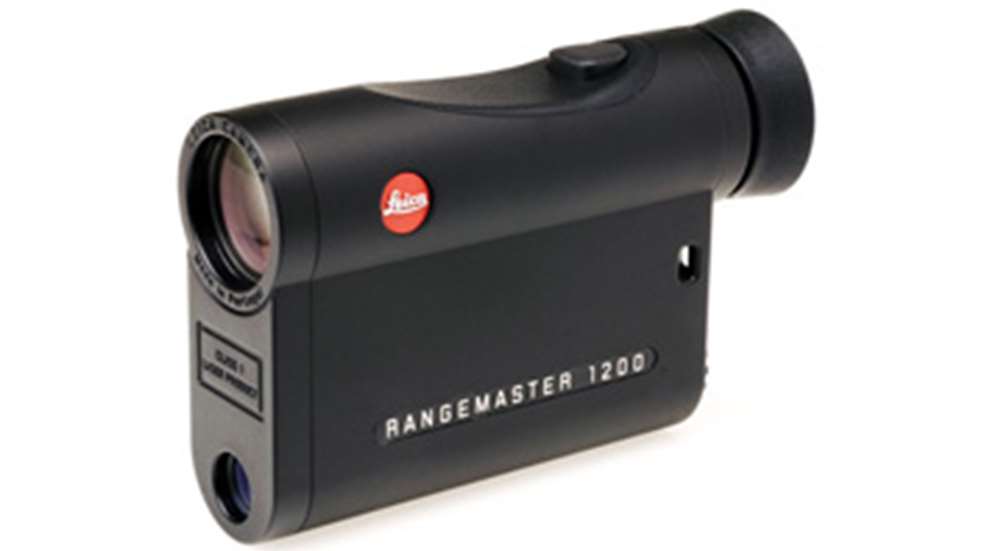
It’s the new Leica Rangemaster CRF 1200, a compact one-handed monocular. I bought it on Amazon for just under $600. I had previously used a Leica LRF 1200, the one that looks like a cigar box. It weighed 320 grams compared to 220 grams for the pocket-size upgrade.
The Leica Rangemaster CRF 1200 is a 7X monocular as well as a laser rangefinder. I find it super-easy to use and it’s so small and lightweight that I don’t even know it’s there. In fact, I connected it to a lanyard to keep from losing the little guy.
For me, the main use for a rangefinder is not ranging game as you might think. I use it to range various landmarks once I sit down to wait and glass an area. That tree on my far right: 347. The big rock over there: 281. The patch of dry grass: 156. Now when a game animal comes along into my field of view, I don’t need to waste time ranging him. I know his distance from the landmarks I’ve already pegged.