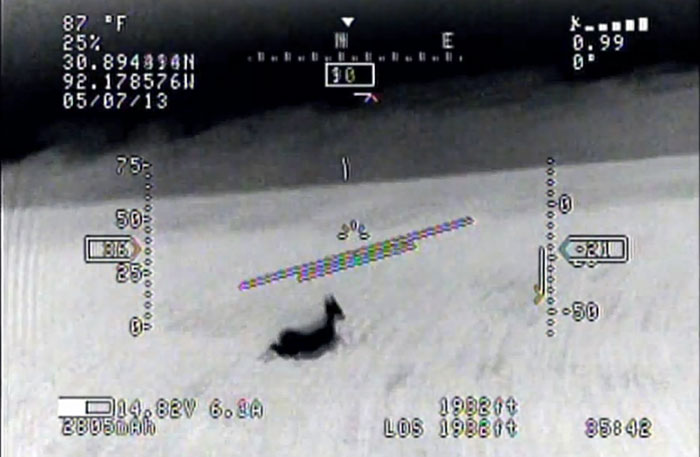
Society's favorite testing ground for good, bad and simply annoying ideas—yes, YouTube—showed how drones can affect the future of hunting way back in 2011. (Well, in this case, let's call them what the Federal Aviation Administration [FAA] does: unmanned aircraft systems [UAS], as the word "drone" conjures up images of secretive military things packing Hellfire missiles.) Among the uncountable multitudes posting videos to the media-sharing website are two people who've been using a UAS equipped with a thermal-imaging camera to slay wild hogs at night.
Cy Brown, a resident of Louisiana, grew up hunting and playing with radio-controlled planes. After Brown graduated from the University of Louisiana at Lafayette with a degree in electrical engineering, he decided to use his skills to attach a thermal camera to a model plane. As his UAS with thermal imaging gained altitude one night, he saw thermal readings that were cows. This gave him an idea. His new contraption would be ideal for spotting and targeting wild hogs at night.
Brown's YouTube videos have since developed a following. Brown says he uses a Skywalker 168cm FPV Plane with a "Range-Video OSD and a FLIR TAU 320 camera." As Brown looks at the screen on his handheld remote control, he relays locations to his friend, James Palmer, who stalks in with a .308 equipped with a thermal-imaging ATN ThOR 640 2.5X scope. They've gotten so deadly they offer their wild-pig-eradicating services free of charge to nearby farmers. So look out wild hogs, here come a couple of geeks with a gadget more advanced than anything used by a lot of militaries.
Brown and Palmer have been ahead of the times—and the laws. Now the debate is catching up to them.
Hunting with UAS?
Hunting big game in Alaska with the help of UAS is now illegal. Alaska Wildlifetroopers say they fear UAS technology has been outpacing game regulations. It has long been illegal to hunt the same day you fly in Alaska—this prevents someone from spotting a moose or brown bear, landing and shooting the animal. Alaska state troopers took this issue to the state's game board after hearing about a UAS-assisted moose kill in the interior.
Meanwhile, the Boone and Crockett Club announced that any game scouted or taken with the help of UAS is ineligible for entry into its records books. "Boone and Crockett likes to, as much as possible, set the standard for fair chase," said Richard Hale, the chairman of the club's big game records committee. "We already don't allow things like trail cameras that could send an image to, say, your phone."
A lot of other states are also changing their laws to fit the times. Colorado, Montana and New Mexico have passed regulations designed to keep UAS out of hunting. Also, game agencies in Idaho and Wisconsin determined UAS are already covered under current prohibitions. Many other states have passed regulations or are considering bans on using the devices while hunting.
Some also are worried that UAS might be used to harass law-abiding hunters. To prevent this confrontational scenario—imagine a duck hunter shooting down a UAS that has been constantly buzzing his blind—Tennessee Gov. Bill Haslam (R) signed a bill that prohibits anyone from using UAS to harass hunters or anglers.
Are UAS Ever Ethical?
Alan Peterson, a documentary filmmaker who runs Flying Leap Films Inc., wanted to use a drone while filming in the Glenn
Canyon National Recreation Area. The National Park Service (NPS) told him it banned UAS on park lands but would sell him a permit to hire a full-sized helicopter to shoot material. "The rationale for not allowing the drone was it might disturb other visitors and wildlife," says Peterson.
"So they wouldn't allow a 3-foot wide, electric drone, but a full-size, jet-fueled, screaming JetRanger was not a problem."
Obviously, sometimes regulations can get ahead of common sense. The NPS banned UAS because rock climbers, hikers and others were flying them around popular parks, which sort of ruins the rustic mood. Peterson thinks the NPS should allow people to obtain permits to use them in defined ways—those lands, after all, are owned by the public.
Jason Miller, owner of Raven 6 Studios, said, "I use UAS when filming hunting shows. They're a great tool. I've never actively used one on a hunt and wouldn't do that even if it were legal. They're not really capable of that anyway, as they are loud and their ranges are small. I do use them to get aerial shots of a property to give viewers a cool visual of where we are hunting."
Miller says that in order to get insurance for his larger UAS he had to take "pilot-training classes." Insurance companies require these because larger UAS take experience to fly safely. "I have $17,000 wrapped up in one of my UAS," says Miller. "Before I fly it I have a flight plan and shot list. This isn't something that can be used to harass wildlife. They'd get stuck in trees or have some other issue if you tried it. I have used them to get video of whales breeching by a beach in Alaska and to get spectacular images of antelope from far above in Mexico."
What's the Future?
Costs are coming down and UAS are getting better as competition in this evolving marketplace improves the technology. This raises worries that a hunter might, for example, soon be able to use a palm-sized UAS to attain a bird's-eye view of what's ahead as he climbs a mountain for elk or stalks the prairie for antelope. Even worse, could some little UAS shaped like a hawk be used to scare waterfowl off a private marsh?
Currently, the FAA basically categorizes UAS as commercial or noncommercial. For noncommercial UAS flights, FAA policy comes down to a few rules: UAS are supposed to stay below 400 feet; they must stay out of controlled airspace, such as near airports; a person must keep a UAS in their line of sight; and they basically can't be flown around a lot of people (for more click here).
These rules are evolving. The FAA tweaked its regulations to allow farmers to use UAS commercially. Some farmers want to watch their fields and livestock without using gas. UAS makers are embracing this market. For example, Precision Drone makes UAS that have infrared cameras that can help determine crop health. Crop stress or weeds can be spotted because the color of vegetation looks different in infrared. This could also help hunters who have food plots.
A UAS with an infrared camera is likely too expensive for most hunters to bother with, but for less than $500 anyone can now buy an entry-level UAS and fit it with a GoPro camera to take daytime aerial photography. They could then combine the images with photo-stitching software and in minutes have an almost real-time aerial map of their hunting property. This detailed aerial photography could tell hunters a lot about how wildlife is using a property. Whether that is ethical or even worth the trouble and expense depends on particular situations and someone's point of view.
Most people would say letting farmers or hunters use this technology to monitor crops or to control invasive species—like feral hogs—is ethical, but what if a hunter used a UAS with thermal imaging an hour before sunup to decide which deer stand to sit in? UAS present a lot of possibilities and ethical dilemmas.
Taking Flight
Amazon says it wants to use drones to deliver packages in urban areas. They'd buzz around like toy planes and use GPS coordinates to place goods on doorsteps.
Contractors for the U.S. military are developing drones the size of birds that'll have rifles attached to stabilized turrets. This is part of the U.S. armed forces' "One Shot Program." These drones would fly quietly over an urban battlefield to target enemy combatants. They might fly under the control of a person on the other side of the planet.
In England last October an airliner came within 80 feet of a quadcopter drone. The pilot spotted the remote-controlled quadcopter "very close" to the plane's right wingtip. This led to fears that terrorists might use them.
Drone footage of wildlife posted on YouTube seems to show animals conditioned to fear raptors, such as quail, squirrels and ducks, skedaddle when drones get close, but big game pays them little attention. This might make it easier for poachers to locate animals.