Fossil Footprints Show Hunt for Giant Sloth

by
posted on July 10, 2018
** When you buy products through the links on our site, we may earn a commission that supports NRA's mission to protect, preserve and defend the Second Amendment. **
fossilfootprints_lead.jpg

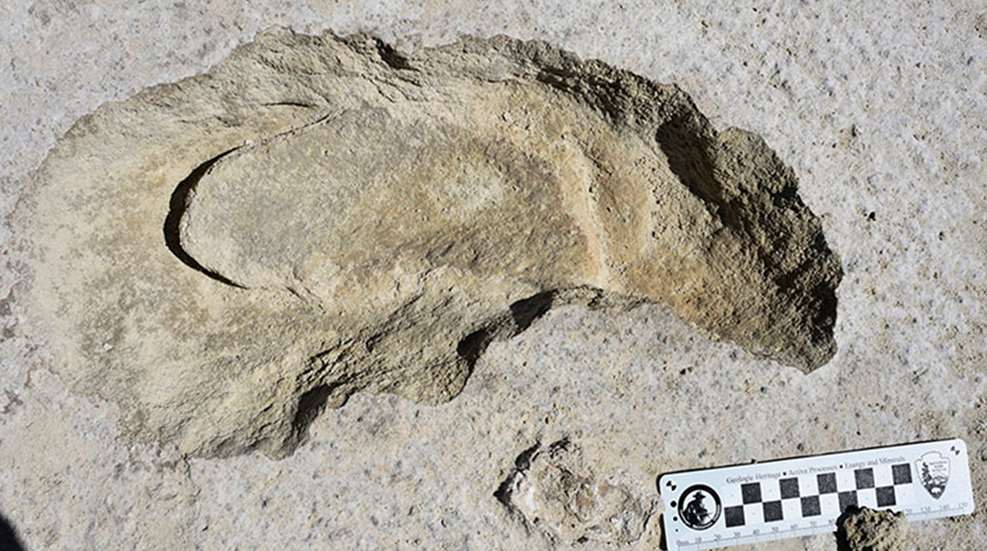
Prehistoric footprints of early human hunters have been found at the White Sands National Monument in New Mexico by a research team from Bournemouth University in southern England. According to a report published in the journal Science Advances, the tracks date back at least 11,000 years and appear to depict a group of humans stalking a giant sloth, an animal similar to sloths today, except it stood more than 6.5 feet tall and was 9 feet long.

Matthew Bennett, professor of environmental and geographical sciences at Bournemouth said, “The story that we can read from the tracks is that the humans were stalking; following in the footsteps, precisely in the footsteps, of the sloth.”

Sally Reynolds of the university’s Institute for Studies in Landscapes and Human Evolution explained how the hunt might have gone down. “The sloth would have raised itself up to full height and attempted to keep the attackers at bay with its long forearms and large, sharp claws,” she said. “The hunters would have needed to wait patiently to get the right opportunity to strike the killing blow in a vulnerable part of the sloth anatomy … . The hunters would have been at significant physical risk to themselves while the animal was defending itself.”

Bennett said the hunters likely coordinated their efforts to bring down the animal. “While [the sloth] was being distracted and turning, somebody else would come across and try to deliver the killer blow,” he described. “It’s an interesting story and it’s all written in the footprints.”

It’s commonly assumed that spears were the main tool of choice. Based on other human tracks found in the area, the hunters pursued the sloth as a group.

“Getting two sets of fossil footprints that interact, that show you the behavioral ecology, is very, very rare,” Bennett stated.

Latest

Proof PXT Barrel Tech Lede

Proof Research Introduces PXT Rifle Barrel Technology

Proof Research has launched Proof Exponential Twist (PXT), an advancement in rifling that promises to improve durability, accuracy and shootability. Further, Proof has backed this new technology with extensive military testing and research. Engineered to meet the demands of modern high-pressure ammunition, PXT is billed as delivering longer barrel life, improved consistency and enhanced performance.  

Ammo Analysis: So You Like 'em Heavy?

Phil Massaro discusses what might make someone opt for a heavy-for-caliber choice when taking on game.

New for 2026: Steiner eDiscovery 10x42 Binoculars with Integrated Camera

Steiner Optics has introduced the eDiscovery 10x42 binoculars, combining clarity and durability with a fully integrated 4K camera.

First Case of CWD Documented on the National Elk Refuge

The Wyoming Game and Fish Department (WGFD) and the U.S. Fish and Wildlife Service (FWS) announced on May 11 that for the first time chronic wasting disease (CWD) has been documented in Wyoming Elk Hunt Area 77, located on FWS-managed National Elk Refuge.

Range Review: Rock Island Armory PK-12 Pak-Out

This 18.5-inch barrel pump action from Rock Island armory folds in half for easier storage and transport. Check out B. Gil Horman's review of the PK-12 Pak-Out here.

New for 2026: Alps OutdoorZ DU Legacy Waterfowl Bag

For those seeking a classy field bag, the Alps OutdoorZ Ducks Unlimited Legacy Waterfowler’s Bag should be on their radar.

Interests


Get the best of American Hunter delivered to your inbox.