


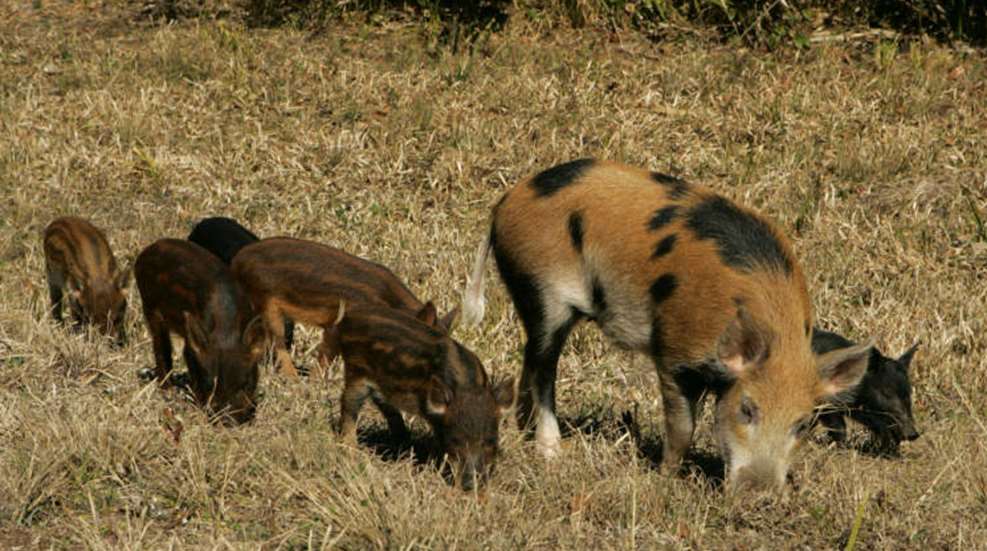
Once it hit the Internet, the photograph went viral: a muscular, coal-black hog carrying off a deer fawn in its mouth. The news story that accompanied the photo explained how surging populations of wild, feral hogs were causing numerous problems across the nation. But the twist here, highlighted by the photo, was that hogs were now becoming a threat to deer and deer hunting.
Feral hog expert Dr. John Mayer didn’t quite buy the photo. To him, the hog looked suspiciously like a hog from India--the Indian wild boar, or Sus scrofa cristatus to be precise--and the fawn an axis deer. As for one of the larger points, though, Mayer said the photo had it right.
“Wild pigs are opportunistic omnivores,” said Mayer, who has researched feral hogs for the last 40 years. “They mostly eat plants, roots and grubs. But they will eat animals given the opportunity, and deer fawns of several species are definitely on the menu.”
Fawns are not a major food source for hogs, Mayer adds. But as more and more hogs populate the landscape, it’s only logical the prolific hogs will have more opportunities to gobble up newborn fawns.
Hogs also have a reputation for pushing out deer. As a dedicated hog hunter, I can attest deer are just about the best lookouts for hogs. When I spot a whitetail nervously looking into brush, and then fleeing, odds are good a hog will pop out of that same brush. If deer are at a feeder or watering hole and hogs show up? The deer run off.
Competition for food is a real issue, too. “Wild pigs have been reported to aggressively exclude deer from feeding on acorns,” Mayer said. Acorns are often a mainstay for whitetails, especially in winter months. In times of low acorn production, it’s quite possible that competition from wild pigs for this scarce food resource could limit whitetail deer populations.
Hogs also hurt other wildlife species such as quail and turkey. One Texas study found hogs preyed on up to 23 percent of simulated nests of Northern bobwhite quail. Researchers concluded hogs were a factor in the bobwhite’s overall decline. In addition, a wildlife management area in Texas documented significant hog predation on numerous nesting sites of Eastern wild turkeys. After two years of implementing a hog-reduction program, nest success rates went from 0 percent to 25 percent.
Paradoxically, there’s an effort to exclude hunters from the management of these invasive hogs. Several years ago, Tennessee removed hogs from its list of game species and greatly limited hog hunting on public lands. Proposed regulations in Oklahoma would’ve made it much harder for hunters and trappers to harvest hogs, though that legislation was defeated.
Recently, the Missouri Department of Conservation asked the state legislature to ban hog hunting on over one million acres of public lands, a story recently covered here on the Hunters' Leadership Forum page. So far no decision has been reached on the proposal.
When questioned, wildlife agency personnel provide the same responses: Hunting isn’t an effective means of controlling hog numbers; trapping works much better; and the development of a hog hunting “culture” can lead to illegal releases of hogs.
What they don’t say is that hogs become trap-smart very quickly. While traps may work better in some situations than hunting, there’s also no guarantee a state has the budget to launch and sustain a full-scale trapping effort.
Meantime, hunters are out on the lands, public and private, often in large numbers. And each and every hog a hunter kills is another hog that can’t reproduce. Not rocket science, but it’s a message some game agencies can’t get their bureaucratic heads around—or simply don’t want to do so.
Hunting Can Help
Researchers at Texas A&M University estimate that hog hunters and trappers harvest some 750,000 hogs annually in Texas. The state's hog population, however, is pegged at 3.4 million animals strong.
According to the research, the harvest represents “29 percent of the estimated feral hog population in Texas. The population model indicated that without harvest the feral hog population was expected to triple within five years--3.33 times the initial population--with a 28 percent annual growth rate.”
So without hog hunting, the Lone Star State would be overrun with hogs, and the cost to farmers, ranchers and home owners would be astronomical. Exponential growth of the hog population also would undoubtedly be a huge detriment to Texas wildlife and wildlife conservation.

































