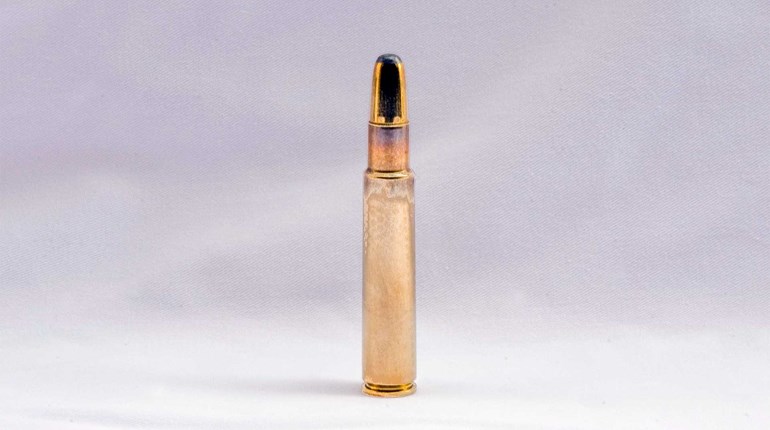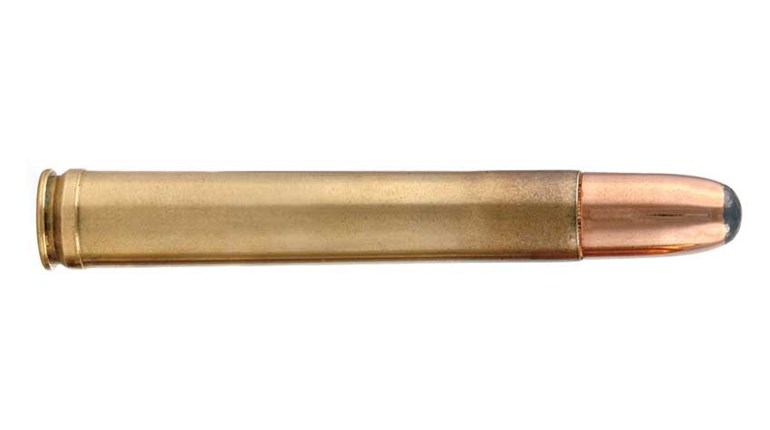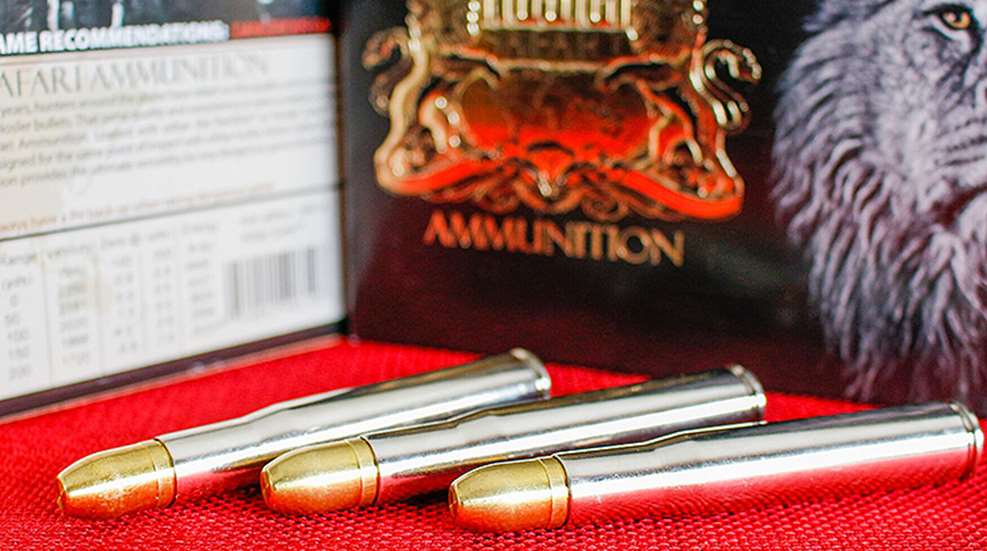
The first two decades of the 20th century saw huge advances in cartridge technology, giving us the .30-06 Sprg., the .375 H&H, the .250-3000 Savage, the .416 Rigby and the .45 ACP. While all those went on to become a star on one stage or another, Jeffery’s .404 Rimless Nitro Express was somehow always overshadowed. It was a smart design, matching the ballistics of the rimmed .450/400 3” Nitro Express—already the darling of the single shot and double rifle crowd—in a repeating bolt-action rifle. Unlike the .450/400, which uses a 400-grain bullet of .411” diameter, the original .404 load used .423”-diameter bullets, maintaining the same muzzle velocity of 2,150 fps, for just over 4,000 ft.-lbs of muzzle energy. Should the hunter want to use his .404 on lighter game, a 300-grain load was developed, with a muzzle velocity of 2600 fps.
Being able to be housed in a Mauser standard-length action, the .404 made an economical, effective and sensible choice as an all-around rifle for sportsmen visiting Africa and India a century ago, and though the production numbers—in comparison to the number of .416 Rigby rifles produced prior to World War II—show that it sold very well, the Jeffery never received the accolades that the Rigby did. It certainly wasn’t due to the fact that the Jeffery was in any way ineffective or unreliable as a dangerous game cartridge; in fact many of the Eastern and Southern African countries chose the Jeffery as the cartridge for their Game Rangers, doing the dangerous animal control work. Yet, history is what it is, and by the 1960’s the .404 Jeffery had all but faded into obscurity.
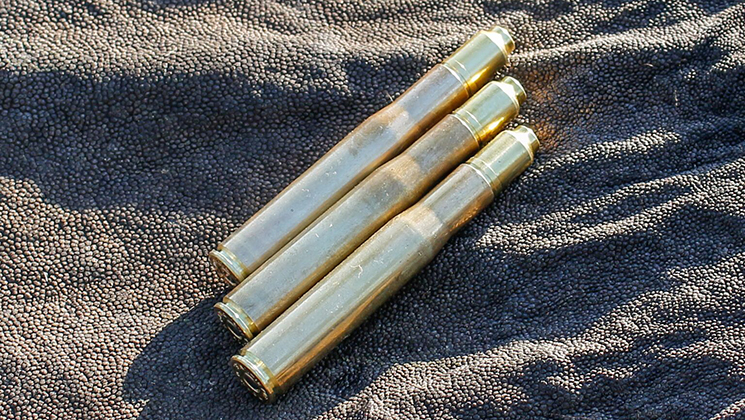
 It has all the necessary ingredients to make a perfect all-around rifle cartridge: it is only slightly longer than our revered .375 H&H Magnum, it uses a shoulder angle of roughly 8˚-20’, so it feeds like a dream, it is easier on the shoulder than most cartridges in its class, and with modern bullets the .404 Jeffery is undeniably capable of taking any and all game animals on earth, including the African elephant. And, thankfully, it seems to be making a strong comeback.
It isn’t as flexible as the African industry-standard .375 H&H—which can do just about anything you’d ask of it—but it is undoubtedly a better choice for the truly large game animals. Modern .404 Jeffery loads have an increased muzzle velocity compared to the ammunition of a century ago; 400-grain bullets at 2350 fps put this old girl in the .416 Rigby and Remington class. Even at that higher speed, the Jeffery still makes an easy-shooting rifle.
There are many premium softpoint bullets designed for the Jeffery; The Swift A-Frame, Woodleigh Weldcore, Hornady DGX, Peregrine BushMaster and Cutting Edge Safari Raptor are all available in .423”-diameter, in many different bullet weights from 325 grains to 450 grains, extending the flexibility of Jeffery. The choice of solid (non-expanding) bullets is equally superb, with Nosler, Woodleigh, Cutting Edge and Hornady all making excellent projectiles. Factory ammunition is once again (thankfully!) plentiful, and the prospect of handloading your .404 ammunition is no difficult task.
The .404 also has a respectable group of offspring, being the basis for the Remington Ultra Magnum series, as well as the line of Dakota and Nosler cartridges; all took full advantage of the large case capacity and beltless design of the Jeffery.
I own two rifles chambered to this lovely old cartridge: my favorite rifle of all time, a Heym Express by Martini, and a Legendary Arms Works Big Five. Both are sweet shooting, both are wonderfully accurate, and I wouldn’t hesitate to take either on a hunt anywhere in the world that warranted a cartridge of this performance level. I’ve used the .404 Jeffery to take game animals from warthog, reedbuck and impala, to the tenacious blue wildebeest (often known as the poor-man’s buffalo) to a huge-bodied elephant; all were taken cleanly and effectively. I’ve handed that Heym to a buddy, while we were out on the Zambezi Delta flood-plains, and watched him take a Cape buffalo at just over 200 yards when we absolutely ran out of cover. I’ve also carried that same rifle into the mopane to take my elephant at a mere 16 yards, with no worries whatsoever.
My own pet handload revolves around a good 400-grain bullet—usually a Peregrine BushMaster or Woodleigh Hydrostatically Stabilized Solid—and a healthy amount of Alliant’s Reloder 15, giving me a muzzle velocity of 2280 fps, with groups hanging right around MOA out to 250 yards. If I feel I want a bit more weight, my Heym Express absolutely loves the Norma African PH ammunition, driving a heavy 450-grain Woodleigh Weldcore at 2150 fps. The Legendary Arms Works rifle also loves the lighter 325-grain Cutting Edge Safari Raptor at 2550 fps, and I plan on taking that weatherproof rifle to Alaska one day for a grizzly.
So, why would one choose a .404 Jeffery over one of the .416s or a .375 H&H? Well, because it’s really cool. There’s something about the look of that cartridge that I like a whole lot. It does, in fact, pair well with a .375H&H while on safari, letting the .375 handle the long shots and acting as a backup gun to the Jeffery for the truly large game. In comparison to the .416s, I feel the modern Jeffery loads are the absolute equal, and having used the .416 Remington extensively throughout Africa, I saw no visible difference in killing power between the two cartridges. It comes in a lighter rifle than does the Rigby version, but in the end it’s really going to come down to a matter of personal preference, and I’d happily use any one of the three .40s for any African hunt.
The ,404 Jeffery received its due in John ‘Pondoro’ Taylor’s famous African Rifles and Cartridges, in which he states “The Game Warden of Tanganyika (now Tanzania) who started his hunting career shooting buffalo for their hides in Portuguese East (now Mozambique) with a rifle of this caliber, found it so entirely satisfactory that he has armed all of his native game scouts in the Elephant Control Department with Vickers’ .404 magazine rifles.” If that doesn’t prove the worthiness of the .404 Jeffery, I don’t know what would.
Looking for previous installments of Behind the Bullet? We've got you covered.
• .44 Remington Magnum
• .243 Winchester
• .338 Winchester Magnum
• .357 S&W Magnum
• 6.5-284 Norma
• 8x57 Mauser
• .38 Smith & Wesson Special
• 7x57mm Mauser
• 9 mm Luger
• .35 Whelen
• .454 Casull
• .375 H&H Magnum
• .45 Colt
• .22-250 Remington
• 10mm Auto
• .308 Winchester