The .300 Winchester Magnum—that belted affair based on a shortened Holland and Holland case—was released in 1963 as the last in a quartet of cartridges that redefined magnum performance to the masses. It bettered the velocity of the benchmark .30-06 Springfield by over 200 fps, yet could fit in a standard long action. It drove the .300 Holland & Holland completely out of the lime light, taking the crown as the preeminent .30 caliber magnum.
Fast forward to the beginning of the 21st century, and you’ll see the 2001 release of the .300 Winchester Short Magnum. Loosely based on a shortened .404 Jeffery, this short-action cartridge was designed and hyped to match the ballistics of its older Winchester sibling in a lighter rifle with a more rigid action. It did just that, driving .30 caliber bullets (within reason) at similar velocities to the belted .300 Winchester, but it’s not as simple as that.
Both cartridges come with some points of interest—or gripes, depending on who you ask—that make them unique, and while fans in each camp fervently wave their flags, it may help if we better understood where they’re coming from.
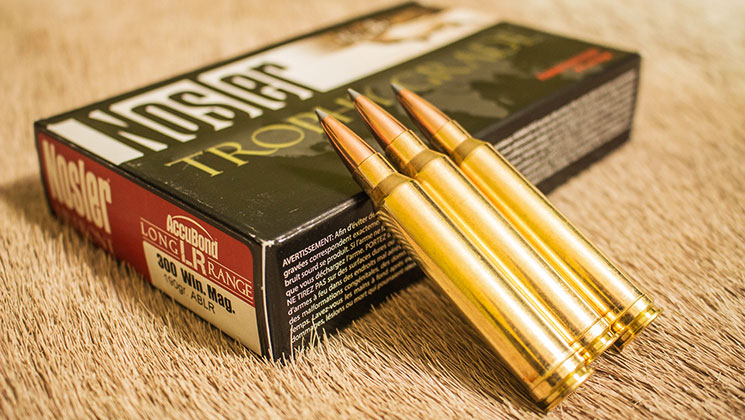
No self-respecting magnum cartridge of the 20th century would have shown its face on the market without the Holland & Holland belt, though very few of them—excepting the straight-walled affairs—needed them at all. That belt was designed for proper headspacing on the sloped-shouldered .375 H&H case (and the .275 H&H Magnum that barely predated it), allowing to feed properly from a box magazine while maintaining the positive headspacing characteristics of the rimmed cases. That belt—often mistaken as making a case stronger—can cause some stretching, and often you’ll see a case separate just north of that belt. The .300 Winchester Magnum was also designed with a very short neck—0.264″ long to be precise—and has been criticized for it. The rule of thumb is that a cartridge should have a neck length of at least one caliber, but I’ve never seen an issue with neck tension in any .300 Winchester, no matter how long or short the bullet. I have seen some issues with the overall length of the case preventing some of the modern bullets—with the really long ogives—being able to function through the magazine in some rifles, but I suppose that comes with the territory.
The .300 Winchester Short Magnum comes with other issues. Being short and fat, it offers a squat powder column. In theory, this leads to more uniform ignition and inherent accuracy. The .308 Winchester and the PPC line of cartridges have been praised for their geometry, and the .300 WSM follows in that trend. And while that theory may hold water, the WSM design garners one major complaint: they don’t feed well. Being short and squat, the angle of the magazine follower can play a huge role in whether or not the rifle will feed smoothly. I’ve had some WSM rifles that fed reliably every time, and others that were a royal pain. In addition, the girth of the cartridge robs magazine capacity; they're fat and take up more room in the rifle’s magazine. While that may not bother some, others prefer as many ‘down’ as possible.
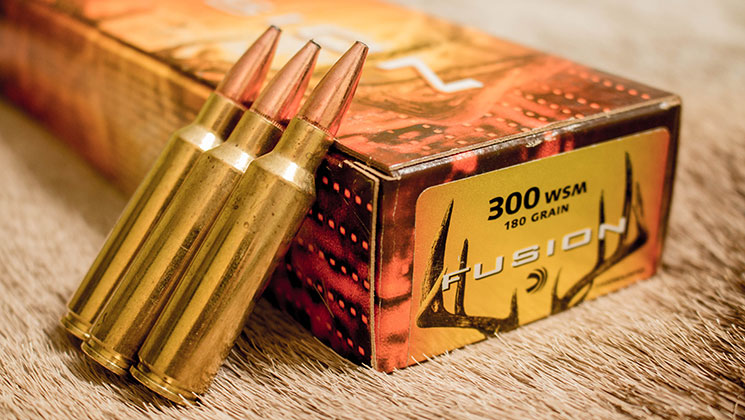
As far as case capacity goes, the WSM runs on a bit less powder, but not enough to really make any sort of long term difference. Both cartridges have a similar recoil; I feel that the differences in felt recoil are more attributable to stock design and fit than to recoil energies generated. Frankly, they both have a sharp, stout recoil, and that just comes with the velocities generated. Some folks feel that the short neck of the .300 Winchester Magnum is an issue due to the fact that most of the heavier and longer bullets will be seated with the base of the bullet well below the shoulder, but I think this happens in quite a few cartridges, perhaps more than you’d think. I’ve never worries about that; the accuracy of the cartridge design removes all doubt.
From a handloader’s perspective, I’ve found the WSM much more finicky than the belted design, or perhaps I should say that the .300 Winchester Magnum has shown to be easier to develop a load for. Once you do get the formula dialed in for the WSM it can be wonderfully accurate, but it’s taken me more time to get things sorted out for the shorter cartridge.
So who gets the award? Based on my experiences, there is no game animal on earth that could ever tell which of the .300 magnums it was shot with, as energy and trajectory figures are so close it’s a moot point. The differences in action length and rigidity haven’t shown up either, as I truly don’t mind carrying a .30-06-length action anywhere. I feel the more reliable feeding of the .300 Winchester Magnum and the added magazine capacity give the edge to the older design; in addition, ammunition is much more prevalent for the belted cartridge than the WSM. I don’t feel comfortable saying I wouldn’t hunt with the .300 WSM, but I do feel comfortable saying that if someone were building me a rifle and I had to choose between them, the .300 Winchester Magnum would get my vote every time.
Looking for previous installments of our "Head to Head" series? We've got you covered.
• .223 Remington vs. .22-250 Remington