You know sports-and-fitness watches are all the rage when you meet people wearing them who don’t even work out. These types love pointing to the watch that has been using a GPS to measure every step they take all day as they say, “Look, I’ve walked 3.21 miles today. That’s 6,779 steps.” To them this is validation that they don’t have to go to the gym. To me it’s reason to want a GPS watch small enough to wear comfortably—one that has a touch screen, loads of high-quality maps and a GPS antenna that actually works in the small package—so I can show one of those wannabes the mountains I climb while hunting grouse.
I want a GPS watch that lets me easily plug in the coordinates of whitetail rub lines, turkey strut zones and mallard sloughs, and that will take me back to them in the dark. The thing is, I remember field-testing the early Suunto GPS watches. Cool concept, but they needed a clear day on a mountaintop to get a reliable signal. Suunto now makes a lot of much-improved GPS sport-and-fitness watches, but not the hunting GPS watch of my dreams.
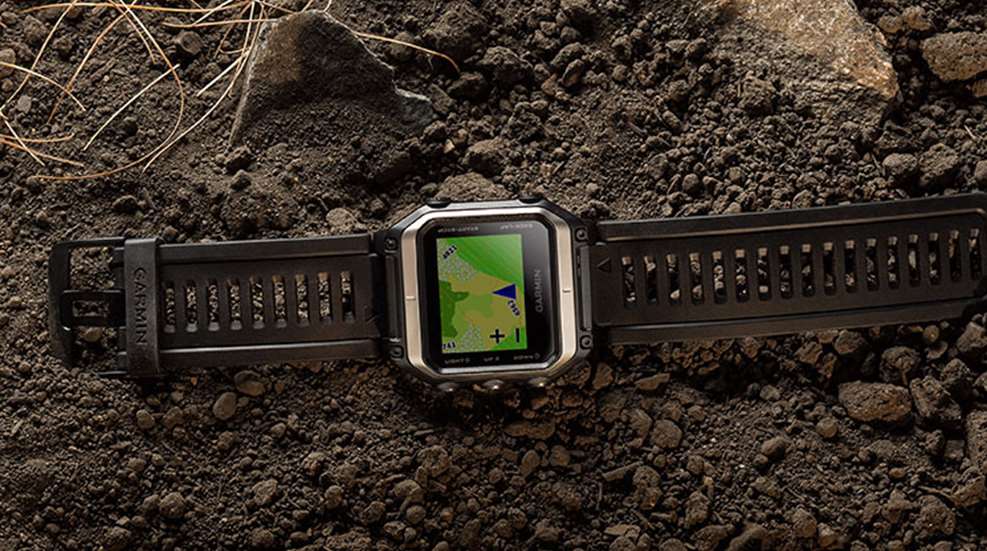
So when I came across Garmin’s Epix, a GPS watch with a high-resolution, color touchscreen, 8 GB of built-in memory that supports mapping, including optional BirdsEye satellite imagery and regional TOPO U.S. 24K maps, as well as an altimeter, barometer and compass, I was excited but skeptical. Would its “stainless steel EXO antenna with GPS/GLONASS reception” really work as well as my handheld GPS?
I took it into the forest. First I should say, Garmin has long been known for software that is intuitive and the Epix doesn’t disappoint—reading the manual is always a smart move, but you can use this unit without it. But what really impressed me is I still had a signal down in a rhododendron swamp, a place where handhelds often have trouble.
Also, the Epix has all the sport-and-fitness options, so you can measure every mile and footstep to and from deer stands. You can plug all this into your computer to download waypoints and routes, or to transfer them to another GPS. Unlike many other Garmin GPS units, the Epix doesn’t have Wi-Fi, but it does have USB as well as Bluetooth Smart, so it is still easy to transfer routes and waypoints via your phone.
The only weakness I found is the Epix needs to be plugged in to be charged, so it might not be the best choice for the pack-in elk hunting trip I plan to do this fall—unless, of course, I also tote a battery pack to plug it into. Maybe I will, as those will be some epic hikes worth showing to those office wannabes.
Gear Tip
You should never rely solely on one navigation device. A GPS unit is your go-to device when far off road, but batteries die and electronics fail. Some smartphones can get GPS coordinates without cell service so their electronic compasses will work without cell towers, but again, their batteries drain fast. The thing is, if you’re just following the arrow on a GPS unit or smartphone you might not be aware of what direction you are going.
This is why you need to use all of your units together. You also need to compare the declination of your magnetic compass (this needs to be adjusted manually) to the electronic devices you are carrying. If you do this, you’ll always be aware of your direction (and whence you came) in case you need to go old-school.