Even if you don’t hunt, when you go outdoors you expect peace and quiet, and you expect to see wildlife. But across the United States, as people venture into public wildlands they’re encountering some other “wildlife.”
In 2008 my son and I were invited by California game wardens to make a documentary about their work as the frontline of conservation. As we began doing ride-alongs, Lt. John Nores asked if we’d like to video the Santa Clara County multi-agency marijuana eradication team (MET) in action.
Marijuana in some form is legal in 23 states (medical marijuana is legal in California), but as John explained, the MET team focuses on illegal marijuana gardens on public wildlands (called “grows”) that are typically run by international organized crime.
We met John and the MET team—a dozen people all dressed in full tactical gear who introduced themselves using aliases—near a regional park in Santa Clara County. Minutes later, a National Guard helicopter landed. A 100-foot rope with a sling on one end was attached to the helicopter. Two men carrying rifles and machetes stepped forward and pulled the sling around them so they could sit on it. The helicopter slowly lifted up, and the two men were pulled into the air. The helicopter quickly headed toward a grove of oak trees about half a mile away. Five minutes later the helicopter returned for a second load. After the fourth trip, the helicopter came back for us. (No, we did not ride in the sling.)
A few minutes later we hovered over the forest. The tree canopy seemed just fine. “Watch,” said the pilot. As the helicopter slowly descended, the branches of the trees parted, revealing bright green plants in the understory, several MET team members cutting them and black plastic irrigation lines everywhere.
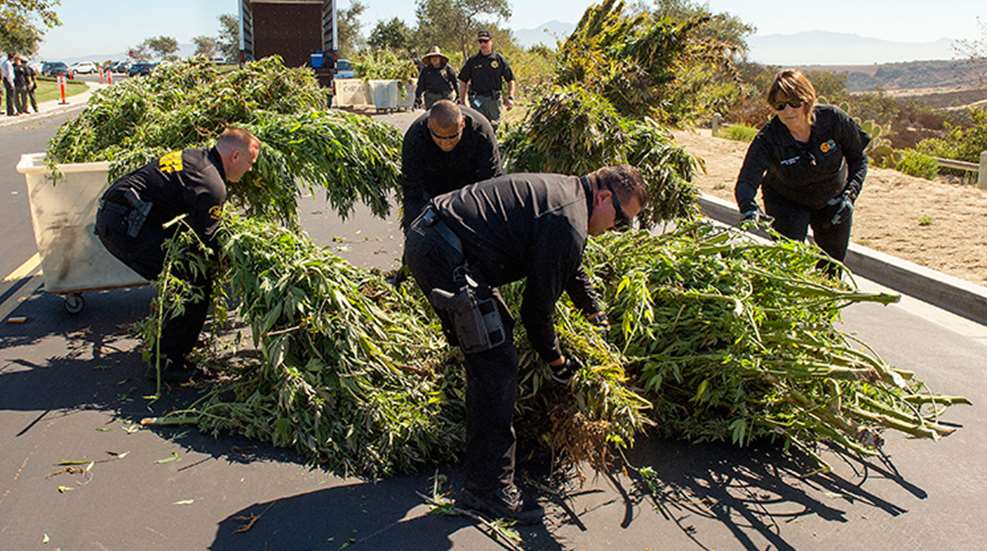
We picked up a load of marijuana plants in the sling and headed back, taking a slightly different route. Passing over another area on the other side of the main road, the pilot said he thought he saw another grow. After a number of trips to bring back plants and the team, the group assembled for a quick lunch. “Ten thousand plants this morning,” the team leader announced. “Think we got another one just like it across the road.”
Minutes later the helicopter took off with two men “high-lining.” After three more trips, the call came in: “All clear.” We were told to drive over and meet John on the road.
 We met John and parked, and he said, “Follow me closely and step where I step.” He explained that sometimes trails leading to gardens had trip wires, deadfalls and bear traps. Fifty yards into the trees, we came to a chicken wire fence used, John said, to keep deer and rabbits out of the garden. Inside the fence there were boxes of rat poison all along the perimeter. The natural understory plants were removed, and in their place were 5-foot-tall marijuana plants, each with its own drip irrigation system connection on a timer. “Each plant is worth at least a thousand-dollar street value,” John explained.
The camp with cots, propane tanks, ice chests, ammo boxes, tent, fertilizer, pesticides and garbage was all camouflaged. Black plastic irrigation pipelines were everywhere. Irrigation water came from a stream nearby that had been dammed. This camp appeared to be only for growing marijuana, but some sites can be used as meth labs and for smuggling drugs, John explained.
Plants cut that day totaled 20,000. Between 2011 and 2013, the MET team eradicated 54 outdoor grows in unincorporated areas surrounding San Jose, yielding a total of 355,005 marijuana plants. In 2015, through August, MET team raids confiscated plants estimated at $65 million in street value.
Aside from this being an illegal crop, and the dangers to anyone who finds a grow, farmers complain about the loss of water for irrigation due to illegal diversions. And as growers use propane to cook on, there is the danger of fire, which is especially bad in drought years.
Typically, the growing season begins in April. The growers move into an area at night. They cut brush, set up irrigation systems, plant the garden and live on site until the harvest is finished in September. They pick up food from cars that drop it along the road at night. The growers are all armed. They generally run when they know they’ve been spotted, but some respond with deadly force. MET averages at least one gunfight per year. In 2005 a warden was shot and seriously wounded in an ambush and a grower was killed. In April 2015, a California game warden shot and killed a grower who pulled a gun on him during a raid on a grow on a wildlife refuge.
The experience of the MET team isn’t unique. In 2014, the Forest Service reported illegal marijuana cultivation in 22 states and 72 national forests. Marijuana is also grown in national parks, wildlife refuges, BLM lands, and state and local parks. Almost 4 million plants are removed from illegal grows on public lands nationwide every year, yet this total is estimated at less than 20 percent of what’s actually out there.
The next time you’re out hunting or hiking, look for these warning signs of something that might indicate a grow: irrigation lines or hoses located in unusual places; a trail where there shouldn’t be one; voices coming from an unusual place; primitive semi-permanent camps; fertilizer, pesticides, trash and small propane bottles; and armed individuals outside hunting season. If you find something suspicious, quietly exit the area and report it immediately.
You can also help by contacting your local game wardens and ask if you can assist with cleanups. There are only about 8,000 federal and state game wardens for the entire United States. Cleanup and restoration typically costs between $10,000 and $15,000 per acre.
Most Popular