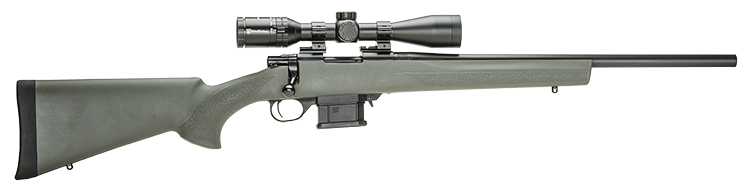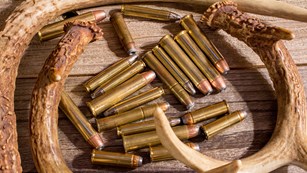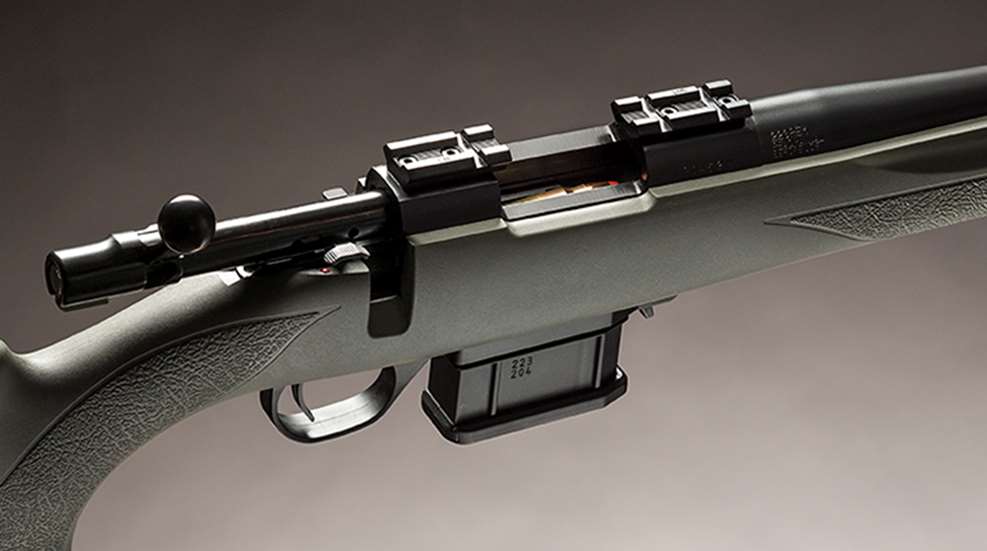
Just in time for the peak of predator season, Japanese manufacturer Howa recently teamed up with Nevada-based Legacy Sports International to introduce the lightweight Mini Action rifle. Available in .204 Ruger, .222 Rem. and .223 Rem., the Mini Action utilizes the same push-feed bolt with dual-opposed locking lugs found on Howa 1500-series rifles, but company engineers significantly shortened the bolt to provide a lighter, trimmer action that’s perfect for the walking varmint hunter. The bolt length is almost an inch shorter than that of Howa’s short-action (.308 Win. class) rifles, which reduces the weight of the bolt by 3 ounces. Put more practically, the new Mini Action is one of the lightest centerfire varmint rifles around.
Howa mates Mini Action receivers to short-drawn barrels in three different contours. The Lightweight version gets a No. 1 contour, 20-inch barrel and has a weight of just 5.7 pounds, making it a great option for mobile hunters who want to hunt all day without dragging around a heavy gun. There’s also a Standard version with a No. 2 contour, 22-inch barrel, while the Heavy model comes with a No. 6 barrel that’s chopped at 20 inches. “Heavy” refers to the barrel only here, because even this version weighs just 6.6 pounds. All three Mini Action variations have a synthetic stock available with a black, olive-drab green or Kryptek Highlander camo finish.
This lightweight, compact rifle is made even better for the field with the addition of the Howa Actuator Controlled Trigger, or HACT, a two-stage design that requires minimal take-up and offers a crisp, clean break. The trigger on the Mini Action I tested, a Heavy model in .223 Rem., consistently broke at a bit less than 3.5 pounds and allowed for very accurate shooting.
Another notable addition to the Mini Action is the Ammo Boost detachable magazine that debuted on Howa’s Alpine Rifle. Box magazines are available in five- or 10-round configurations, and their plastic construction is impervious to the elements. The magazine release lever is positioned at the front of the magazine well.
While the Ammo Boost design doesn’t preclude topping off the magazine through the action port, the Mini Action’s reduced port makes the process tougher than it would be with a full-size action. I believe most shooters will find it’s simpler and faster to just drop the magazine for reloading. Anyone who spends time thumbing .223 rounds into a metal box magazine will appreciate how quickly and easily you can load rounds into the plastic Ammo Boost magazine, and even after a long session on the range you won’t be suffering from sore thumbs.
Aside from its abbreviated action and the new Ammo Boost system, the Mini Action will seem familiar to anyone acquainted with the Howa 1500. There’s a three-position, rocker-type safety on the right side of the receiver, a flat-tip bolt-release button on the left side, and the top of the receiver is drilled and tapped for mounting optics. The rifle I tested was part of a package that included a Nikko-Stirling Panamax 3X-9X-40mm scope. Even with the optic in place and the heavy-contour barrel, the rifle weighed just 7.4 pounds. The scoped Mini Action with a light-contour barrel weighs in at a mere 6.6 pounds. With an overall length of less than 40 inches, these rifles are maneuverable in thick cover.
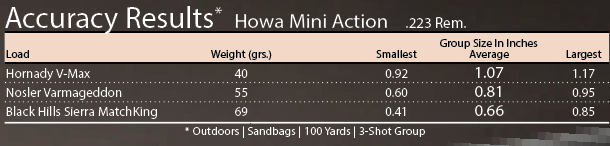
Howa’s push-feed budget guns have a reputation for accuracy, and the Mini Action certainly did not disappoint. From 100 yards, every load I tested had a group average of about an inch or better. The most accurate was Black Hills’ 69-grain Sierra MatchKing load, which averaged just .66 inch and produced the best group of the day at slightly more than .4 inch off sandbags. This level of accuracy belies the Mini Action’s affordable price tag.
With a soft-touch finish and finger grooves along the forearm, the synthetic stock felt firm and natural in my hand. The pistol grip has a slight swell, and the deep curve offered a secure and comfortable hold. Also, the shortened action does more than just reduce weight: With the minimized bolt stroke you can reload faster and deliver quick follow-up shots, perfect for doubling down on incoming song dogs. Even from a cramped sitting position I could quickly and easily cycle the action with a flick of the wrist.
Twice I accidentally hit the forward-positioned magazine release lever when I moved my front hand back on the forearm. Dropping a magazine in the midst of shooting a pair of coyotes is no good, but I quickly learned how to avoid the lever. When I wanted to reload, it was a fast and intuitive system.
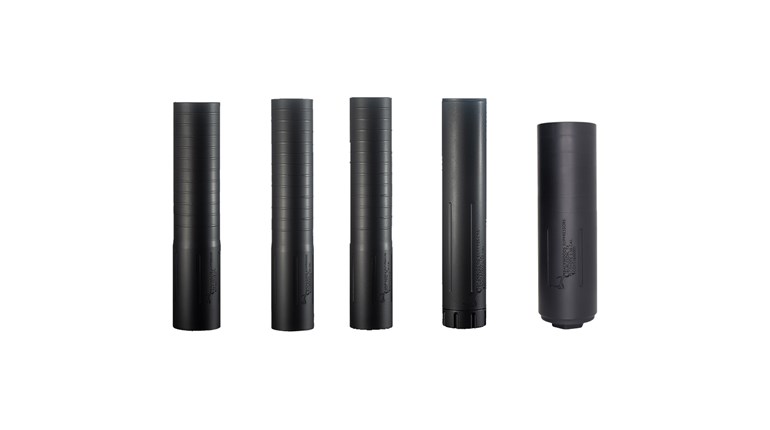
I’d love to see a version of this rifle with a threaded muzzle, because the Howa Mini Action is just begging to have a suppressor mounted to it. With suggested retail prices starting at just $608 (sans scope) this is an accurate rifle that should draw the attention of any predator or varmint hunter, especially if you like to change setups often.
Technical Specifications:
• Type: bolt-action centerfire rifle
• Caliber: .204 Ruger, .222 Rem., .223 Rem. (tested)
• Barrel: 20"; short-drawn No. 6 contour; 4 grooves, 1:9" RH twist
• Trigger: two-stage HACT; 3.4-lb. pull weight
• Magazine: Ammo Boost detachable box; 10-rnd. capacity
• Sights: Nikko-Stirling Panamax 3X-9X-40mm scope (package as tested); drilled and tapped for optics
• Safety: three-position toggle
• Stock: straight-comb synthetic; OD green, soft-touch finish; LOP 13.87"
• Metal Finish: blued
• Overall Length: 39.5"
• Weight: 6.6 lbs. (rifle only)
• MSRP: $782 (with scope), $681 (rifle only)