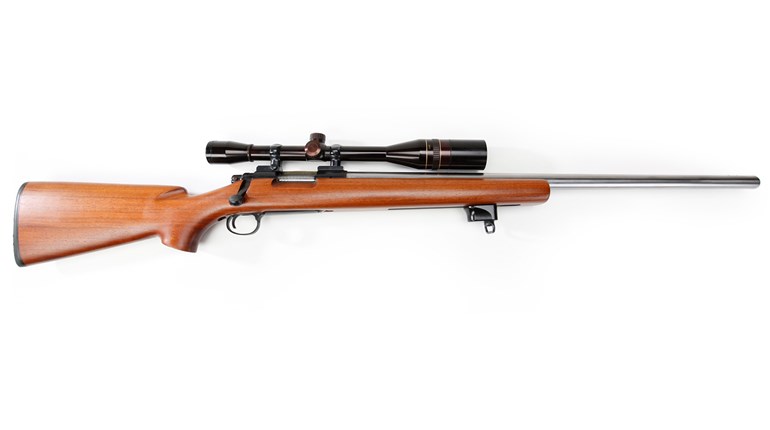
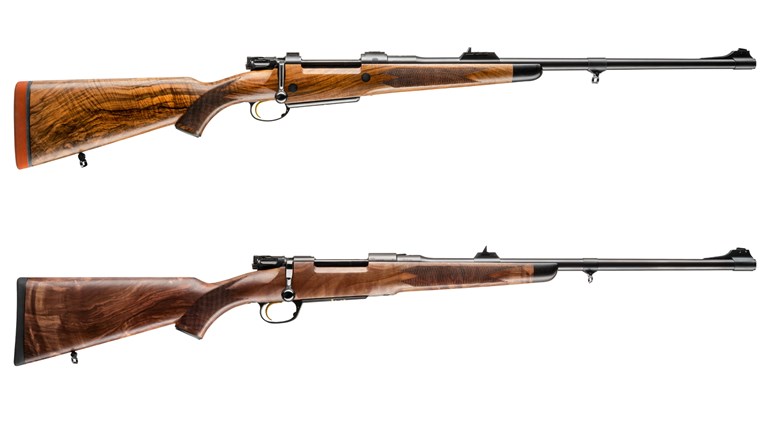
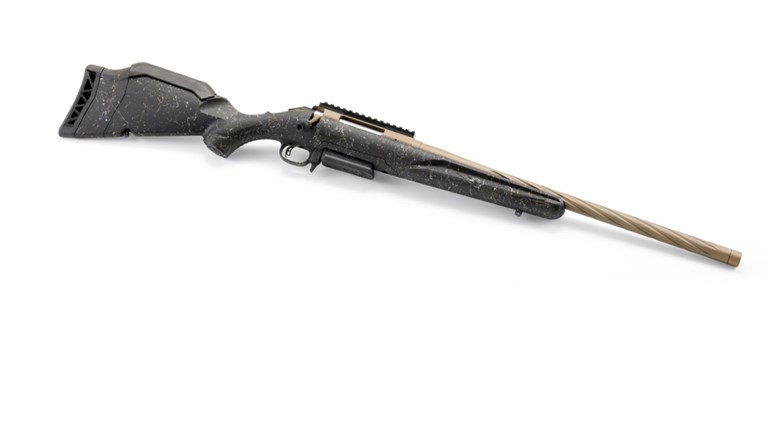
The Model 101 is the newest bolt-action rifle in the Sauer line, intended to provide Sauer quality at a more affordable price than the top-of-the-line 202. The 101 lists at $1,699. It is difficult to find a comparable rifle for twice that amount.
The 101 is produced at Sauer’s new home in Isny, Bavaria, where it is part of the Blaser-Mauser conglomerate. Although Sauer rifles are produced by the main Blaser machining operation, the company has its own building and staff, and the three marques compete at every level. Sauer rifles are designed by Sauer people, and assembled and tested by them.J.P. Sauer & Sohn has been in business since 1751. This makes it the second-oldest gunmaker in the world, after Beretta. For the past century, rifles have been Sauer’s specialty, and are currently its only product. The company has always been known for the quality of the machining, fit and finish, and particularly the smoothness of its bolt-actions.
The slogan for the 101 is: “Old school. New rules.” The rifle lives up to that. It is a conventional turn-bolt design, with six locking lugs and a low (60-degree) bolt lift, but that is only what you see. What you don’t see is a completely new approach to attaching the barrel to the receiver, and the receiver to the stock. The barrel and receiver are machined to tolerances so exact the barrel can be seated in the receiver ring through heat treatment, providing an extremely precise, permanent fit.
The bolt lugs seat in the barrel, not in the receiver ring, and the bolt is as smooth as one expects from Sauer.
Other innovative features include the trigger, safety and bedding system.
The barreled action is bedded using a patented method, and is held in place by one machine screw just forward of the trigger. The trigger guard must be removed to gain access to this screw, but unlike the Mauser and its derivatives, the bottom metal and guard screws play no part in holding the rifle together.
The safety catch is located on the rear of the bolt shroud, where it is pushed forward and up to fire, pulled back and down to be put on safe. The sliding catch has a spring-loaded button that must be depressed before the catch will move in either direction. The safety immobilizes the striker, rather than merely blocking the trigger, and also locks the bolt closed.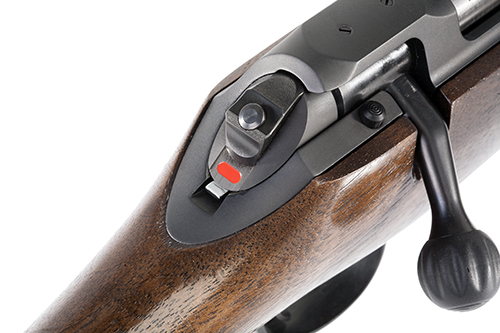
The bolt can be opened with the safety on and the striker immobilized by pressing a small button on the action just above the bolt handle. This is a neat and effective way of dealing with the two-position/three-position dilemma. Having the bolt locked closed when the safety is on is an extremely valuable feature missing from many new rifles.
The magazine is a detachable, staggered box, made from polymer. It is released by a recessed button just forward of the magazine, which must be depressed all the way to release it. There is almost no chance of dropping the magazine accidentally.
In range testing, the rifle’s feeding, extraction and ejection all functioned perfectly, performing equally well whether working the bolt quickly or sliding it softly back and forth.
The receiver accepts scope-mount bases configured for the Remington 700. Adjustable open sights are optional.
The most notable single feature of the Sauer 101 is its superb trigger, set at the factory at a nominal 2 pounds; it is not adjustable by the user. The test rifle averaged a pull of 2.45 pounds, which Sauer says is within its accepted range. By modern standards, this is a remarkably light pull.
As it comes from the factory, the quality of the trigger pull is extraordinary. There is no creep and it releases like the proverbial snapping glass rod. Most rifles today come from the factory with a trigger pull that would challenge an orangutan, but the Sauer trigger is benchrest quality.
Sauer gives a guarantee of accuracy: five shots into a 1-inch group with factory ammunition. Included with each rifle is the brand and type of ammunition with which it was proven, and the name of the tester. Sauer tries to prove rifles shipped to the United States with American ammunition.
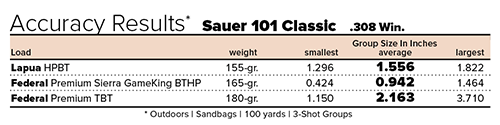
My rifle, a .308 Winchester, was test-fired at the factory with Geco 170-grain match ammunition rather than the usual Hornady load, because of the current difficulties obtaining ammunition. With the Geco load, it matched Sauer’s standard of accuracy. In my testing, the rifle performed very well with three lots of ammunition (two hunting, one match), from two manufacturers (Federal and Lapua), using 155-, 165- and 180-grain bullets.
The average of nine three-shot groups was 1.55 inches; removing the effect of the lone flyer reduced the average to 1.25 inches.
Overall, the Sauer 101 gives the impression of a rifle that looks and performs at a much higher level than its price would suggest. Although it is completely machine-made, it is assembled and tested by skilled human hands, and seems almost like a throwback to an earlier age of riflemaking.
I have no doubt that trying different types of ammunition, including handloads, would result in consistent accuracy as good as, or better, than Sauer’s factory guarantee. In fact, it would be interesting to see just how good this rifle could be with tailored handloads.
Sauer 101 Classic
Type: bolt-action repeating centerfire rifle
Caliber: .308 Win. (tested)
Barrel: 22"; 4-groove rifling; 1:12" RH twist; match-grade steel
Trigger: non-adjustable; factory setting, 2 lbs. (test rifle measured 2.45 lbs.)
Magazine: detachable box; capacity: 5+1 (w/.308 Win.)
Sights: none (adjustable open sights optional); drilled and tapped for Remington M700 bases
Safety: two-position, sliding, on bolt shroud, with bolt-lock detent
Stock: walnut; length of pull 14.25"
Overall Length: 42"
Weight: 6.75 lbs. (fully loaded w/sling, scope, 8.5 lbs.)
Metal Finish: satin blue
MSRP: $1,699