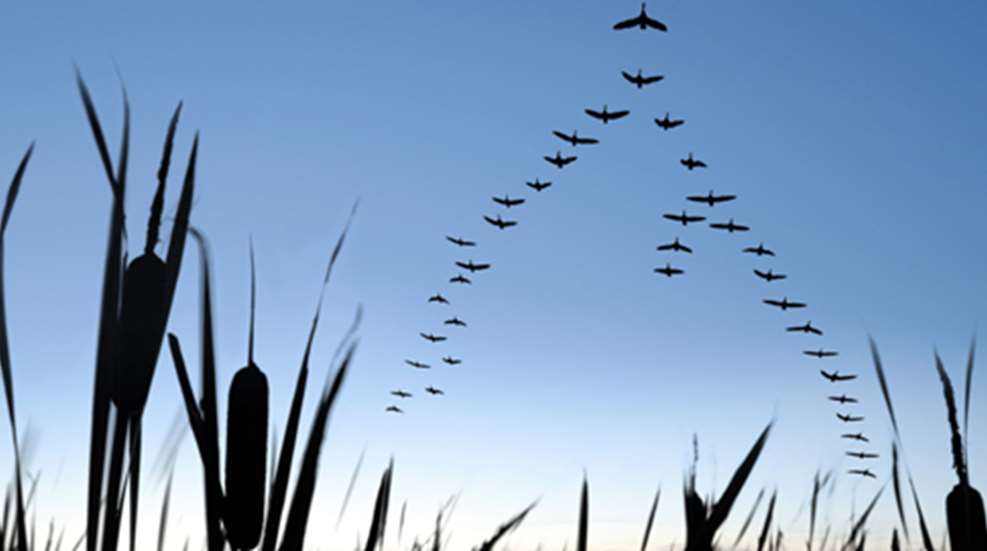
No dearth of locations exist across the country or around the globe for a waterfowler to visit in order to acquire the full flavor of the sport. From exotic locales in Europe, South America and Africa to more domestic fare in North America’s four flyways, each site offers its own history, scenery, mode of hunting and species of birds. Here’s our Top 10 list of locations every waterfowler would give a precious bid to hunt.
10. Chesapeake Bay
The cradle of American waterfowl sport, Chesapeake Bay duck and goose hunting helped fund the economic engine of the area during market-hunting days, not to mention feed the population while providing plumage for fashionable clothing.
The area gave rise to punishing and effective punt guns, long-line rigs of decoys and the only truly American retriever, the Chesapeake Bay Retriever. Used to picking up the hundreds of downed ducks shot by market hunters, the Chessie developed into the thick-coated, hard-swimming dog required to ply the cold water and strong currents of the bay. These dogs also acquired, and still retain today, a one-man dog mentality borne from guarding boats, decoys and guns while commercial hunters frequented local saloons.
With more than 150 rivers emptying into the bay, today’s waterfowlers can enjoy intimate hunts on small creeks and rivers upstream of the estuary or brave open-water layout boats in big water. Whichever area of the wide spectrum of hunting opportunities piques your interest, every American waterfowler owes it to him- or herself to visit the area.
9. Canada
Our neighbors to the north provide the lion’s share of habitat used by nesting ducks and geese in the spring. The vast numbers of geese—both Canadas and white-fronted—and ducks—everything from large divers to small dabblers—congregate to give waterfowl hunters gunning opportunities rarely experienced in the U.S. And, like in the U.S., different regions of the country supply their own flare and modes of hunting.
“Nothing surpasses the sight of seeing North America’s waterfowl population staging in great number before migrating southward toward U.S. hunters,” said Ramsey Russell, an avid waterfowler from Mississippi and owner of getducks.com, a travel agency specializing in domestic and international duck hunting.
“In eastern Canada, Quebec City is one of North America’s oldest settlements, and the tradition of hunting in the St. Lawrence River Valley is long and honored. The food and customs are French-influenced and completely unlike western Canada,” he said. “Hunting for greater snow geese is completely different than hunting lesser snows due to the species’ habits and the St. Lawrence River’s epic tidal fluctuations. Unlike any other place I’ve visited in North America, Quebec hunting is most enjoyably unique.”
8. New Zealand
An exotic locale that affords you the opportunity to spend quality time with the family and hunt some of the most-sought duck species, the land of kiwis and the setting of the “Lord of the Rings” movie trilogy has it all—bungee jumping, white-water rafting, trout fishing and, most importantly, big-game hunting.
“Pre-settlement it was a landscape predominated by bird life. Today, some of its endemic waterfowl species, such as the paradise shelduck, pacific black duck and Australian shovelers are some of the world’s most prized species,” said Russell. “Along with mallards, Canada geese, pheasants, black swans, Merriam’s turkeys and peafowl provide some of the most unique and quality wingshooting to be found on earth. It’s like Disney World, but with a shotgun!”
7. Louisiana
Coastal Louisiana provides some of the most spectacular waterfowl habitat in the world, but the fragile ecosystem is vulnerable and square miles succumb to natural and man-made forces every year.
“It’s literally vanishing before our eyes, at the equivalent of a football field every 30 to 60 minutes. With so much of the original marsh now washed into the Gulf due to erosion and to the cessation of natural processes that replenished it through soil deposition, it takes no more than a strong tidal surge associated with tropical depressions to increase salinity to levels that annihilate the vegetation that not only feeds overwintering waterfowl but that also prevents further erosion,” said Russell.
While hunting the brackish marshes and coastal estuaries of extreme southern Louisiana is a laborious affair, the dividends are huge. “When saltwater intrusion is minimal, the spectacle that is coastal Louisiana duck hunting is a sight to behold: Canvasbacks and Northern Pintail galore. Scaup, gadwalls, Mottled ducks, as well as blue-winged and green-winged teal,” said Russell. “While northern latitude regions within the U.S. may experience comparable abundance during migration periods, their breeding plumage is superior in January and the birds have never looked better than when they’re wintering here.”
Louisiana’s world-renowned hospitality and endless culinary delicacies compliment any hunt perfectly.
6. New England
Up the Atlantic coast from Chesapeake Bay you’ll find the iconic American stronghold of Boston. The convenience of the metro area helps keep costs down for a traveling wingshooter while the vast array of opportunities will keep your head on a swivel. The ambiance of the New England coast and lifestyle just adds to the experience.
Big-water sea duck hunts for eiders, scoters, long-tailed ducks and black ducks, combined with legendary lobsters and clams, are just a taste of what a waterfowl hunter experiences in and out of the field.
“Our lodge partner in Maine annually produces not only American eiders, but also Northern eiders—a subspecies prized by collectors—as well as a precious few King eiders,” said Russell. “In addition to morning sea duck hunts, afternoon forays for dabblers and geese in the backwater estuaries are part of the program in New England.”
5. Mexico
Duck hunting in flip-flop weather? That’s exactly what Mexico offers, along with inexpensive entertainment and food fare—and let’s not forget about the fully plumed trophy duck species wintering south of our border.
“Duck limits are generous in Mexico and among the most commonly harvested species are immaculately plumed cinnamon teal, blue-winged teal, northern shovelers and northern pintail— considered trophy species to most hunters,” said Russell. “Pacific Brant hunting in Baja, which is combined with fun hunts for Gambel’s and Valley quail, is a beautiful way to spend a few days hunting species unavailable to most U.S. hunters.”
While cinnamon teal top the list of most American hunters, they’re far from only trophy in Old Mexico. “Fulvous whistling ducks, black-bellied whistling ducks and Mexican mallards are also targeted there by collectors,” said Pat Pitt of thewaterfowljournal.com.
4. Arkansas
One location offers thousands of ducks packed into the recesses of flood timber, giving rising en masse to a volley of hunters’ shots. It’s Arkansas, and like the Chesapeake Bay, it should be on the must-visit list of every North American hunter.
“So much has been written about hunting Arkansas’ flooded timber and rice fields, what more can be said. It’s incredible. We’ve shot all but a handful of the continent’s species, everything but sea ducks, from our northeast Arkansas duck camp during a single season,” said Russell. “Flooded green timber hunting or hunting among bottomland hardwoods that are ephemerally impounded with managed or seasonal flood waters is purely magical—the substance of dreams.”
3. Alaska
The Land of the Midnight Sun is a sportsman’s playground not only for big-game hunters, but for waterfowl gunners, too.
“The stunning scenery alone makes this trip worthwhile, but the last-frontier state of Alaska is also home to many of North America’s crown jewel species, most notably in the ranks of sea ducks,” said Russell, referring to the diminutive and beautifully marked and coveted, harlequin, as well as perhaps the most precious species for waterfowlers—the king eider. “Practically the entire world’s population of Pacific brant avail themselves annually to the second-largest eel grass bed in the world near Cold Bay.”
In addition to shooting abundant Pacific brant, king eiders and harlequins in places like Cold Bay and St. Paul Island—a tiny rock in the middle of the Bering Sea—Spectacled eiders and Emperor geese can be photographed and crossed off the bucket list of bird watchers.
2. Uruguay
Unheralded and slightly off the beaten path, Uruguay is overshadowed by its popular neighbor to the south, Argentina. What most people don’t realize, however, is that Uruguay challenges its more famous South American brethren for both numbers of waterfowl and upland birds while surpassing it in ease of in-country travel for mix-bag opportunities.
“We began operating in Uruguay while searching for excellent mixed-bag wingshooting from a single lodge or with minimal mid-trip transfers when swapping from ducks to doves, for example. We found what we were looking for—good waterfowl hunting and good upland hunting,” said Russell. “The best duck hunting is primarily confined to Uruguay’s eastern seaboard, and upland hunting for doves and pigeons, the likes of which can at times rival Argentina, is as little as an hour’s drive inland.”
While Uruguay offers a change of pace for travelers familiar with Argentina, the availability of birds is nearly identical. In fact, northern Argentina has more in common with Uruguay when talking hunting opportunities than it does with the southern portions of its own country—ringed teal and Brazilian ducks most notably.
1. Argentina
Topping the list of sites for waterfowl hunters to visit is the South American country of Argentina. Renowned for shoulder-breaking limits of doves, Argentina duck hunting is just as popular and birds proliferate.
While generous limits, usually lodge-imposed, may initially lure first-time wingshooting guests, it’s the combination of superb food, excellent service and amenities that compel them to return to the country. Like the United States, it’s impossible to quantify hunting in any one area; each region has its own history and mode of hunting, influenced by lifestyle, habitat and populace demands.
Eastern Argentina’s landscape is generally low-lying grassland called pampas that, interspersed with numerous rivers and expansive marshes, lends itself exceptionally well to duck production. Waterfowl hunting is primarily limited to visiting hunters, making shooting pressure extremely low. Northern Argentina is far more rural, with several species far more abundant, and hunting styles and techniques influenced strongly by the Parana River. While daily bag limits are generally lower in May through August, seasonal opportunities are greater and include rice depredation shooting from November through February when southern Argentina duck hunting lodges are dry, or in the grip of summer drought. Northern Argentina also offers good wingshooting for ducks, doves, perdiz and volume decoying of pigeons from a single lodge, as well as fishing for golden dorado.
“Many of the common duck species are endemic to South America and are among my list of favorites—two species of pintail, several species of teal, three species of whistling ducks and the mighty rosy-billed pochard,” said Russell. “But Argentina is a very big country, too. The differences in southern duck hunting areas, such as the provinces of Buenos Aires and La Pampa, are markedly different than the northern provinces of Entre Rios and Corrientes. The experiences are very different and one cannot achieve a complete perspective of Argentina duck hunting having only visited one or the other.”
Most Popular